Which Jobs Suit a Forklift and Which Require a Road Roller?
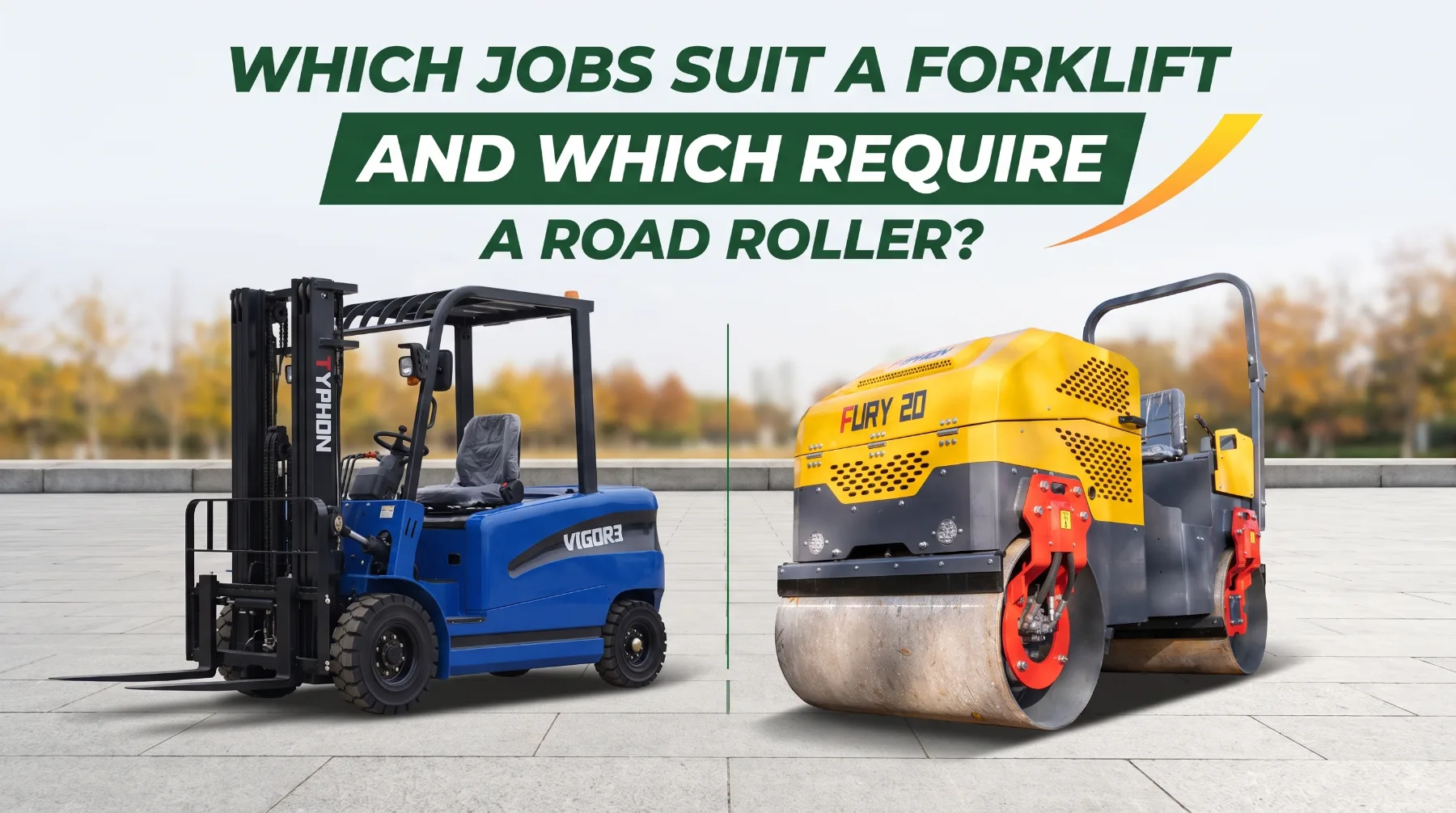 A forklift and a road roller may both be essential pieces of heavy equipment, but they are built for completely different jobs. A forklift is designed to lift, carry, and position materials, while a road roller is engineered to compact soil, gravel, asphalt, and other surfaces. Choosing between them is not about which machine is more powerful; it is about identifying what the job actually requires. Using the wrong machine can waste rental costs, reduce productivity, and leave critical work unfinished.
The difference becomes clear when you look at how each machine works. A forklift is suited to material handling in warehouses, yards, construction sites, and loading areas, while a road roller is used where surface density and compaction are the priority. This guide compares their main functions, working environments, capabilities, and limitations, then shows how to determine which machine fits your specific task.
The Core Difference: Handling Versus Compacting
Everything about these two machines flows from a single distinction. A forklift is a material-handling machine, designed to lift, carry, and place loads. A road roller is a compaction machine, designed to press and densify surfaces. That one difference in purpose shapes every part of their design.
Look at a forklift and you see the tools for lifting: two forks mounted on a vertical mast that raises and lowers loads, a counterweight at the rear to balance heavy pallets, and tires suited to smooth warehouse floors or firm yards. Its whole structure exists to pick something up, move it, and set it down with precision.
Look at a road roller and you see the tools for compaction: one or more heavy steel drums, or pneumatic tires, that roll over a surface and squeeze out air and voids. Many drums vibrate to drive density deeper into the material. There are no forks, no mast, and no interest in lifting anything.
What a Forklift Does Best
Material handling is the forklift’s entire reason for existing, and few machines do it more efficiently. Wherever goods need to move short distances, get stacked, or be loaded onto transport, a forklift earns its place.
Its strongest applications cluster around storage and logistics:
- Warehouse operations. Moving palletized goods through aisles, stacking inventory on tall racking, and organizing storage space.
- Loading and unloading. Transferring pallets on and off trucks, trailers, and shipping containers at docks and yards.
- Pallet lifting and stacking. Raising heavy loads to height and placing them precisely, again and again, throughout a shift.
- Yard and site material movement. Shifting bagged materials, crates, lumber, and equipment across manufacturing floors, lumberyards, and construction laydown areas.
The forklift shines because it combines lifting height, load capacity, and maneuverability in one compact package. An operator can retrieve a pallet from the top of a rack, carry it across a warehouse, and load it onto a truck without ever leaving the seat.
Key takeaway: if the job is about moving, lifting, or stacking discrete loads, the forklift is almost always the right answer.
What a Road Roller Is Built For
Compaction is a different problem entirely, and it demands a machine built purely for pressure. A road roller creates firm, stable, load-bearing surfaces by driving air and moisture out of loose material until it holds together as a solid base.
This work sits at the heart of construction and infrastructure:
- Asphalt paving. Compacting fresh hot mix into a smooth, dense, durable road or parking lot surface.
- Soil compaction. Firming up subgrade and fill so it can support structures, pavements, and foundations without settling.
- Gravel and aggregate compaction. Locking down base layers of crushed stone before paving or surfacing.
- Road construction and repair. Building new roadways layer by layer, and restoring surfaces after utility work.
- Site preparation. Compacting large pads and building sites so the ground stays stable under future loads.
The road roller succeeds through sheer weight, drum design, and often vibration, applying consistent force across a wide path. Skip this step, and the finished surface cracks, ruts, or sinks under use.
Key takeaway: whenever the goal is a firm, stable, long-lasting surface, compaction is the task and the road roller is the tool.
Key Differences in Function and Design
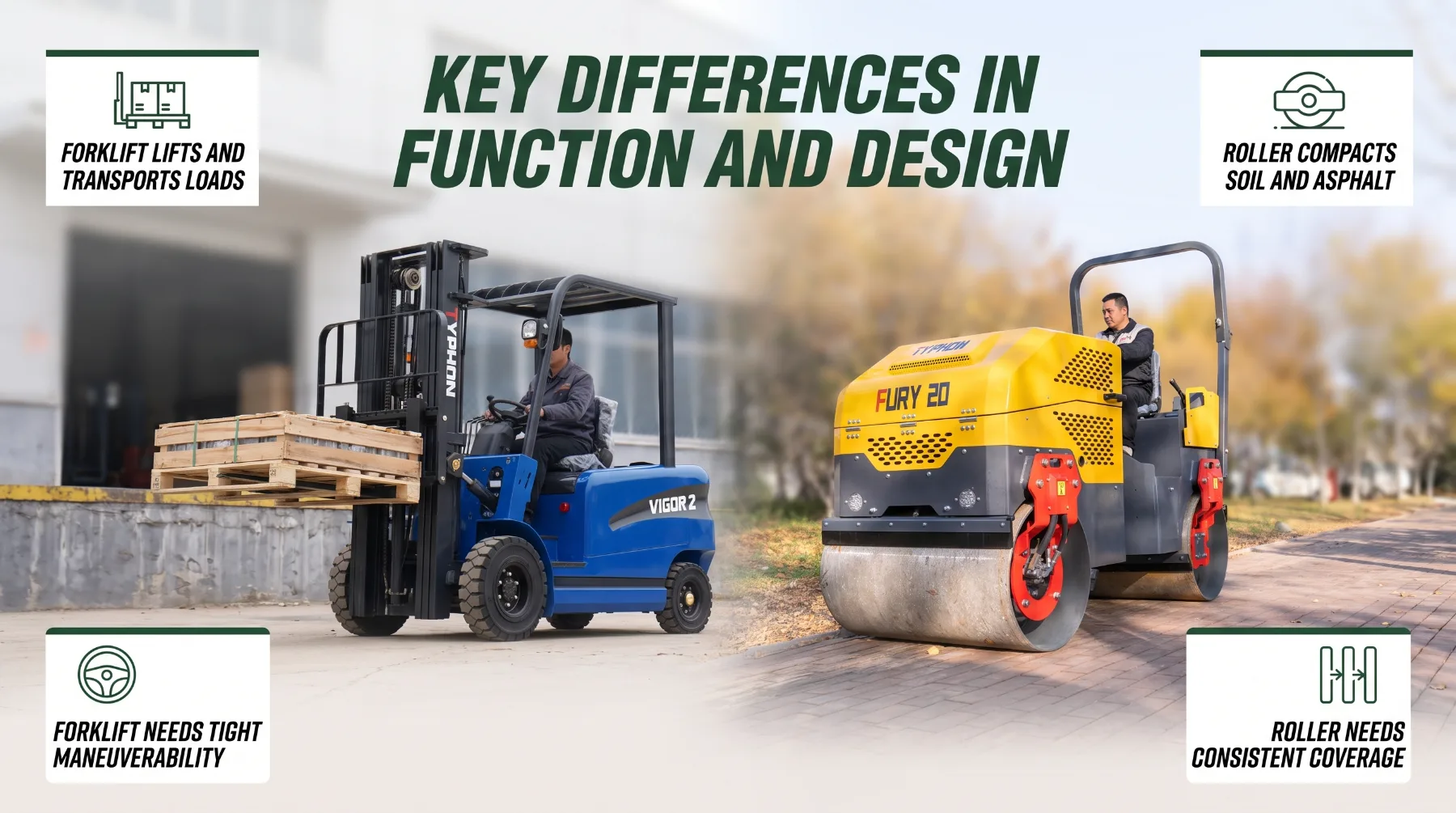 Put the two machines side by side, and the differences become clear because every major design choice is built around a different type of work.
Purpose comes first. A forklift is designed to lift, transport, and position loads, while a road roller is built to compact soil, gravel, asphalt, and other surfaces. Their functions are fundamentally different, so their designs are optimized for completely different tasks.
The working components reflect that difference. A forklift uses a mast and forks to raise loads vertically, while a road roller uses drums or compaction tires to apply downward force across the ground. One machine is designed to handle suspended loads, while the other is designed to transmit repeated compaction force into a surface.
Their movement patterns are also different. A forklift needs precise steering, quick direction changes, and tight turning capability so it can position loads in confined spaces. A road roller typically moves in controlled, repeated passes, where consistent travel and uniform coverage are more important than quick maneuvering.
The operating environment further separates them. Forklifts commonly work in warehouses, loading docks, factories, yards, and other prepared surfaces where controlled load handling is required. Road rollers operate mainly outdoors on construction sites, roadways, and other areas where soil, aggregate, or asphalt must be compacted.
Key takeaway: The differences between a forklift and a road roller are not simply visual. Forks and a lifting mast, or drums and compaction systems, exist because each machine is engineered around a specific job. A forklift is built around load handling and positioning, while a road roller is built around controlled movement and ground compaction.
Job-Site Examples That Make the Choice Obvious
Real-world scenarios make the choice much clearer. Look at the actual task, and the machine you need is usually obvious.
A distribution center receiving a truckload of palletized goods needs to unload pallets from the trailer, transport them through the facility, and place them into storage racks. The job is centered on lifting and moving loads, making a forklift the appropriate machine from start to finish.
A crew paving a new parking lot has just placed hot asphalt that needs to be compacted before it cools. The task does not involve lifting or transporting materials. It requires controlled downward force and repeated passes across the surface, making a road roller the right machine for the job.
A building site preparing a foundation pad needs to compact fill soil so the ground can provide a firm, stable base for the structure. The material must be densified across a broad area, which is again a road roller application.
A lumberyard organizing stock needs to move bundles of timber from delivery areas to storage bays and then load them onto customer trucks. The work involves lifting, carrying, positioning, and unloading materials, so a forklift is the better choice.
Key takeaway: Reduce the job to its main action. If the primary task is to lift, move, and position loads, choose a forklift. If the task is to compact and densify ground, choose a road roller. Once the work is defined clearly, the machine choice becomes much easier.
When the Wrong Machine Creates Real Problems
Choosing the wrong machine rarely ends in a simple compromise. More often, it costs time, money, productivity, or the quality of the finished work. Understanding what each machine cannot do is just as important as knowing what it can do.
Send a forklift to perform compaction work, and the ground will not be properly compacted. A forklift is designed to lift and transport loads, not to apply controlled, repeated compaction force across a surface. Driving it back and forth over soil or asphalt may apply some weight, but it does not provide the uniform vibration and controlled passes required for reliable compaction.
Send a road roller to handle materials, and the work cannot proceed. A road roller is not designed to lift pallets, reach into storage racks, or load materials onto a truck. The goods remain in place, the workflow is interrupted, and another machine is still needed to complete the handling task.
There is also a common trap in trying to make one machine “make do” for the other. Using a heavy forklift to firm up ground may produce uneven and unpredictable results, while using a road roller for material handling is simply not practical. Saving money by avoiding the correct machine can easily lead to poor-quality work, additional labor, rework, or delays.
Key takeaway: A forklift and a road roller serve fundamentally different purposes. Substituting one for the other does not simply reduce efficiency. It can prevent the task from being completed correctly and may create additional costs to fix the result.
A Practical Decision Framework
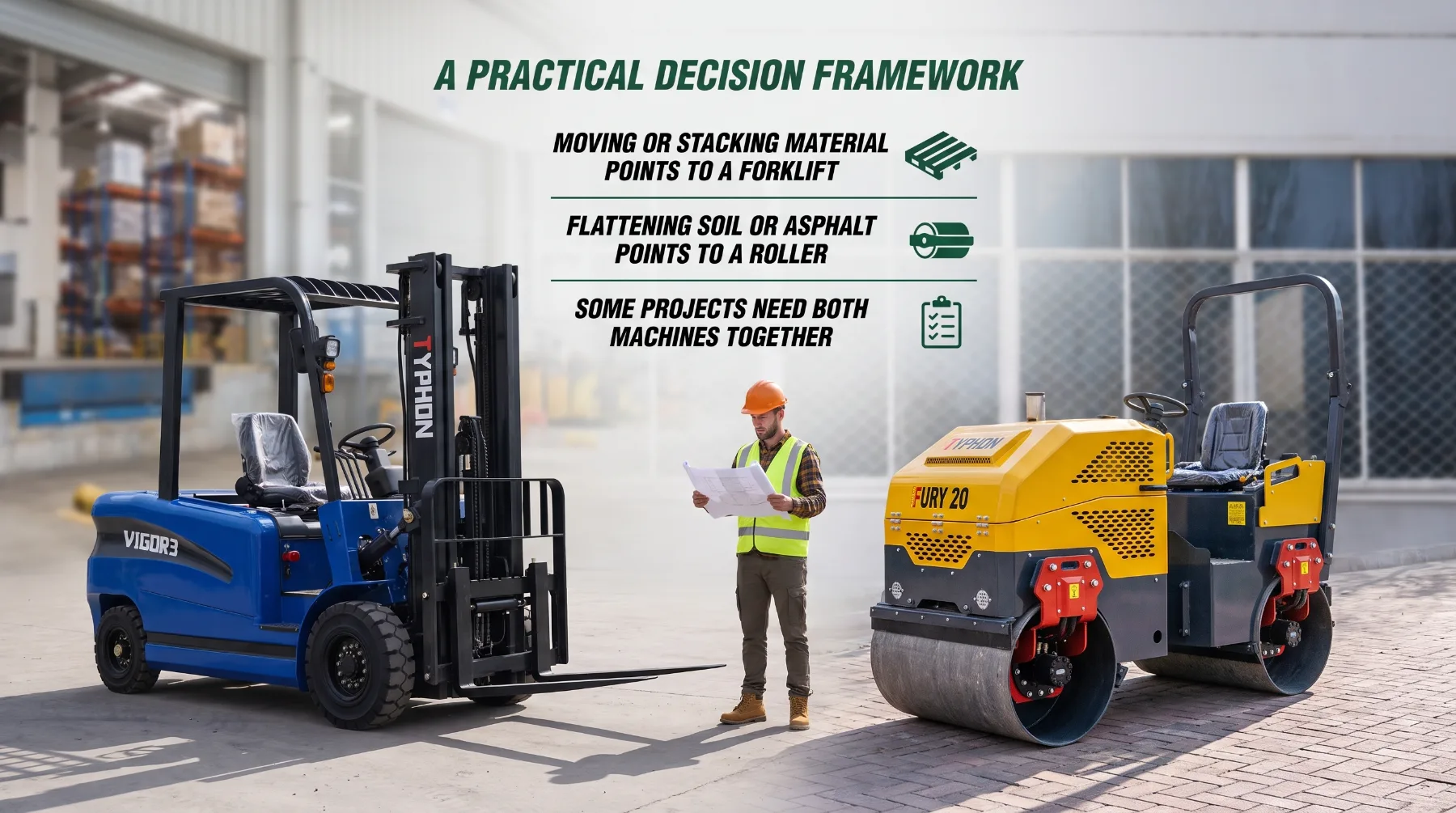 The right machine starts with understanding the work itself. If the job involves moving, lifting, or stacking materials, a forklift is the natural choice. If the goal is to flatten, firm, or densify a surface, a road roller is better suited. The material also matters: pallets, crates, and bundles point to material handling, while soil, gravel, and asphalt require compaction.
The desired outcome and work environment help confirm the choice. Warehouses, loading docks, and prepared surfaces commonly suit forklifts, while construction sites, roadways, and ground preparation projects are better suited to road rollers. Some projects need both, with a forklift handling materials and a road roller compacting the ground at different stages.
Making the right decision during planning can prevent wasted rental costs, delays, and poor results. Key takeaway: identify the core action, the material or surface, and the work environment to determine whether you need a forklift, a road roller, or both.
Conclusion
The choice between a forklift and a road roller comes down to the core action your job requires: are you moving a load or compacting a surface? A forklift is designed for material handling, lifting, carrying, loading, and stacking discrete loads in warehouses, yards, docks, and other material-handling areas, while a road roller is built to compact soil, gravel, and asphalt into stable, durable surfaces. Because their functions are fundamentally different, choosing the wrong machine can slow the project, increase operating costs, or produce poor results. The best approach is to match the machine to the main task, material, working environment, and project phase, with larger construction projects often requiring both machines for different stages of the work. Before renting or purchasing, define the job by its main action, evaluate the material and site conditions, and choose the machine that is specifically designed to perform that task efficiently and safely.
Frequently Asked Questions
Can a forklift be used for any kind of ground compaction?
No. A forklift is built to lift and carry loads, not to compact surfaces, and it has no mechanism to densify soil or asphalt evenly. Driving a heavy forklift over loose ground produces uneven, unreliable results that fall well short of proper compaction. For any job that needs a firm, stable, load-bearing surface, a road roller or a dedicated compaction machine is the correct choice, and skipping proper compaction usually leads to costly surface failures later.
Does a road roller ever replace a forklift on a construction site?
Not at all. A road roller cannot lift pallets, reach into racking, or load and unload trucks, so it cannot perform material-handling tasks. On large construction sites, the two machines may work side by side at different stages. A forklift moves materials into position, while a road roller compacts soil, gravel, and asphalt. Each machine is used for the task it is designed to perform.
How do I decide which machine my project needs?
Start with the core action. If the job involves moving, lifting, or stacking discrete loads, you need a forklift. If it involves flattening, firming, or densifying a surface, you need a road roller. Then consider the material and environment. Pallets, crates, and bundled materials point to a forklift, while soil, gravel, and asphalt point to a road roller. Indoor and prepared-surface work commonly suits forklifts, while open-ground construction and roadwork typically require road rollers. Larger projects may need both machines at different stages.