
Wheel Loader Ultimate Guide
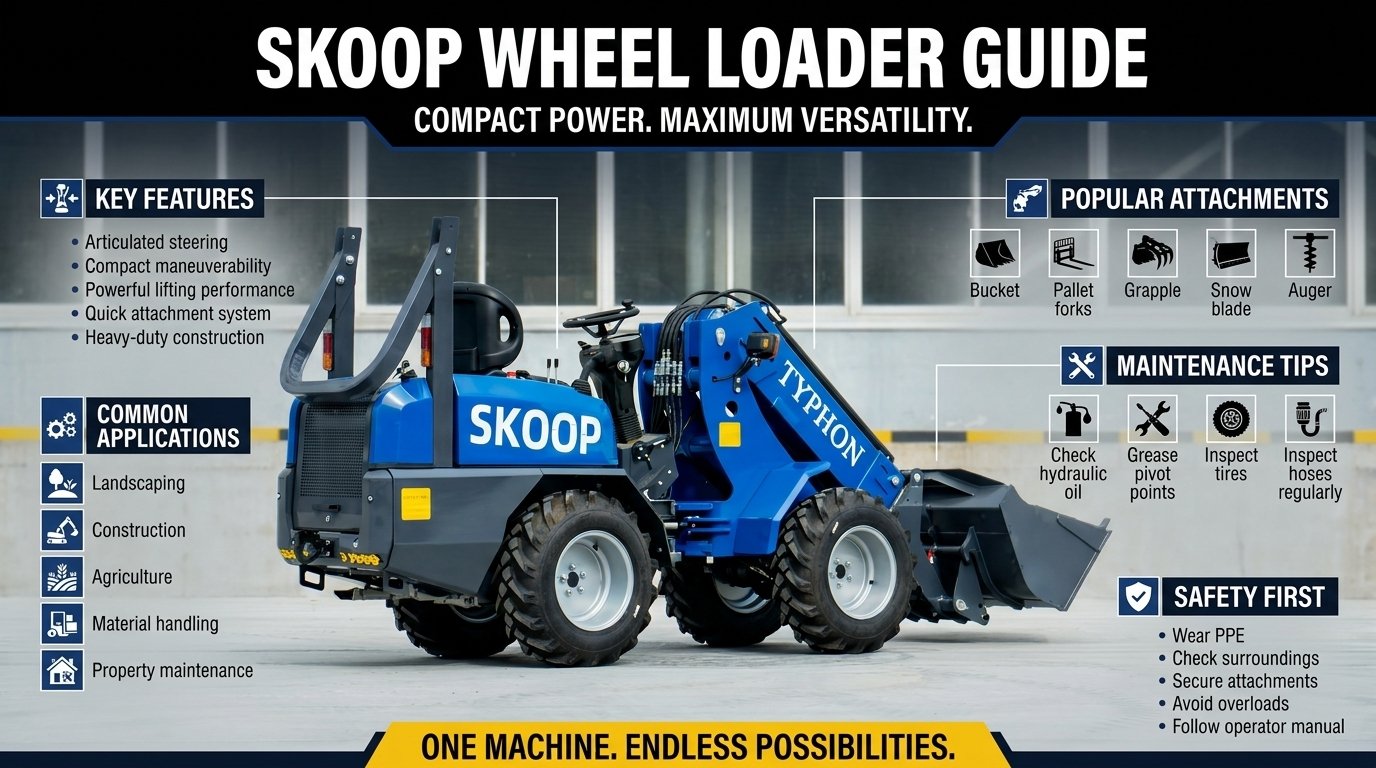
A Beginner-to-Advanced Learning Manual for Operators, Contractors, Quarry Workers, Construction Teams, Farmers, and Heavy Equipment Enthusiasts
Table of Contents
- 1. Introduction & History
- 2. Main Components & Anatomy
- 3. How Wheel Loaders Work
- 4. Types: Compact vs. Large
- 5. Attachments & 12-in-1 Versatility
- 6. Understanding Specifications
- 7. Safety Rules & Best Practices
- 8. Basic Operating Instructions
- 9. Advanced Techniques: V-Pattern
- 10. Excavation & Stockpile Management
- 11. Working on Slopes & Uneven Terrain
- 12. Maintenance & Service Guide
- 13. Troubleshooting Common Problems
- 14. Buying Guide: ROI Strategy
- 15. Future Trends & Automation
- 16. Glossary of Terms
- 17. Frequently Asked Questions (FAQ)
1. Introduction to Wheel Loaders
The wheel loader is a high-capacity earthmover designed to lift, transport, and load bulk materials with speed and mobility. Unlike tracked loaders, wheel loaders utilize large, durable tires that allow for faster travel across paved surfaces and stable job sites. At Trenchers.net, we focus on machinery that maximizes "Cycle Time"—the speed at which an operator can dig, lift, and dump a load.
Our Typhon brand loaders are engineered to handle the world's most demanding environments, from mining operations in Australia to infrastructure projects in Southeast Asia. This guide provides the technical deep-dive necessary to master these complex machines, ensuring longevity and peak performance for your fleet.
History and Evolution
The earliest wheel loaders were developed in the 1920s by mounting primitive buckets onto agricultural tractors. These early models lacked the stability required for heavy industrial work. The introduction of Articulated Steering in the 1950s changed everything. By allowing the machine to pivot at a central hinge, designers could build larger machines that remained highly maneuverable. Modern wheel loaders have evolved into high-tech powerhouses featuring electronic torque management, hydrostatic transmissions, and pressurized ergonomic cabins.
2. Main Components and Anatomy
A wheel loader is a masterclass in structural engineering. It is divided into two primary frames—the front and the rear—connected by an articulation joint.
The Articulation Joint
This is the central pivot point that allows the front and rear frames to "bend" independently of each other. It contains massive hydraulic steering cylinders and oscillation bearings that ensure all four tires stay on the ground when traversing uneven terrain. Proper maintenance of this joint is the most important task for preventing frame failure.
- The Lift Arms (Z-Bar Linkage): Most Typhon loaders utilize the Z-Bar linkage design. This geometry provides maximum breakout force at ground level, allowing the bucket to penetrate compacted material piles with minimal effort.
- The Bucket: The primary tool of the machine. It is designed with a "spill guard" at the top to protect the hydraulic cylinders from falling debris during a high-lift cycle.
- The Transmission: Typically a Powershift or Hydrostatic system that allows for rapid directional changes (Forward to Reverse) without damaging the drivetrain.
- Tires: Specialized L-3 or L-5 rock tires are used depending on whether the machine is working in soft soil or jagged quarry stone.
3. How Wheel Loaders Work: Tractive Effort
The power of a wheel loader is defined by Tractive Effort—the machine's ability to push forward into a pile without losing tire traction. As the operator drives into a stockpile, the hydraulic system redirects power from the drivetrain to the lift arms. This allows the bucket to rise and "curl" through the material while the machine continues its forward push, resulting in a perfectly filled bucket every time.
4. Types: Compact vs. Large Wheel Loaders
Wheel loaders are categorized by their "Operating Weight" and "Bucket Capacity." Selecting the right size is a balance between site space and material volume requirements.
Compact Loaders
Typically under 80 horsepower. Perfect for landscaping, nursery work, and urban construction in cities like Phnom Penh where space is limited.
Medium Loaders
The industrial standard. These machines are the backbone of construction sites and aggregate yards, offering a balance of 2 to 4 cubic yard bucket capacities.
Large Loaders
The "Monsters" of the quarry and mining industry. These machines can lift 20+ tons in a single pass and are designed for 24/7 high-production loading of massive haul trucks.
5. Common Attachments and 12-in-1 Versatility
A wheel loader's utility extends far beyond its standard bucket. By utilizing a Hydraulic Quick Coupler, an operator can swap tools in seconds without leaving the cab. Our equipment strategies prioritize a 12-in-1 attachment combo, ensuring that a single Typhon machine can transition from heavy excavation to logistics and site cleanup within a single shift.
- Pallet Forks: Transforms the loader into a heavy-duty forklift for moving bricks, timber, and equipment on rough terrain.
- Grapple Buckets: Essential for demolition and land clearing; dual hydraulic arms secure irregular loads like logs or concrete debris.
- Snow Pushers: High-volume blades designed for rapid clearing of parking lots and commercial zones.
- Side-Dump Buckets: Allows the machine to dump material to the side, critical for backfilling trenches in narrow roadways.
- Bale Spears: Used in agricultural settings for transporting large hay bales with high efficiency.
6. Understanding Wheel Loader Specifications
Physics dictates the limits of every lift. When reviewing technical data, two figures determine the machine’s safe working envelope: Static Tipping Load and Rated Operating Capacity (ROC). These are not interchangeable and must be understood to prevent catastrophic accidents.
This is the weight required to lift the rear wheels off the ground while the machine is stationary. This value changes significantly when the loader is articulated (turned); a "Full Turn Tipping Load" is always lower than a "Straight Tipping Load."
Per industry standards (ISO 14397-1), the ROC for a wheel loader is typically set at 50% of the Static Tipping Load. This safety margin accounts for the dynamic forces involved when driving and turning with a full bucket.
The maximum upward force the lift cylinders can apply to the bucket’s cutting edge. High breakout force is required for "breaking" into hard-packed clay or frozen earth.
The Load Center Calculation
The leverage applied to the machine is a function of weight ($F$) and distance ($d$) from the front axle fulcrum. The Moment ($M$) is calculated as:
$$M = F \times d$$
If an attachment (like long pallet forks) moves the center of gravity of the load further away from the machine, the effective lifting capacity decreases proportionally. Always consult the specific Typhon load chart for each attachment.
7. Wheel Loader Safety Rules and Best Practices
The "Clear Zone" Protocol
A wheel loader has massive blind spots, particularly behind the rear engine compartment and on the side of the lift arms. Never allow ground personnel to approach the machine while the engine is running. Establish a 360-degree clear zone of at least 30 feet, and never move the machine until you have received a clear signal from a dedicated spotter.
The Stability Triangle
Like a forklift, a wheel loader relies on a Stability Triangle formed by the two front wheels and the center of the rear oscillating axle. As you raise a full bucket, the center of gravity moves up and forward. If this center of gravity moves outside the triangle—due to high speed, uneven ground, or excessive turning—the machine will tip. Always carry loads as low to the ground as possible during transport.
8. Basic Operating Instructions
Before operation, perform a Pre-Start Circle Check. Inspect tire pressure, hydraulic hose integrity, and fluid levels. Once inside the ROPS-certified cab, adjust the seat so you can reach the joysticks comfortably without stretching.
Joystick Pilot Controls
Most modern Typhon machinery utilizes a single-joystick control system.
- Forward/Backward: Pull back to lift the arms; push forward to lower.
- Left/Right: Move left to "curl" the bucket back (securing the load); move right to "dump."
- Proportional Steering: Unlike a car, the steering wheel controls the flow of hydraulic oil to the articulation cylinders. The faster you turn the wheel, the faster the machine pivots. Steering should always be smooth and gradual to maintain stability.
9. Advanced Operating Techniques: The V-Pattern Loading
In high-production environments like quarries or large-scale construction, efficiency is dictated by the geometry of the machine's path. The most efficient method for loading trucks is the V-Pattern (or Y-Pattern). The loader approaches the pile straight on, backs up while articulating, and drives forward to the truck positioned at a 45-degree angle. This minimizes travel distance and tire wear while maximizing the number of cycles per hour.
10. Excavation and Stockpile Management
A wheel loader is not just for moving dirt; it is for managing it. Professional stockpile management prevents material contamination and ensures drainage. Typhon operators are trained to build "Flat-Top" piles that prevent water from pooling and turning the material into unusable mud. When excavating a face, always work from the bottom up to prevent "slumping" or cave-ins that could bury the front of the loader.
11. Working on Slopes and Uneven Terrain
Stability is compromised as soon as the machine leaves level ground. When operating on a slope, the rule is absolute: Keep the heavy end pointing uphill. If the bucket is full, the front of the machine is the heavy end—drive forward up the slope. If the bucket is empty, the rear engine compartment is the heavy end—reverse up the slope. Never turn the machine while articulated on a steep incline, as this drastically narrows the Stability Triangle and can cause an immediate rollover.
12. Maintenance and Service Guide
The longevity of a wheel loader is determined by its daily greasing and hydraulic hygiene. Unlike smaller machines, a loader's articulation pins and Z-bar linkages are under constant high-pressure stress. Neglecting a single grease point can lead to "slop" in the steering or lift arms, which requires expensive line-boring to repair.
| Interval | Task | Critical Component |
|---|---|---|
| Daily (10h) | Grease articulation and lift pins; check transmission fluid. | Pivot Points |
| Weekly (50h) | Inspect tire pressure and wheel nut torque; check air filters. | Drivetrain |
| Monthly (250h) | Change engine oil/filters; inspect hydraulic hose wear. | Engine System |
| Annual (1000h) | Flush hydraulic system; change transmission/axle oil. | Total Machine Health |
Tire Care: The Most Expensive Wear Item
Wheel loader tires are a significant operational cost. Maintaining the correct PSI is vital—under-inflation causes sidewall heat buildup and failure, while over-inflation reduces traction and increases the risk of punctures in rock quarries. Rotate tires based on the wear patterns, as the front tires typically wear 30% faster due to the stress of digging.
13. Troubleshooting Common Problems
A wheel loader is a high-duty cycle machine that operates under intense thermal and mechanical stress. When a machine fails to perform, a systematic approach to diagnostics is required. Our Typhon machinery is designed with clear hydraulic test ports and electronic fault code reporting to reduce the time spent in the shop.
Low Breakout Force
Symptoms: The bucket fails to penetrate the pile or lifts slowly under load.
Primary Checks: Verify main relief valve settings. A common cause is internal "bypassing" in the lift cylinders or a worn hydraulic pump that can no longer maintain standard operating pressure.
Transmission Slippage
Symptoms: The engine revs high, but the machine lacks tractive effort in 1st or 2nd gear.
Primary Checks: Check transmission oil levels and filter condition. In hydrostatic models, slippage often indicates air in the lines (cavitation) or a failing charge pump.
Steering Hesitation
Symptoms: The machine is slow to articulate or requires excessive force on the steering wheel.
Primary Checks: Inspect the steering priority valve. If the lift arms are working but steering is not, the priority valve is likely stuck or contaminated with debris.
14. Wheel Loader Buying Guide: ROI Strategy
Purchasing a loader for your operations—whether in the quarries of Australia or the infrastructure projects of Phnom Penh—is a capital investment that must be justified by Total Cost of Ownership (TCO).
15. Future Trends: Automation and Hybridization
The industry is moving toward "Zero-Emission" job sites. We are seeing the rise of Electric and Hybrid Wheel Loaders, which offer instant torque and silent operation—perfect for indoor demolition or night-time utility work. Furthermore, Autonomous Load-and-Carry systems are being deployed in mining. These machines use LiDAR to navigate between the stockpile and the crusher without a human operator, eliminating fatigue-related accidents and ensuring 100% consistent cycle times.
16. Glossary of Wheel Loader Terms
17. Frequently Asked Questions (FAQ)
Q: What is "Ride Control" and do I need it?
A: Ride Control uses hydraulic accumulators to cushion the lift arms. It is essential if you perform "Load-and-Carry" tasks over distances greater than 100 feet, as it prevents material spillage and reduces machine wear.
Q: Can I use a wheel loader as a crane?
A: Only if equipped with an approved lifting hook and a dedicated load chart. Using the bucket or forks to "dangle" loads without a proper crane attachment is a major safety violation.
Q: How do I prevent tire "spinning" in the pile?
A: Use a lower gear and maintain a steady, slow approach. Spinning the tires does not increase breakout force; it only causes expensive tire damage and "polishes" the ground, reducing future traction.