
Forklift Ultimate Guide
A Beginner-to-Advanced Learning Manual for Operators, Warehouse Workers, Construction Professionals, Logistics Teams, and Equipment Enthusiasts
Table of Contents
- 1. Introduction & History
- 2. Main Components & Mechanics
- 3. How a Forklift Works
- 4. Types & Classifications
- 5. Electric vs. Internal Combustion
- 6. Understanding Specifications
- 7. Common Forklift Attachments
- 8. Safety & Best Practices
- 9. Basic Operating Instructions
- 10. Warehouse Operations
- 11. Load Handling Principles
- 12. Outdoor & Construction Applications
- 13. Maintenance & Service
- 14. Daily Inspection Checklist
- 15. Troubleshooting Common Issues
- 16. Forklift Buying Guide
- 17. Future Trends
- 18. Glossary of Terms
- 19. Frequently Asked Questions (FAQ)
1. Introduction to Forklifts
The forklift, formally known as a powered industrial truck (PIT), is the backbone of global logistics and material handling. Without this machine, the modern supply chain would collapse. Whether it is moving pallets in a climate-controlled warehouse or hauling heavy timber on a rugged construction site, the forklift provides the mechanical advantage necessary to handle loads that would otherwise be impossible for human labor.
At Trenchers.net, we prioritize machinery that balances power with precision. Our Typhon brand forklifts are engineered to meet the rigorous demands of industrial environments, offering reliable lifting solutions for a wide range of industries. This guide is designed to take you from a basic understanding of the machine to advanced operational mastery.
History and Evolution of Forklifts
The origins of the forklift date back to the early 20th century. The first iterations were simple "hoists" and "lift trucks" used to move heavy materials in factories. World War I acted as a catalyst for innovation; with a shortage of labor, factories needed more efficient ways to move large quantities of supplies. Companies like Clark and Yale began developing motorized versions of these lift trucks.
By the 1920s, the "Tructractor" became the first internal combustion-powered machine that integrated a lifting mechanism with a driving platform. The introduction of standardized pallets in the 1930s revolutionized the industry, leading to the vertical mast design we recognize today. Post-World War II, the focus shifted to ergonomics, safety, and energy efficiency, leading to the high-performance electric and LPG models used by Typhon Machinery today.
2. Main Components and Parts
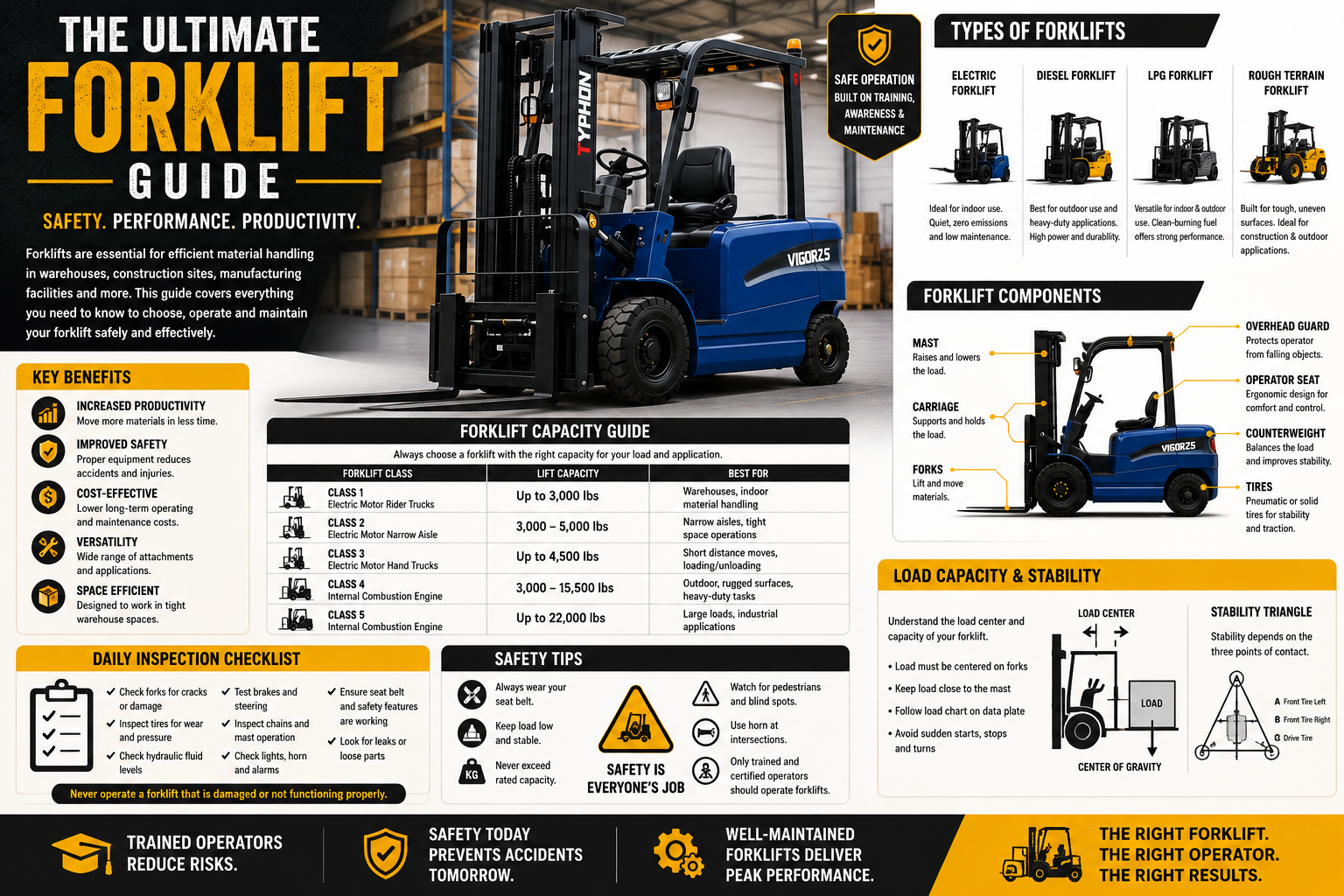
A forklift is a complex machine consisting of several integrated systems. Understanding these components is the first step toward safe operation and effective maintenance.
- The Truck Frame: The base of the machine to which all other components are attached. It provides the structural integrity required for heavy lifting.
- The Counterweight: A heavy mass of iron or lead attached to the rear of the machine. Its purpose is to offset the weight of the load being lifted to prevent the forklift from tipping forward.
- The Power Source: This can be an internal combustion (IC) engine (Diesel, LPG, or Gasoline) or an electric motor powered by lead-acid or lithium-ion batteries.
- The Mast: The vertical assembly that handles lifting and lowering the load. It consists of interlocking rails that provide lateral stability.
- The Carriage: The component that travels up and down the mast. It serves as the mounting point for the forks and other attachments.
- The Forks (Tines): The long, flat metal prongs that support the load.
- The Overhead Guard: A steel cage designed to protect the operator from falling objects.
3. How Forklifts Work: The Science of Balance
The fundamental principle of a forklift is the fulcrum and lever. The front wheels of the forklift act as the fulcrum (the pivot point). The load on the forks is on one side of the fulcrum, and the counterweight is on the other. For a forklift to remain stable, the downward force on the counterweight side must always exceed the downward force on the load side.
The Stability Triangle
Unlike a car, which has a four-point suspension, a forklift has a three-point suspension system. The three points are the two front wheels and the pivot point of the rear steering axle. This creates the "Stability Triangle." As long as the forklift's Center of Gravity (the combination of the machine's CG and the load's CG) stays within this triangle, the machine will not tip over. High speeds, uneven terrain, or lifting a load while turning can cause the Center of Gravity to shift outside the triangle, leading to a catastrophic tip-over.
4. Types and Classifications
Forklifts are categorized into seven primary classes by the Occupational Safety and Health Administration (OSHA) in the USA. Choosing the right class is critical for operational efficiency and compliance.
- Class I: Electric Motor Rider Trucks. Ideal for indoor warehouse use where exhaust fumes are prohibited.
- Class II: Electric Motor Narrow Aisle Trucks. Designed for maximum storage density in tight spaces.
- Class III: Electric Motor Hand Trucks or Hand/Rider Trucks. Often called "pallet jacks" or "walkies."
- Class IV: Internal Combustion Engine Trucks (Solid/Cushion Tires). Best for smooth, indoor surfaces.
- Class V: Internal Combustion Engine Trucks (Pneumatic Tires). Designed for outdoor, rugged terrain.
- Class VI: Electric and Internal Combustion Engine Tractors. Primarily used for towing.
- Class VII: Rough Terrain Forklift Trucks. Features large, aggressive tires for mud and uneven construction sites.
5. Electric vs. Internal Combustion (IC) Forklifts
Choosing between an electric motor and an internal combustion engine is one of the most significant decisions in fleet management. At Trenchers.net, we categorize this choice based on the environment of the job site and the intensity of the work cycle. Both power sources have evolved significantly, with modern Typhon models offering competitive performance in both categories.
Electric Forklifts
Ideal For: Food processing, pharmaceuticals, and indoor warehouses where ventilation is limited.
- Zero Emissions: No exhaust fumes, making them safer for indoor personnel.
- Lower Operating Costs: Electricity is generally cheaper than fuel, and electric motors have fewer moving parts to maintain.
- Quiet Operation: Reduces noise pollution in tight warehouse environments.
- Lifespan: High-quality lead-acid or lithium-ion batteries can provide 5-7 years of consistent service.
Internal Combustion (IC)
Ideal For: Construction sites, lumber yards, and multi-shift operations where downtime for charging is not an option.
- High Performance: Generally offers higher torque and faster travel speeds on uneven terrain.
- Fast Refueling: Swapping an LPG tank takes minutes, whereas batteries require hours of charging (unless utilizing rapid-charge lithium).
- Outdoor Versatility: Better suited for damp or extreme temperature environments.
- Lower Initial Cost: IC trucks typically have a lower purchase price compared to electric models of the same capacity.
6. Understanding Forklift Specifications: The Load Center
Operating a forklift requires more than just knowing its "Rated Capacity." You must understand Actual Capacity. A forklift rated for 5,000 lbs is only rated for that weight if the load's center of gravity is exactly at the specified Load Center—typically 24 inches from the face of the forks.
If you pick up a long load (like a crate of mini excavator attachments) where the center of gravity is 36 inches away, your 5,000 lb forklift can no longer safely lift 5,000 lbs. The leverage changes, and the machine's capacity drops. Always consult the Data Plate (or Nameplate) on your Typhon forklift to calculate the safe lifting limit for irregular loads. Failing to account for load center shift is the leading cause of forward tip-overs.
7. Common Forklift Attachments
While standard forks are the most common tool, specialized attachments turn a forklift into a versatile material handler. These attachments connect to the carriage and utilize the machine's auxiliary hydraulics.
- Side Shifters: Allows the operator to move the forks left and right without moving the truck. Essential for precision alignment in tight racks.
- Fork Positioners: Allows the operator to adjust the width between forks from the seat. Saves time when handling pallets of varying sizes.
- Paper Roll Clamps: Designed for the paper and printing industry to handle large rolls without crushing the material.
- Rotators: Allows the carriage to rotate 360 degrees. Frequently used in recycling and manufacturing to dump bins of material.
8. Forklift Safety Rules and Best Practices
The "Fatal Four" Hazards
Over 100 workers are killed and 95,000 injured every year in forklift-related accidents in the USA. The most common causes are tip-overs, pedestrians being struck, falling from elevated forks, and loads falling. Safety is never optional.
The Rule of Three for Safe Travel
When traveling with a load, always follow the Rule of Three:
- Keep it Low: Forks should be 2 to 4 inches off the ground to maintain the lowest possible center of gravity.
- Tilt it Back: Tilt the mast back slightly to secure the load against the carriage backrest.
- Look it Over: If the load blocks your forward vision, you must drive the forklift in reverse to maintain a clear view of your path.
Ramps and Inclines
When driving on a ramp, the rule is simple: Keep the load pointing uphill. If you are carrying a load, drive forward up the ramp and reverse down the ramp. If you are empty, drive reverse up the ramp and forward down the ramp. This ensures the center of gravity stays centered on the machine's wheelbase.
9. Basic Forklift Operating Instructions
Before starting any shift, a Pre-Operation Inspection is mandatory. Check tire pressure (or solid tire condition), look for hydraulic leaks under the mast, and test all lights and the backup alarm. Once inside the cab, ensure your seatbelt is fastened—in the event of a tip-over, the seatbelt is the only thing that keeps you within the protective ROPS cage.
Starting and Steering: IC forklifts require a "warm-up" period for the hydraulic oil to reach operational viscosity. When steering, remember that forklifts utilize Rear-Wheel Steering. This creates "Rear-End Swing." A forklift's rear end will swing much wider than a car's during a turn. Always allow extra clearance for the counterweight when maneuvering near rack uprights or walls.
10. Warehouse Operations and Material Handling
In a high-density warehouse, the forklift is a precision instrument. Efficiency is measured by "Cycle Time"—the speed at which an operator can retrieve a pallet and deliver it to the loading dock. However, speed must never compromise safety. Modern Typhon warehouse loaders are designed with tight turning radii to navigate narrow aisles, but operators must be aware of "Aisle Clearance." A standard sit-down forklift typically requires a 12-foot aisle, while "Reach Trucks" (Class II) can operate in aisles as narrow as 8 feet.
Mastering the Rack: When placing a load into high racking, the operator must check the capacity of the rack itself, not just the forklift. As the forks rise, the operator's perspective changes; utilized "Tilt Indicators" or "Integrated Cameras" on the carriage can help ensure forks are level before entering the pallet. Strict Rule: Never walk or stand under a raised load, regardless of whether the forklift is powered on or off.
11. Load Handling Principles: The Moment of Force
Safe lifting is governed by the physics of the Moment of Force. This is calculated as the weight of the load multiplied by the distance from the fulcrum (the front axle). The formula is expressed as:
$M = F \times d$
Where $F$ is the force (weight) and $d$ is the distance (load center). If you increase the distance of the load from the carriage, the "Moment" increases, potentially exceeding the counterweight's ability to keep the rear wheels on the ground.
The Dynamic Center of Gravity
A forklift’s center of gravity is not fixed. It moves forward as the mast is tilted forward and upward as the carriage is raised. A "Dynamic Tip-over" occurs when an operator makes a sharp turn while the mast is elevated. This causes the Center of Gravity to move laterally outside of the Stability Triangle, resulting in a side tip-over. Side tip-overs are significantly more fatal than forward tip-overs because they often lead to "mousetrapping," where the operator is crushed by the overhead guard.
12. Outdoor and Construction Applications
Operating a forklift on a construction site or lumber yard requires a Class V or Class VII machine equipped with pneumatic tires. Unlike the smooth floors of a warehouse, outdoor surfaces are often composed of loose gravel, mud, or uneven asphalt. These conditions can drastically affect traction and braking distance.
Ground Conditions: Always survey the path of travel for "soft spots" or hidden voids. A 10,000 lb forklift carrying a 5,000 lb load exerts massive ground pressure. If one wheel sinks into a soft patch of mud, the machine can tip instantly. For these environments, Typhon rough-terrain models utilize heavy-duty vertical masts and high-torque diesel engines to overcome rolling resistance.
13. Maintenance and Service: The Energy Hub
Whether your machine is electric or internal combustion, the power system requires a rigorous maintenance schedule. At Trenchers.net, we emphasize that proactive care is the only way to avoid the high cost of emergency repairs.
Battery and Charging Systems (Class I, II, III)
Lead-acid batteries require "Watering"—the addition of distilled water to maintain electrolyte levels. This should only be done after a full charging cycle. Lithium-ion batteries, increasingly standard in the Typhon lineup, are "Maintenance-Free" but require specific "Opportunity Charging" protocols to maximize their 3,000+ cycle lifespan. Never allow a lead-acid battery to discharge below 20%, as this leads to "sulfation," permanently reducing its capacity.
Tire Types and Maintenance
Forklift tires do not have traditional suspension; the tires themselves provide the only cushioning for the machine and the load. Choosing the wrong tire can lead to operator fatigue or load damage.
| Tire Type | Best Surface | Maintenance Note |
|---|---|---|
| Cushion (Solid) | Smooth Concrete / Indoors | Check for "chunking" or flat spots caused by hard braking. |
| Pneumatic (Air-Filled) | Gravel / Rough Asphalt | Maintain exact PSI to ensure lateral stability during lifts. |
| Solid Pneumatic | Outdoor Demolition | Puncture-proof; check for wear down to the "safety line" (60-J line). |
| Polyurethane | Electric / Cold Storage | Check for "delamination" (the tread peeling off the hub). |
14. The Daily Inspection Checklist
In the USA, OSHA requires a written inspection at the start of every shift. A "Pre-Op" check is a legal requirement and a mechanical necessity. If any item on this list fails, the machine must be Locked Out/Tagged Out (LOTO) and removed from service until repaired by a certified technician.
- Visual: Check for hydraulic oil "weeping" on mast cylinders and floor leaks.
- Mechanical: Inspect fork tines for cracks or thinning (less than 10% wear allowed). Check the "heel" of the fork specifically.
- Operational: Test the "deadman" pedal (if equipped), backup alarm, horn, and strobe light.
- Hydraulic: Raise the mast to its full height to check for smooth transition between stages and no "drifting" when held at height.
15. Troubleshooting Common Forklift Issues
A forklift is a complex tool that integrates high-pressure hydraulics with sensitive electrical safety interlocks. When a machine fails on the warehouse floor, a systematic approach to troubleshooting is required to minimize downtime. On our Typhon machines, we prioritize accessible diagnostic ports to simplify this process and get your logistics back on track quickly.
Loss of Hydraulic Lift
Primary Checks: Verify the hydraulic fluid level is at the "Full" mark. If the pump is whining, air may be entering the system through a loose intake fitting. If the mast "drifts" downward under load, the lift cylinder seals or the main control valve may be bypassed internally.
Electrical Power Failure
Primary Checks: For electric models, ensure the emergency disconnect (the red button) hasn't been engaged. Inspect the battery connector for "arcing" or corrosion. If the machine turns on but won't drive, the seat sensor or seatbelt interlock is the most likely culprit.
Erratic Steering
Primary Checks: Forklifts utilize rear-wheel steering. If the steering is "heavy," check the power steering fluid or the hydraulic steering motor. In many warehouse environments, floor debris (like plastic wrap) can wrap around the rear trunnion, causing significant mechanical resistance.
16. Forklift Buying Guide: Financial Strategy
Purchasing a forklift is a major capital expenditure that should be evaluated based on the Return on Investment (ROI). When deciding between machines, consider the total cost of ownership over a five-year window. For high-intensity operations, a new Typhon forklift often provides a better ROI than a used unit due to lower maintenance costs and higher energy efficiency.
17. Future Trends: Automation and Hydrogen
The material handling industry is moving rapidly toward Autonomous Guided Vehicles (AGVs). These forklifts use LiDAR and advanced sensors to navigate warehouses without a human operator, performing repetitive pallet movements with 100% precision. Furthermore, Hydrogen Fuel Cells are becoming a reality for large logistics hubs. These power sources provide the zero-emissions benefit of electric trucks but can be refueled in under three minutes, matching the uptime of traditional diesel or LPG engines.
18. Glossary of Forklift Terms
19. Frequently Asked Questions (FAQ)
Q: How often do I need to water a lead-acid battery?
A: Generally once a week after a full charge. Only use distilled water to prevent mineral buildup on the lead plates.
Q: What is the average lifespan of a forklift?
A: A well-maintained forklift can last between 10,000 and 15,000 hours. For a typical warehouse, this equates to roughly 8 to 10 years of service.
Q: Can I use an indoor forklift outside?
A: Only on smooth, paved surfaces. Standard "Cushion" tires have very little traction on gravel or mud and can lead to the machine becoming stuck or tipping.