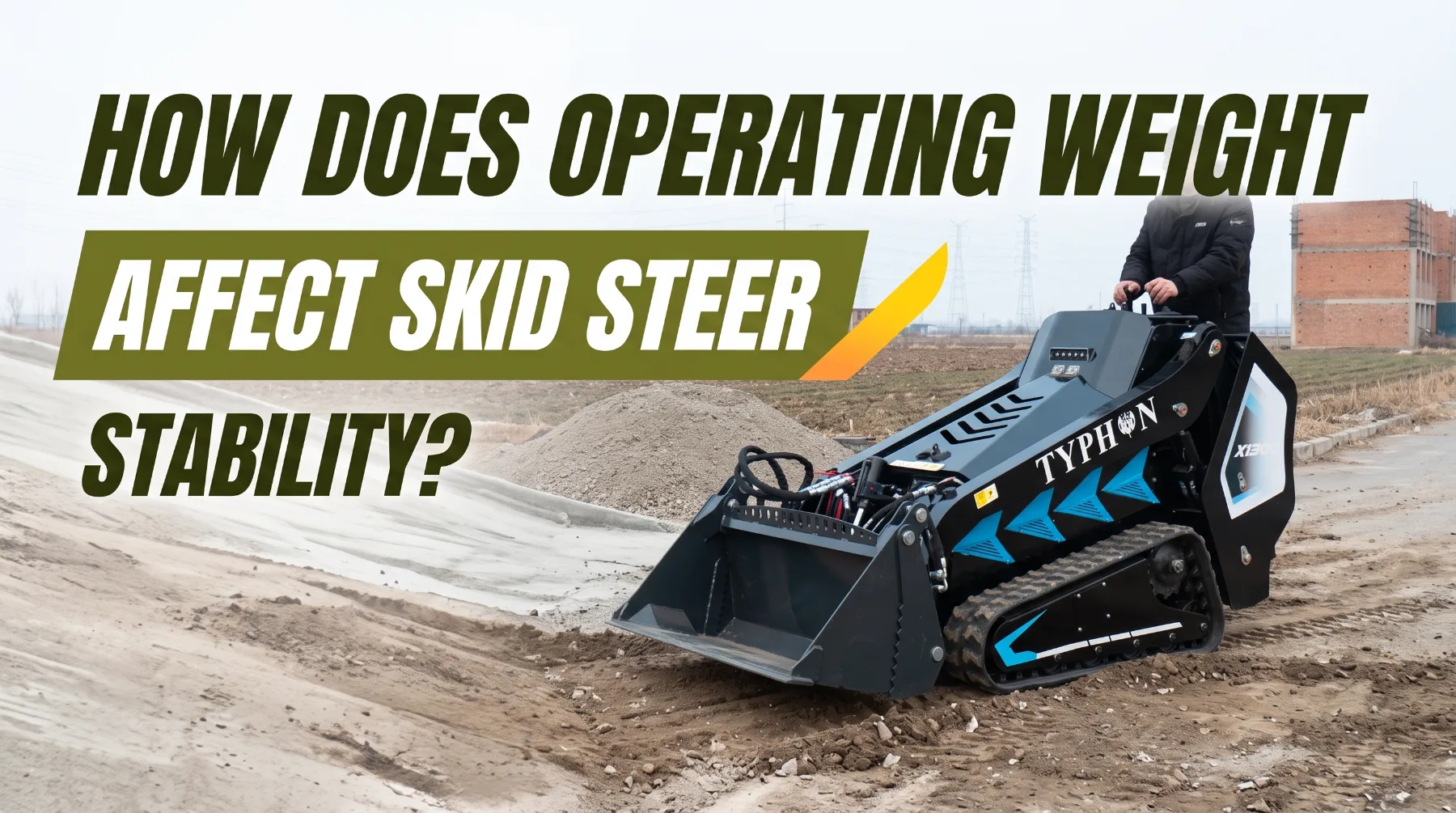
How Does Operating Weight Affect Skid Steer Stability?
Skid steers can wear the same tires, run the same bucket, and post nearly identical horsepower, yet one feels planted while the other gets tippy the moment you lift a full load. The gap usually traces back to operating weight, the total mass of the machine ready to work. That figure does far more than fill a line on the spec sheet. It anchors the machine to the ground, resists the forward pull of a loaded bucket, and decides how confidently the unit handles slopes, lifts, and heavy attachments. Buyers who shop on lift height or engine size alone often overlook how much operating weight governs whether the machine stays steady when the work gets demanding.
Weight earns your attention because it sits at the root of every stability decision you make. A properly weighted skid steer counterbalances its load, keeps its rear wheels firmly down, and gives the operator a stable platform even at full reach. Skimp on it, and the same lift that should feel routine starts lightening the back end and threatening a tip.
How Operating Weight Establishes the Center of Gravity
Every skid steer balances around a center of gravity, the single point where the machine’s mass is evenly distributed. Where that point sits, and how firmly it stays inside the footprint of the wheels or tracks, decides whether the machine feels rooted or restless. Operating weight, and how the maker positions it, sets that balance point from the start.
Manufacturers concentrate weight low and toward the rear, packing the engine, counterweights, and heavy components behind the operator. That placement pulls the center of gravity back and down, away from the front where loads are lifted and carried. A heavier machine with weight biased rearward keeps its balance point well within its base, so a load out front has to work much harder to drag that point toward the tipping edge.
Key takeaway: Operating weight and its rearward placement set the center of gravity low and back, keeping the balance point safely inside the machine’s footprint where stability begins.
How Weight Resists the Tipping Load of a Raised Bucket
Lift a loaded bucket and extend it forward, and you create a tipping moment, a rotational force trying to pivot the whole machine over its front wheels. The weight of the load, multiplied by how far it reaches ahead of the front axle, is what drives that force. Left unchecked, it lifts the rear end and rolls the machine forward.
Operating weight is the direct counter to that force. The mass behind the front axle creates its own moment in the opposite direction, holding the rear down and keeping the machine level. A heavier skid steer, with more counterweight to draw on, resists a larger tipping load before the back wheels ever begin to lighten. A lighter one reaches that threshold much sooner, which is exactly why two machines with the same lift arms can carry very different safe loads.
Key takeaway: A raised, extended load creates a tipping moment, and operating weight supplies the opposing counterbalance that holds the rear down and keeps the machine level.
How Weight Shapes Stability on Slopes and Uneven Ground
Flat, firm ground flatters any machine. Slopes and rough terrain expose the difference weight makes. When a skid steer sits on a grade, gravity pulls its center of mass toward the downhill side, shrinking the margin before the balance point drifts past the wheels. How the machine’s weight is distributed decides how much slope it can take before that margin runs out.
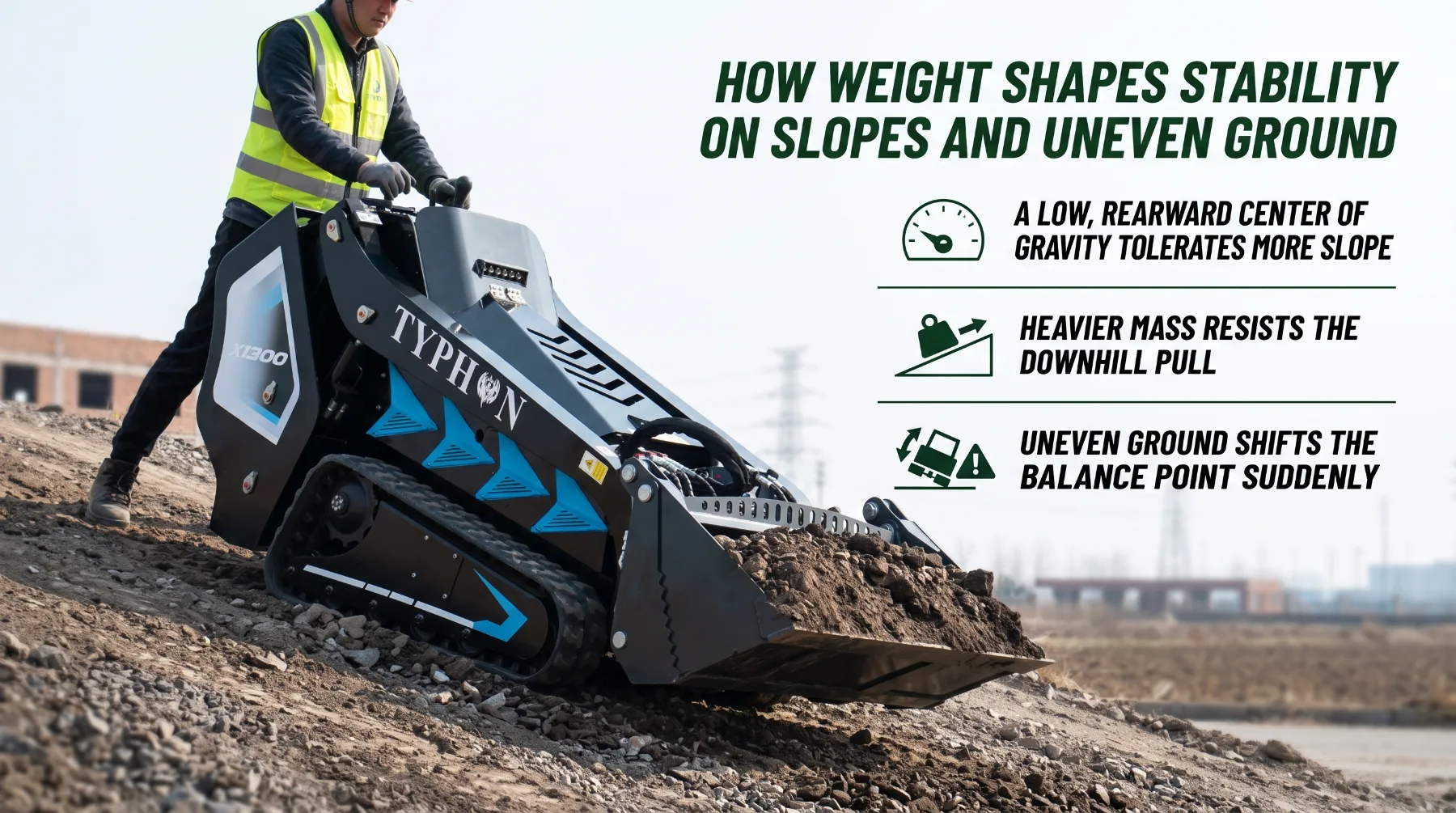 A heavier machine with a low, rearward center of gravity hugs the ground and tolerates more incline before it feels unsteady. Point it uphill with a load, and the rearward weight helps keep the front planted; face downhill, and that same mass resists the forward pull. On uneven surfaces, a dip under one wheel tilts the machine and shifts the balance point suddenly, and greater operating weight, especially when kept low, dampens how sharply that shift threatens stability. A light machine reacts far more abruptly to the same bump or slope.
Key takeaway: On grades and rough ground, gravity pushes the center of mass toward the tipping edge, and a heavier, low-set machine holds a wider stability margin than a light one.
How Operating Weight Ties Into Rated Operating Capacity
Skid steers carry a rated operating capacity, the maximum load the maker certifies for safe handling, and that figure is set as a fraction of the machine’s tipping load. For wheeled units, the industry standard is fifty percent of the tipping load; tracked units, which sit lower and spread their mass over a longer base, are typically rated at thirty-five percent. Both ratings flow directly from how much the machine weighs and how that weight is arranged.
Because tipping load depends on counterweight, a heavier machine earns a higher tipping load and therefore a higher safe operating capacity. This is why operating weight and rated capacity climb together across a product line. Read the two numbers as a pair: a machine that promises big lift capacity must carry the operating weight to back it up, or the rating rests on thin margins. Treat the rated capacity as a firm ceiling, since it already builds in the safety buffer between routine work and the tipping point.
Key takeaway: Rated operating capacity is a set fraction of tipping load, so heavier machines earn higher safe ratings, and the two figures should always be read together as a pair.
How Weight Influences Ground Pressure and Traction
Operating weight doesn’t only act through the center of gravity. It also presses the machine into the ground, and that contact shapes both traction and how the surface holds up. Ground pressure is the machine’s weight spread across the contact area of its tires or tracks, and it determines whether the unit floats over soft ground or sinks and churns.
More weight raises ground pressure, which can be an asset or a liability depending on the surface. On firm ground, added weight drives the tires or tracks down for stronger grip, giving the machine the traction to push, dig, and steer without slipping, and steady traction underpins stable handling. On soft or wet ground, that same weight can sink the machine, undercutting both mobility and the level footing stability depends on. Tracked machines spread their operating weight over a far larger contact patch, lowering ground pressure and keeping a stable stance on surfaces where a wheeled unit of similar weight would dig in.
Key takeaway: Operating weight sets ground pressure, which builds traction and stable footing on firm surfaces but can sink a machine on soft ground, where tracks spread the load and hold stability better.
How Attachments Shift the Weight and Stability Equation
Swap the bucket for a heavier attachment, and you change the stability picture in an instant. A grapple, auger, breaker, or pallet fork adds mass out front and often extends the load farther ahead of the front axle, both of which enlarge the tipping moment the machine’s operating weight has to counter. The base weight that felt more than sufficient with a bucket can suddenly sit closer to its limit.
The heaviest attachments demand you rethink balance rather than assume the machine will cope. A dense attachment carried high and forward pulls the center of gravity toward the tipping edge even before you pick up a load. This is exactly why many operators add rear counterweights when running demanding tools, restoring the rearward mass that keeps the machine level. Match every attachment to the machine’s rated capacity and its ability to stay balanced, and never treat a tool’s weight as an afterthought once it hangs off the front.
Key takeaway: Heavier, forward-reaching attachments enlarge the tipping moment, so match each tool to the machine’s rated capacity and add rear counterweight when a demanding attachment pulls the balance forward.
Practical Tips for Managing Weight and Stability
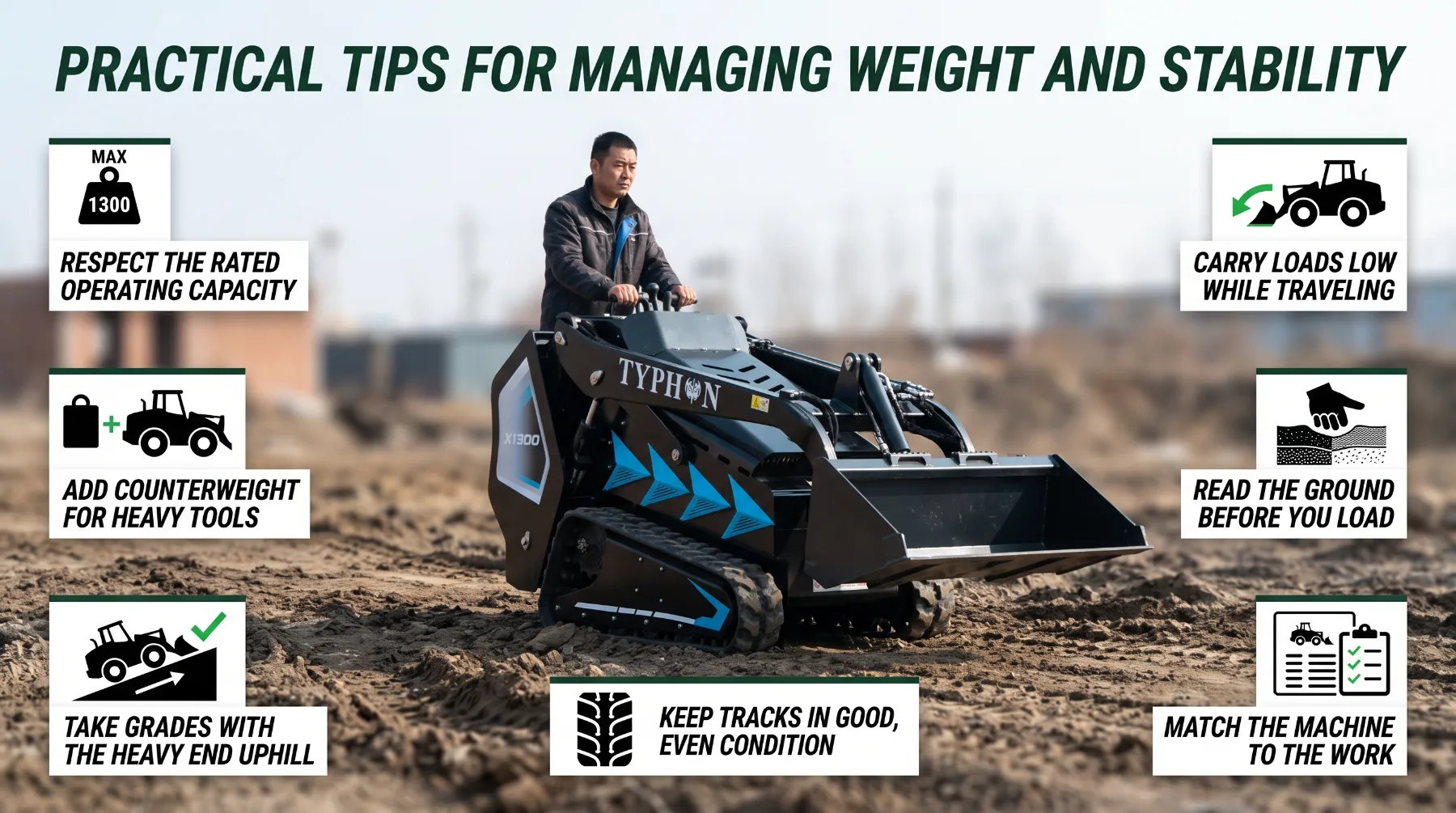 You steer more of your machine’s stability than the spec sheet alone implies. A handful of deliberate habits keep the center of gravity where it belongs and the machine planted through every task.
- Respect the rated operating capacity. Treat it as a hard ceiling, not a target to crowd, since it already holds the safety margin between routine work and the tipping point.
- Carry loads low. Keep the bucket or attachment close to the ground while traveling, so the center of gravity stays low and the machine resists tipping and rocking.
- Add counterweight for heavy tools. Fit rear weights when running dense or forward-reaching attachments, restoring the rearward mass that holds the machine level.
- Read the ground before you load. Confirm firm, level footing before lifting near capacity, and slow down on soft, wet, or uneven surfaces where the balance point shifts fast.
- Take grades with care. Travel with the heavy end uphill where practical, and avoid lifting to full reach while parked on a slope.
- Match the machine to the work. Choose a unit whose operating weight suits your typical loads, so it isn’t working near its stability limit on every lift.
- Keep tires or tracks in good shape. Even wear and correct pressure keep the contact patch consistent, which steadies traction and footing under load.
Key takeaway: Respecting the rated capacity, carrying loads low, adding counterweight, and reading the ground keep the center of gravity planted and the machine stable through every task.
Conclusion
Operating weight and skid steer stability are closely linked through the center of gravity, as the machine’s mass helps keep the rear planted and counteracts the tipping moment created by raised or extended loads. Heavier, low-set machines generally maintain a wider stability margin on slopes and rough ground, while heavier attachments can increase the tipping moment and may require additional counterweight. Operating weight also affects ground pressure and traction, so always match the machine’s weight, rated operating capacity, terrain, and attachments to your actual loads and verify performance under real working conditions before buying.
Frequently Asked Questions
Why does the rear of my skid steer feel light when I lift a full bucket?
That lightness is the tipping moment at work. When you raise a loaded bucket ahead of the front axle, its weight and reach create a forward rotational force. The machine’s operating weight behind the axle acts as a counterbalance, but as the load approaches the safe limit, the rear begins to lighten. This is normal behavior, but it signals that you should lower the load, keep it closer to the machine, or confirm you are within the rated operating capacity.
Is a heavier skid steer always more stable?
More operating weight generally improves stability, but weight placement and terrain matter too. Weight positioned low and toward the rear helps keep the center of gravity within the machine’s footprint and counterbalances a loaded bucket. However, a heavy machine can sink on soft or wet ground and lose its level stance. Tracked machines often stay steadier in these conditions because they spread weight over a larger contact area. Match the machine’s weight and configuration to the terrain rather than assuming heavier is always better.
How do attachments change my skid steer’s stability?
Attachments can significantly affect stability by adding weight and extending farther ahead of the front axle. Tools such as grapples, augers, breakers, and pallet forks increase the tipping moment, bringing the machine closer to its stability limit even before carrying a load. Heavy attachments positioned high or far forward shift the center of gravity toward the tipping edge. Rear counterweights may help balance demanding tools, but every attachment must still stay within the machine’s rated operating capacity.