
Scissor Lift Ultimate Guide
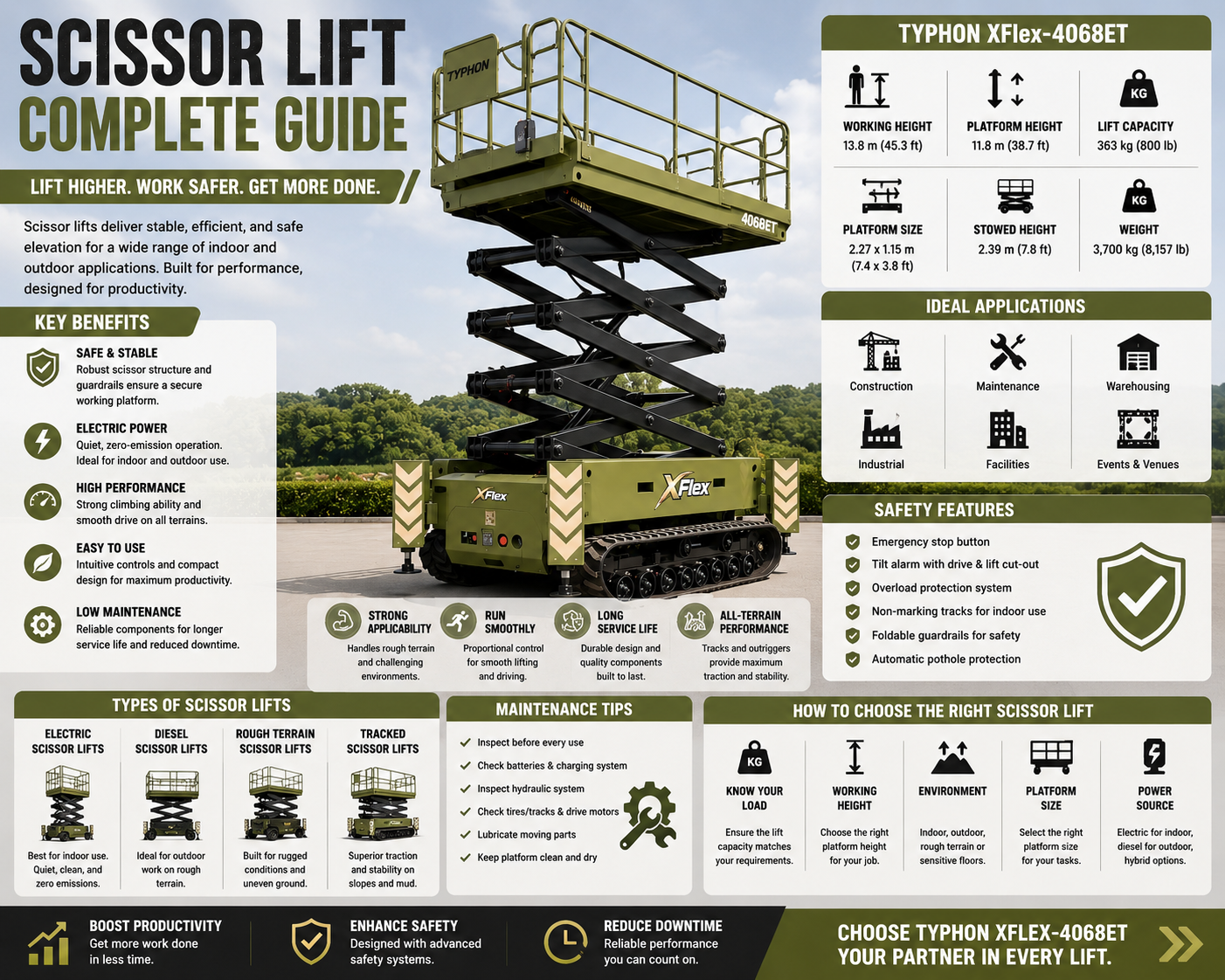
A Beginner-to-Advanced Learning Manual for Operators, Construction Workers, Warehouse Teams, Maintenance Crews, Facility Managers, and Equipment Enthusiasts
Table of Contents
- 1. Introduction & History
- 2. Main Components & Anatomy
- 3. How Scissor Lifts Work
- 4. Types: Electric vs. Diesel
- 5. Specifications & Choice
- 6. Safety & Best Practices
- 7. Basic Operating Instructions
- 8. Advanced Operating Techniques
- 9. Stability & Load Management
- 10. Working on Ramps & Transport
- 11. Maintenance Mastery
- 12. Emergency Procedures
- 13. Troubleshooting Common Problems
- 14. Buying Guide: ROI & Strategy
- 15. Future Trends
- 16. Glossary of Terms
- 17. Frequently Asked Questions (FAQ)
1. Introduction to Scissor Lifts
A scissor lift is a type of mobile elevated work platform (MEWP) designed to move personnel and equipment in a vertical direction. Unlike boom lifts, which can extend both horizontally and vertically, scissor lifts provide a stable, spacious platform for tasks that require multiple workers or heavy tools to reach heights safely. These machines are essential in modern construction, warehousing, and facility maintenance, providing a significant safety upgrade over traditional ladders and scaffolding.
At Trenchers.net and newscissorlift.com, we specialize in high-durability Typhon machinery. Our scissor lifts are engineered to provide maximum stability and ease of operation, whether you are installing HVAC ductwork in a high-ceiling warehouse or performing exterior maintenance on a commercial building. This manual is designed to be your definitive resource for operational excellence.
History and Evolution
The concept of the scissor lift is rooted in the "pantograph" mechanism—a series of connected folding struts that expand and contract like an accordion. The first motorized scissor lifts appeared in the 1970s as a response to the growing need for safer vertical access in industrial settings. Early models were purely hydraulic and lacked the sophisticated safety interlocks of today. Over the decades, the integration of electric drive motors, tilt sensors, and weight-sensing technology has transformed the scissor lift into one of the safest and most efficient tools in the equipment fleet.
2. Main Components and Anatomy
Understanding the mechanical structure of a scissor lift is vital for safe operation and pre-start inspections. A scissor lift is composed of four primary sub-assemblies.
The Pantograph Mechanism
The "scissor" legs are the most recognizable part of the machine. These are heavy-duty steel members connected by pivot pins. When hydraulic pressure is applied to the cylinders, the legs are pushed apart, causing the platform to rise vertically. Pinch points are a major safety concern here; operators must never place limbs near the legs while the machine is in motion.
- The Platform: The workspace where operators stand. It includes guardrails, a toe board to prevent tools from falling, and a control console.
- The Base: The foundation of the machine. It houses the power source (batteries or engine), hydraulic tank, and steering components.
- The Extension Deck: Most modern Typhon lifts feature a deck that can slide forward, providing extra reach over obstacles or a larger workspace for two operators.
- The Hydraulic Cylinders: The "muscle" of the machine. Typically, one or two cylinders provide the force needed to expand the scissor legs.
3. How Scissor Lifts Work: The Physics of Lift
The operation of a scissor lift is a classic application of Pascal's Law. This law states that pressure applied to a confined fluid is transmitted undiminished in every direction. In a scissor lift, a hydraulic pump forces oil into the cylinders. The pressure ($P$) is equal to the force ($F$) divided by the area of the piston ($A$):
$$P = \frac{F}{A}$$
As the piston extends, it pushes against the pivot point of the scissor legs. Because the legs are fixed at one end of the base and free to slide at the other, the horizontal force is converted into vertical displacement. This mechanical advantage allows a relatively small hydraulic system to lift thousands of pounds of platform and payload.
4. Types: Electric vs. Diesel Scissor Lifts
Choosing the correct power source is the most critical decision in fleet acquisition for Typhon industrial equipment. While both types serve the same vertical purpose, their operational environments and maintenance requirements differ significantly. Modern construction projects in urban centers like Phnom Penh often require a mix of both platforms depending on the stage of development.
Electric Scissor Lifts
Ideal For: Indoor facility maintenance, high-ceiling warehouses, and multi-story construction finishing.
- Zero Emissions: Safe for use in enclosed spaces without ventilation.
- Non-Marking Tires: Equipped with solid rubber tires that prevent scuffs on finished warehouse floors.
- Quiet Operation: Essential for working in hospital or retail environments during business hours.
- Maintenance: Primarily involves battery care and hydraulic fluid checks.
Diesel Scissor Lifts
Ideal For: Rough terrain construction sites, exterior wall cladding, and heavy-duty infrastructure projects.
- High Traction: Features aggressive pneumatic tires and four-wheel drive capabilities.
- Heavy Payload: Generally offers higher platform weight capacities for multiple workers and heavy tools.
- Levelling Jacks: Equipped with outriggers to stabilize the machine on uneven outdoor soil.
- Endurance: Can operate for full shifts in extreme temperatures without downtime for charging.
5. Specifications: Choosing the Right Typhon Model
Understanding the specification sheet is vital for safety and site efficiency. When selecting a machine for newscissorlift.com, operators must look beyond just the maximum height.
- Working Height vs. Platform Height: Platform height is the distance from the ground to the floor of the deck. Working height is generally platform height plus 6 feet (to account for a standing operator's reach).
- Platform Capacity: The maximum weight, including personnel, tools, and materials. Exceeding this triggers the Overload Sensor, disabling the machine for safety.
- Gradeability: The maximum slope the machine can climb while in the stowed position. Most electric models are limited to 25%, while rough terrain models can handle up to 40-50%.
- Wind Rating: Outdoor-rated lifts are engineered to withstand specific wind speeds. Indoor-only lifts must never be used outdoors as they can tip in even moderate gusts.
6. Scissor Lift Safety and PPE
The "Fall Protection" Rule
While the guardrails on a scissor lift act as primary fall protection, site-specific safety plans often require a full-body harness and a short lanyard (Restraint System). This prevents the "Ejection Effect" if the machine is struck by another vehicle or hits a pothole while moving. Safety is never a coincidence.
Essential Personal Protective Equipment (PPE)
Before stepping onto a Typhon platform, ensure all personnel are equipped with standard safety gear:
- Hard Hat: Protection against overhead hazards while working in tight construction gaps.
- High-Visibility Vest: Crucial for ground visibility, especially on busy logistics sites.
- Safety Footwear: Steel-toed boots with non-slip soles for stable positioning on the metal deck.
- Full-Body Harness: Inspected daily for any fraying or hardware damage.
7. Basic Operating Instructions
Operating a scissor lift requires precision and awareness of the "Crush Zone." Modern machines utilize a single-hand proportional joystick for both drive and lift functions. Before operation, always check the Emergency Stop buttons on both the base and the platform.
The Pre-Start Walkaround: Inspect the hydraulic lines for leaks, check the tire condition, and ensure the "Pothole Protection" bars are functioning. These bars deploy as the lift rises, reducing the ground clearance to prevent the machine from tipping if a wheel enters a hole. If the pothole guards fail to deploy, the machine's safety system will prevent further elevation.
8. Advanced Operating Techniques
Once basic vertical movement is mastered, operators must learn to manage the Extension Deck. This sliding platform allows you to reach over fixed obstacles like conveyors or HVAC units. However, extending the deck shifts the machine's center of gravity forward. You must never exceed the specific weight limit for the extension deck, which is always lower than the main platform capacity.
Power Line Safety: The Minimum Approach Distance (MAD)
Working near energized power lines is the most dangerous task for any MEWP operator. Electricity can "arc" or jump through the air to your machine even if you don't make physical contact. Standard OSHA regulations require a minimum clearance of 10 feet for lines up to 50kV. For higher voltages, the distance increases significantly.
9. Stability and Load Management: The Physics of "Tip-Over"
A scissor lift’s stability is determined by its Moment of Stability. This is the weight of the machine's base ($W_b$) multiplied by its horizontal distance from the pivot point ($D_b$), which must always be greater than the Overturning Moment (the weight of the platform and load, $W_p$, multiplied by the distance $D_p$).
$$W_b \times D_b > W_p \times D_p$$
As you elevate, even a small slope or a gust of wind can increase the overturning moment. This is why Typhon lifts are equipped with tilt sensors that disable lift and drive functions if the machine is off-level by more than 1.5 to 3 degrees (depending on the model).
10. Working on Ramps and Transport
Loading a scissor lift onto a trailer is a high-risk maneuver. Most drive-system failures occur during this stage because the operator exceeds the machine’s Gradeability. When driving on a ramp:
- Always keep the machine in its stowed (lowest) position.
- Drive with the motor/battery end pointing downhill for better traction.
- Ensure the trailer is on level ground and the ramps are clear of oil or ice.
- Once loaded, secure the machine using the designated "Tie-Down" points on the chassis—never secure straps over the scissor arms or the guardrails.
11. Maintenance Mastery: Protecting the Typhon Fleet
Professional maintenance is what ensures a high resale value on newscissorlift.com. Because scissor lifts often sit idle for periods and then work at 100% capacity, "Vigilant Maintenance" is required.
Over-watering or under-watering a lead-acid battery is the #1 cause of lift failure. Only add distilled water after a full charge cycle to prevent acid boil-over. Ensure terminals are coated with a protector to prevent corrosion.
Check hoses for "pinhole" leaks. A high-pressure hydraulic leak can cause Fluid Injection Injuries, which are medical emergencies. Replace any hose showing signs of "weather checking" (cracking) or bulging.
The scissor legs contain dozens of pivot points. These must be greased according to the manual (usually every 50-100 hours) to prevent the steel from "galling" or seizing, which would require a total rebuild of the pantograph.
12. Emergency Procedures and Rescue Operations
The Manual Descent Valve
If the machine loses power while you are at height, you must know how to use the Manual Descent Valve (or Emergency Lowering Valve). This is typically a red pull-handle located at the base of the machine. It allows hydraulic oil to bypass the pumps and flow back into the tank, slowly lowering the platform using gravity alone. All ground personnel must be trained on its location.
13. Troubleshooting Common Problems
A scissor lift failure at a height of 30 feet is more than a mechanical issue—it is a significant site safety risk. Identifying the root cause of a failure quickly is essential for maintaining project timelines. Most Typhon lifts utilize an onboard LED diagnostic display that provides "Fault Codes." Always consult the manual for the specific code before beginning repairs.
Machine Won't Lift (Beeping)
Primary Checks: This is often a safety lockout rather than a mechanical failure. Check if the machine is off-level (Tilt Sensor). Also, check the Overload Sensor; if the platform weight exceeds the limit, the machine will disable the lift function to prevent a tip-over.
Slow Drive or Lift Speeds
Primary Checks: For electric models, this usually indicates low battery voltage. For diesel models, check the hydraulic oil filter. A clogged filter will "starve" the pump of oil, reducing the flow and slowing down all hydraulic functions.
Hydraulic Drifting
Primary Checks: If the platform slowly lowers itself over time, there is a leak in the lift cylinder seals or the manual descent valve is slightly open. Inspect the cylinder rods for scarring, which can tear the internal seals and lead to pressure loss.
14. Scissor Lift Buying Guide: ROI and Strategy
Whether you are expanding your fleet on newscissorlift.com or making your first purchase for trenchers.net, the decision to buy versus rent depends on utilization. If a machine is in use for more than 60% of your workdays, the monthly financing payment on a new Typhon unit is typically lower than the cost of a long-term rental.
15. Future Trends: Lithium-Ion and Telematics
The industry is moving toward Lithium-Ion power systems. These batteries provide "Opportunity Charging," allowing you to charge the machine during a 30-minute lunch break without damaging the battery’s lifespan. They are also 30% lighter and require zero maintenance (no watering), which is a major advantage for facility managers.
Furthermore, Telematics systems are now standard. Owners can track machine location, battery health, and unauthorized usage via a smartphone app. This data allows for "Predictive Maintenance," where the machine alerts the owner to a potential hose or battery failure before it causes downtime on the job site.
16. Glossary of Scissor Lift Terms
17. Frequently Asked Questions (FAQ)
Q: Can I drive a scissor lift while the platform is raised?
A: Yes, on most modern machines. However, the machine will travel at a significantly reduced "Creeper Speed" for safety, and the pothole guards must be fully deployed.
Q: Why does my lift stop working when it gets cold?
A: Battery capacity drops in cold temperatures, and hydraulic oil becomes more viscous (thicker). This can trigger low-voltage sensors or slow down valve movements.
Q: How often does a scissor lift need an annual inspection?
A: Every 13 months, a "major inspection" by a certified technician is required to verify the structural integrity of the scissor arms and the safety interlock systems.