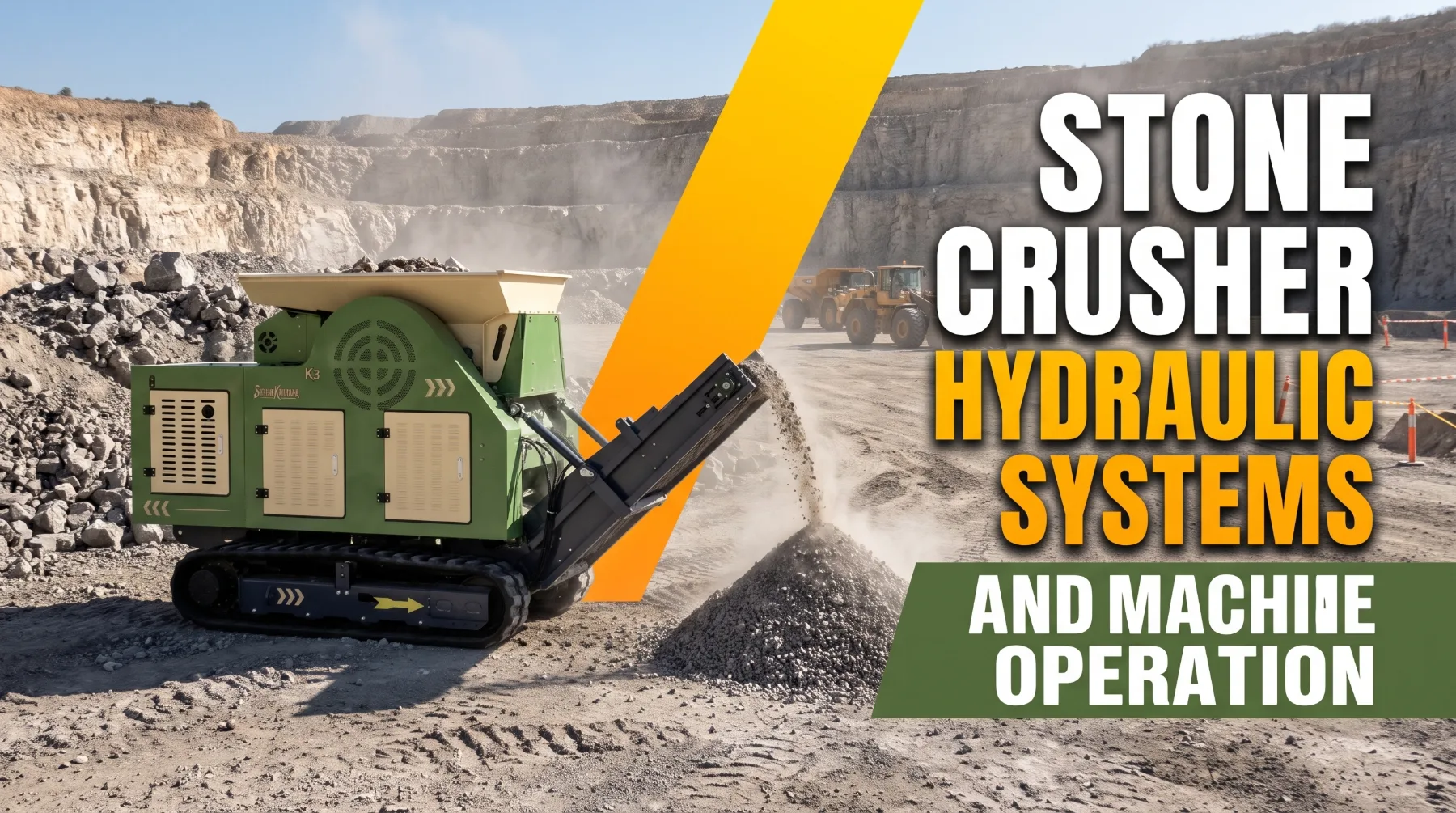
Dust hangs over a limestone quarry as a track-mounted jaw crusher works through its second shot pile of the day. Production looks steady until the operator notices that the side conveyor drops a few inches every time the feeder surges. An hour later, the main conveyor slows under load and the hydraulic temperature warning starts to flash. The crushing chamber is still reducing stone, but the systems around it are falling behind. The cause turns out to be a clogged return filter and a cooler packed with fine dust. Neither was difficult to fix. Both could have been caught during the morning inspection.
Hydraulic systems play a central role in the operation of most mobile stone crushers. They drive conveyors and feeders, fold and position conveyors, raise hopper extensions, set jack legs, adjust the crusher setting, protect the chamber from uncrushable material, and move the machine on its tracks. On some designs, hydraulics also drive the crushing mechanism directly. Operators who understand how these systems work can recognize performance changes early, use the controls correctly, and avoid the downtime that follows a neglected hose, filter, or cylinder.
Main Components of a Stone Crusher Hydraulic System
Behind every conveyor movement and setting adjustment sits a group of hydraulic components working as one system. Most mobile crushers use a diesel engine or electric motor to drive one or more hydraulic pumps. The pumps draw oil from a reservoir and push it through control valves, which direct flow to the cylinders and motors that need power. Oil then returns to the reservoir through filters and, on most machines, through an oil cooler.
The reservoir does more than store oil. It allows air bubbles to escape, lets contaminants settle, and gives hot oil time to release heat. A breather on the reservoir allows air to move in and out as the oil level changes, and a filter element in that breather keeps dust out. On a crusher working in a dusty quarry, a damaged or missing breather can let fine abrasive particles straight into the system.
Pumps come in several designs. Gear pumps are common on simpler circuits because they’re durable and economical. Piston pumps, often variable displacement and load-sensing, are common on larger machines because they deliver only the flow the system needs and waste less energy as heat. Many crushers use several pumps, with separate circuits for conveyors, tracks, and auxiliary functions.
Control valves direct oil to each function. Some are operated by manual levers at a control station, while many modern crushers use electrically operated solenoid valves controlled through a display panel or radio remote. Relief valves limit maximum pressure in each circuit to protect components from overload. Check valves and load-holding valves keep cylinders from moving when the controls are released.
Actuators turn hydraulic energy into motion. Cylinders create straight-line movement for folding conveyors, raising hopper wings, setting jack legs, and adjusting or protecting the crushing chamber. Hydraulic motors create rotation for conveyor belts, vibrating feeders, track drives, and, on some machines, the crusher itself. Hoses and steel lines connect everything, while filters on the suction, pressure, or return side remove particles before they damage pumps and valves. Accumulators appear on some machines, particularly in tramp release systems, where they store pressurized oil to absorb shock loads. The exact arrangement varies widely between jaw, cone, and impact crushers, and between manufacturers. Use the hydraulic diagram for your specific machine when identifying components or tracing a fault.
Key takeaway: A crusher hydraulic system combines pumps, a reservoir, valves, filters, hoses, cylinders, motors, and sometimes accumulators, so use your machine’s hydraulic diagram to identify each component correctly.
How Hydraulic Pressure and Flow Affect Operation
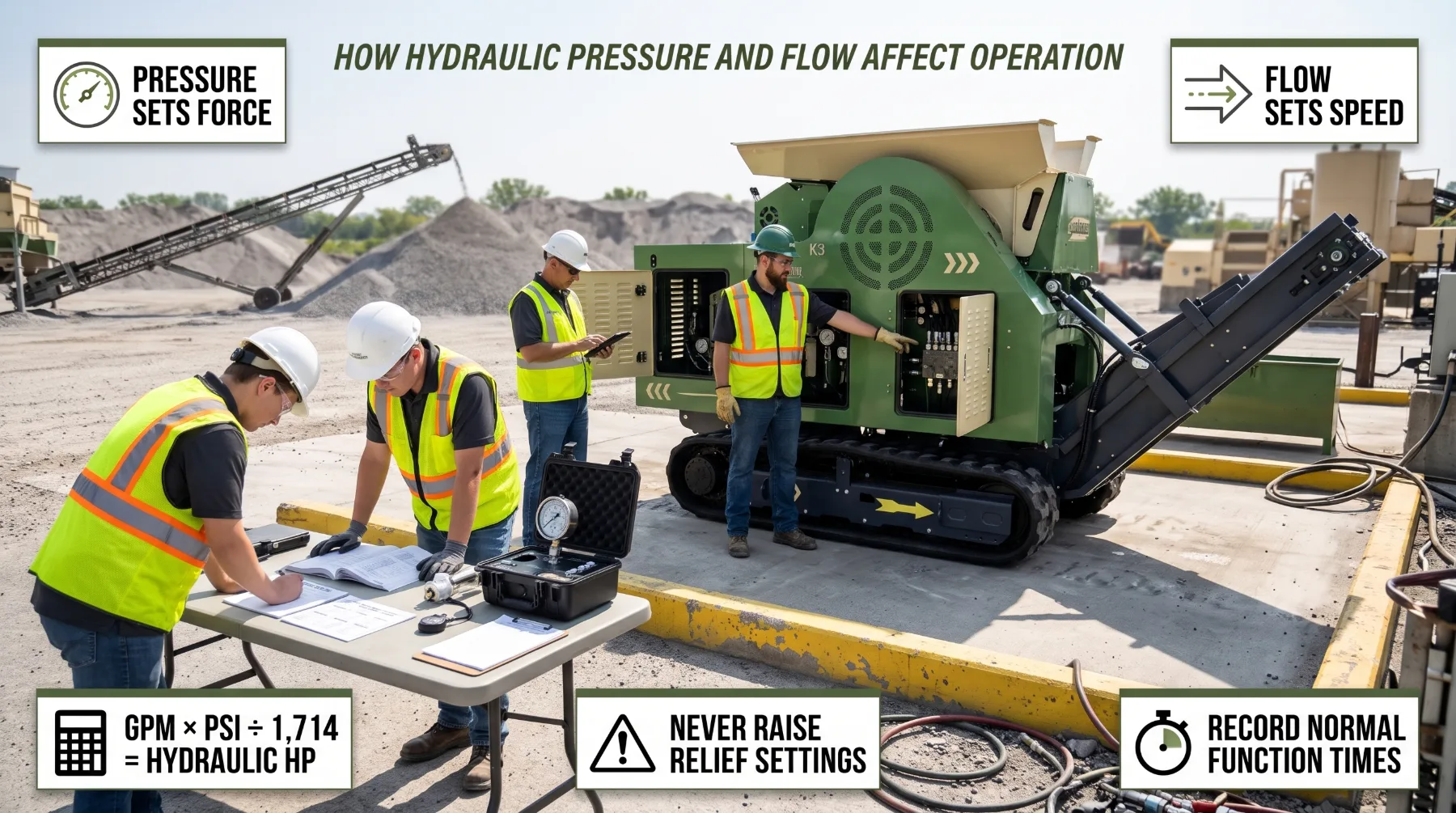
Pressure and flow describe two different things, and confusing them leads to poor troubleshooting. Pressure determines force in a cylinder and torque in a motor. Flow determines how fast a cylinder extends or how fast a motor turns. Pressure only builds when a component meets resistance, up to the limit set by the relief valve.
When system pressure drops because of a worn pump or a weakened relief valve, force available at a cylinder falls with it. A conveyor that once folded smoothly may hesitate or stall partway through its travel. Flow controls speed in much the same way. When a restricted filter or worn pump reduces flow to a conveyor drive motor, the belt slows, material builds up at the transfer point, and the crusher may eventually have to stop to avoid a blockage.
Pressure and flow together define hydraulic power, and any power not converted into useful work becomes heat in the oil. When setting up a stone crusher for operation, hydraulic pressure and flow must match the manufacturer’s recommended specifications to deliver consistent crushing performance. Raising pressure or flow beyond the manufacturer’s limits doesn’t improve crushing performance. Higher relief settings can burst hoses, overload cylinders, and damage pumps, while excess flow can overspeed motors and generate heat. Correct settings depend on the pump, valves, motors, cylinders, and the work each function performs. Only qualified technicians should check and adjust pressure or flow, using calibrated gauges, flow meters, and the manufacturer’s procedures. Operators should never change hydraulic settings without proper authorization.
Key takeaway: Pressure sets force and torque while flow sets speed, so diagnose slow or weak functions by measuring both rather than raising settings beyond the manufacturer’s limits.
Hydraulic Functions During Crushing Work
Crushing itself happens in the chamber, where jaws, a mantle and concave, or impact blow bars reduce stone to size. On most jaw and impact crushers, the engine drives the crusher through a clutch and belts. Some machines use a hydrostatic drive or a direct hydraulic drive for the crusher, which can allow reversing to clear blockages. Operators need to know which arrangement their machine uses, since it changes how the crusher starts, stops, and responds to overload.
Around that core, hydraulics handle a long list of supporting functions. These typically include track drive motors that move the machine into position, feeder and grizzly drives that control how fast material enters the chamber, and main, side, and fines conveyor motors that carry product and byproduct away. Folding cylinders lower conveyors into working positions and raise them for transport. Hopper wing cylinders raise and lock hopper extensions, while jack leg cylinders stabilize the machine on some models. Setting adjustment systems change the closed side setting to control product size, tramp release systems let uncrushable material pass without damaging the chamber, and chamber clearing systems help free a blocked crusher after a stall. Some machines also include access functions such as raising an impactor’s rear housing for blow bar changes.
Each function has its own demands. Conveyor motors run continuously, so flow and cooling matter most. Setting adjustment and tramp release cylinders work under very high loads but move only occasionally. Track drives need high torque at low speed for short periods. A machine whose conveyors run smoothly may still have a weak tramp release circuit, so every function needs its own attention. When a crusher operator tightens the closed side setting to produce finer product, power draw rises. If the feed rate stays the same, the chamber may overload and the tramp release may cycle repeatedly. Reducing feed rate slightly after the adjustment keeps the crusher within its intended range and protects both the hydraulic and mechanical systems.
Key takeaway: Hydraulics support crushing through conveyors, feeders, tracks, setting adjustment, overload protection, and chamber clearing, so learn which controls operate the crusher and which operate supporting functions before production starts.
Preparing the Hydraulic System Before Operation
Preparation starts before the engine turns over. Position the crusher on firm, level ground that can carry its full weight plus the load of material in the hopper and on the conveyors. Uneven ground stresses the chassis, puts side loads on cylinders and conveyor mounts, and can affect how oil returns to the reservoir. Set jack legs where fitted, following the manufacturer’s sequence.
Check the hydraulic oil level at the sight gauge with the machine in the position the manual specifies. On many crushers, that means conveyors folded or lowered and cylinders in a defined position, since extended cylinders hold oil outside the tank and can give a false low reading. Top up only with the specified oil, using a clean funnel or filtered transfer system. Confirm that the reservoir cap and breather are secure and undamaged, and check filter restriction indicators for any sign of bypass.
Walk around the machine and inspect hoses, steel lines, and fittings. Look for abrasion where hoses rub against the chassis, conveyor frames, or each other, along with cracked covers, exposed reinforcement, bulges, kinks, and oily residue at crimped ends. Check cylinders for scored rods and leaks at the glands, and look for fresh oil beneath the machine. Confirm that hose guards, clamps, and protective sleeves are in place, particularly where hoses flex at conveyor hinge points. Inspect the oil cooler as well. In crushing work, fine dust settles on cooler fins quickly and cuts cooling capacity. Clean the cooler with the machine shut down and locked out, following the manufacturer’s method, and confirm the fan and guard are undamaged.
Start the machine following the operating procedure. Allow the hydraulic oil to reach normal operating temperature before demanding full performance, especially in cold weather, when thick oil moves slowly and can cause pump cavitation. Then test functions one at a time with the area clear, including conveyor startup, feeder operation, emergency stops, and conveyor pull-cord switches. Listen for whining, knocking, or chattering, and watch for jerky movement or warning messages. Investigate any abnormal sign before production begins.
Key takeaway: Position the crusher on firm, level ground, check oil level, filters, breather, hoses, and cooler, then warm the oil and test each function with the area clear before starting production.
Operating Hydraulic Controls Correctly
Smooth control use protects both the hydraulic system and the people around the machine. Sudden lever movements or rapid switching create pressure spikes that stress hoses, fittings, and seals. Move controls progressively, and allow each function to start and stop under control.
Avoid holding any control against the end of a cylinder’s stroke. When a cylinder reaches its stop and the operator keeps the control engaged, oil flows over the relief valve and turns hydraulic power directly into heat. On a crusher that already runs warm in summer quarry conditions, a few seconds of this at every conveyor fold adds up quickly. Release the control as soon as the movement is complete.
Conveyor folding, hopper wing movement, and track travel require a clear area. Before moving any component, confirm that no one is beneath the conveyor, near hinge points, or in the machine’s travel path. Many crushers use radio remote controls for tracking, which allows the operator to walk alongside at a safe distance with a clear view of the route. Never travel with conveyors in their working position unless the manufacturer permits it, and keep well back from stockpile toes, highwalls, and excavation edges.
Startup and shutdown sequences matter as well. Most crushers start conveyors before the crusher and feeder, so product has somewhere to go, and stop them in the reverse order after the chamber has emptied. Follow the machine’s sequence exactly. Stopping the main conveyor while the crusher is still discharging can bury the conveyor and overload its motor at the next startup. Blockages call for particular care. Never attempt to clear a blocked chamber, feeder, or transfer point by hand or by standing on the feeder while the machine can move. Use the machine’s chamber clearing function where fitted, following the manual, or shut down and lock out before removing material. Never place hands or tools near moving hydraulic components while the system is pressurized. Only trained, authorized personnel should operate the crusher.
Key takeaway: Use controls smoothly, release them at the end of each stroke, move conveyors and tracks only when the area is clear, follow the startup and shutdown sequence, and never clear blockages by hand while the machine can move.
Safe Leak Checks, Lockout, and Service
Stored energy makes hydraulic service on a crusher hazardous. Pressurized oil sits in hoses, cylinders, and accumulators. Raised conveyors and hopper wings hold their weight on trapped oil. Tramp release accumulators can retain high pressure long after the engine stops. Safe service begins by controlling every one of these energy sources.
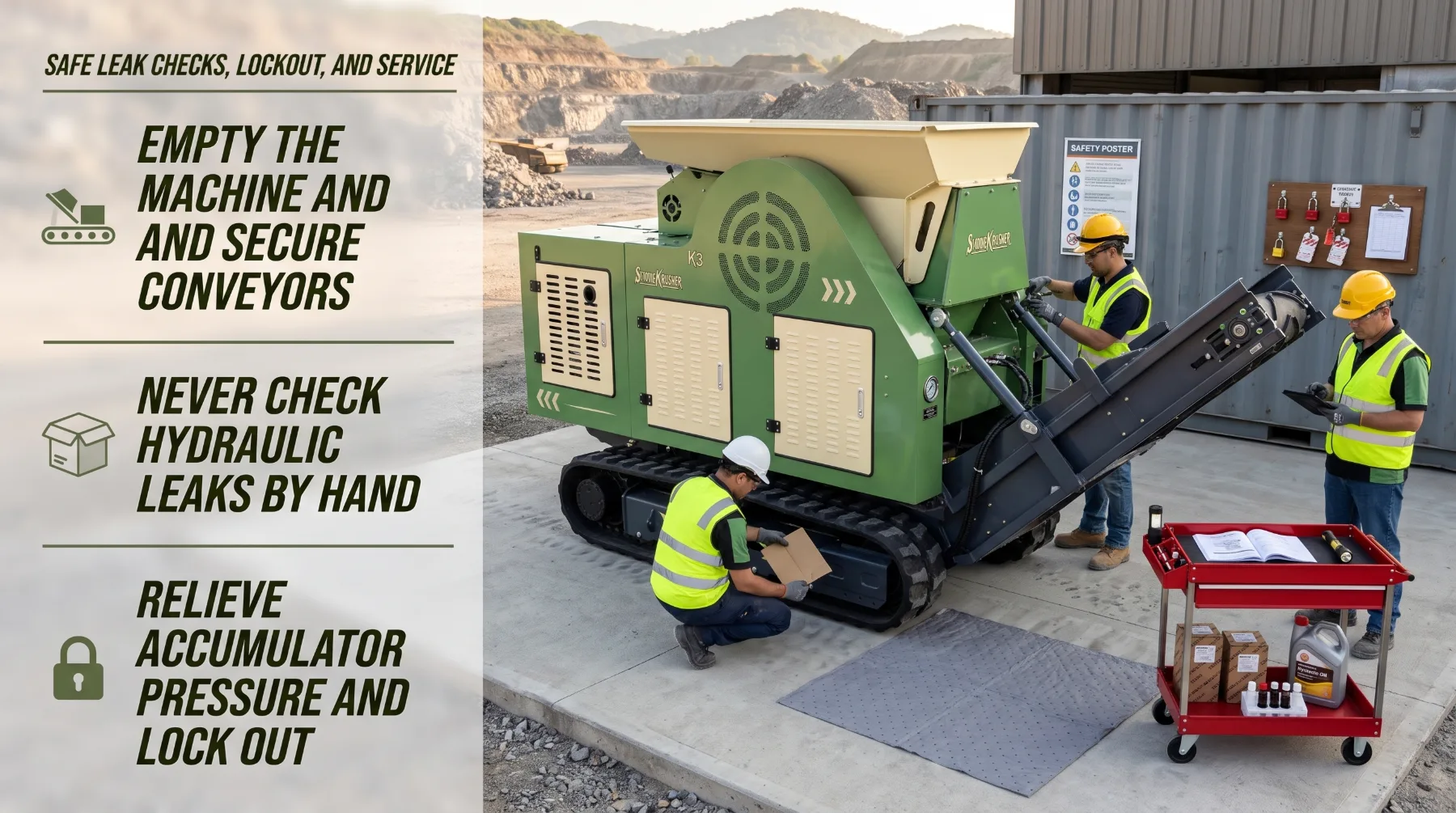
Never use your hand to search for a hydraulic leak. Fluid escaping through a pinhole under pressure can penetrate skin and cause an injection injury. The wound may look like a minor puncture at first, but it’s a medical emergency that requires immediate surgical treatment. Use a piece of cardboard or wood held near the suspected hose, fitting, or gland, wear gloves and eye protection, and keep your face and body out of line with the leak point. If anyone is struck by escaping hydraulic fluid, get emergency medical care at once and tell medical staff it’s a hydraulic injection injury.
Before any inspection beyond the visual walk-around, and before every repair, follow a complete lockout sequence. Stop feeding material and run the crusher and conveyors until they’re empty, following the shutdown sequence. Lower or fold conveyors and hopper wings to their resting positions, or secure raised components with the manufacturer’s approved mechanical supports. Shut down the engine or power unit and remove the key. Isolate electrical power at the main isolator where fitted. Relieve hydraulic pressure, including accumulator pressure in tramp release and setting circuits, as the manufacturer instructs. Apply your personal lock and tag according to your site’s lockout procedure. Allow hot oil and components to cool, then verify isolation before starting work.
Never work beneath a raised conveyor, hopper wing, or housing held only by hydraulics, and never rely on improvised blocking. Use the manufacturer’s transport locks, props, and support devices. Confirm that conveyors can’t roll back under the weight of material left on the belt. Leave pump, valve, accumulator, and relief pressure work to qualified technicians using the manufacturer’s procedures and specified parts. After any repair, check for leaks with cardboard and cycle each function slowly with the area clear before returning the crusher to production.
Key takeaway: Check leaks with cardboard or wood rather than your hands, and empty the machine, secure raised components, relieve all hydraulic and accumulator pressure, and lock out before every service task.
Conclusion
Hydraulic systems keep a mobile stone crusher productive by driving its conveyors, feeders, and tracks, positioning its components, adjusting the crusher setting, and protecting the chamber from overload. Pumps, valves, filters, cylinders, and motors work together, while pressure sets the force and flow sets the speed of every function. Careful preparation before startup, smooth control use, and correct shutdown sequences prevent much of the wear that leads to breakdowns. Clean oil, clean coolers, scheduled filter changes, and oil analysis protect the system’s most expensive components. Operators and maintenance teams who track performance changes, record symptoms, and rely on qualified diagnosis instead of pressure adjustments keep crushers running longer between repairs. Combined with disciplined safety practice, including cardboard leak checks, approved mechanical supports, and full lockout with accumulator pressure relieved, that approach delivers reliable production and protects every person working around the machine.
Frequently Asked Questions
Q: What does a hydraulic pump do in a stone crusher? The pump draws oil from the reservoir and supplies flow to the valves, which direct it to the cylinders and motors that power each function. Those functions include conveyors, feeders, track drives, folding cylinders, setting adjustment, and overload protection. Many crushers use several pumps serving separate circuits. Pump condition directly affects how fast and how strongly every hydraulic function performs.
Q: Does higher hydraulic pressure always improve crusher performance? No. Pressure must remain within the manufacturer’s specifications and match the design of the pump, valves, hoses, cylinders, and motors. Raising relief settings beyond those limits can burst hoses, overload components, and generate excess heat without improving crushing output. If a function feels weak, have a qualified technician measure pressure and flow to find the actual cause.
Q: Why do hydraulic components move slowly? Common causes include low oil level, restricted filters or suction lines, cold oil, a worn pump, and internal leakage in cylinders or motors. Slow movement can also result from a valve fault or an electrical control problem. Recording normal function behavior makes gradual slowdowns easier to spot and diagnose.
Q: How often should crusher hydraulic oil be changed? Follow the manufacturer’s service interval for your specific machine. Dusty conditions, high temperatures, and heavy continuous use may justify shorter intervals where the manual allows. Oil analysis helps confirm whether the oil remains clean and serviceable, and it can reveal contamination or component wear before visible problems appear.