V900 Skid Steer Ready for 5 Quick Coupler Attachments
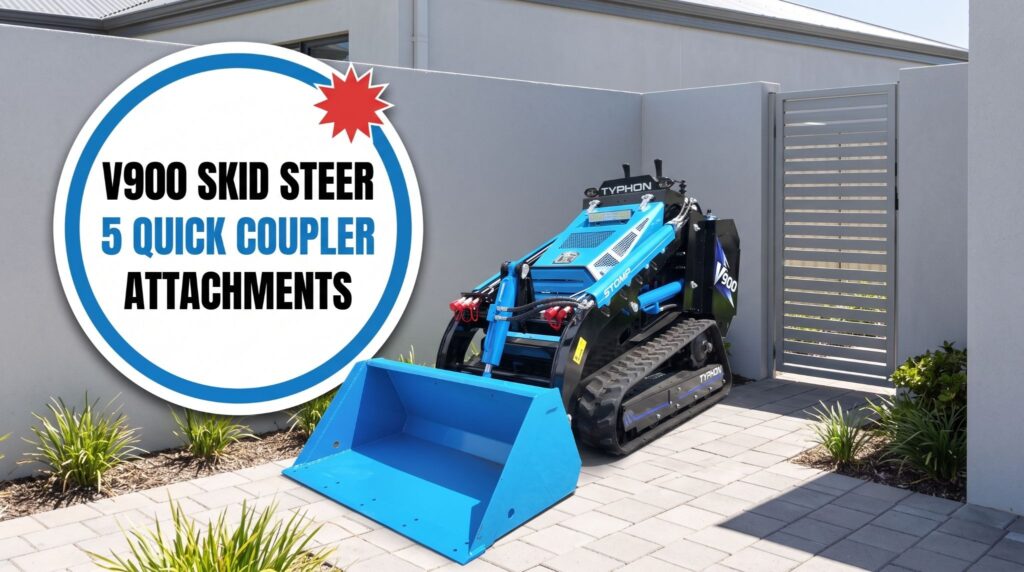
A landscaper buys a compact V900 to squeeze through a 36-inch gate that his full-size loader could never clear, figuring the little machine will mostly push dirt around tight backyards. Three jobs later he’s drilling deck footings with an auger, hauling brush with a grapple, and setting pallets of blocks with forks, all by clicking a different tool onto the same coupler in under a minute each. The machine that looked like a one-trick dirt mover turned into the busiest piece of iron in his fleet, and the only thing that changed was the attachment on the front. That realization is exactly why understanding what the V900 can run matters before you assume a compact machine is limited.
The V900 packs a 1,014 lb rated operating capacity and a universal quick-attach coupler into a frame just 35.9 inches wide, which means it clicks on the same family of tools that fit standard skid steers while still fitting where bigger machines can’t. Its three hydraulic valves also feed powered attachments that need flow, not just muscle. This guide walks through five quick coupler attachments the V900 handles well: the bucket, the auger, the grapple, the hydraulic breaker, and pallet forks. For each one, you’ll get what it does, where it shines on the job, and a clear takeaway. Here’s what to know before you pick a tool for the front.
Moving Material With the Standard Bucket
Buckets are the tool most V900 owners reach for first, and for good reason. Bolted onto the quick coupler, a general-purpose bucket scoops, carries, and dumps dirt, gravel, mulch, sand, and debris, covering the everyday material handling that fills most work days. The machine’s compact width lets it maneuver that bucket through gates and around obstacles where a larger loader would stall out.
Capacity shapes how you load it, so keep the 1,014 lb rating in mind on every scoop. Dense material like wet soil or gravel fills a bucket to that limit fast, while lighter loads like mulch or snow let you heap it fuller without straining the machine. Matching the material to the load keeps the V900 stable and spares the hydraulics unnecessary stress.
Bucket variations extend what the tool handles, too. A low-profile bucket improves your sightline to the cutting edge for grading, while a toothed bucket bites into harder ground that a smooth edge would skate across. Picking the right bucket style for the material in front of you turns a single attachment into several.
Key takeaway: The bucket is your bread-and-butter tool for moving loose material. Match the load to the V900’s 1,014 lb capacity, carry it low for stability, and choose the bucket style that fits what you’re actually digging.
Drilling Clean Holes With an Auger
Augers turn the V900 Mini Skid Steer into a precision hole-digger, and they run off the machine’s auxiliary hydraulics rather than its lifting power. Fitted with a rotating bit, an auger bores clean vertical holes for fence posts, deck footings, sign bases, and tree planting, swapping bit diameters to match whatever the job demands. Where hand-digging a single footing eats twenty sweaty minutes, the auger sinks it in seconds.
Hydraulic flow is what makes this tool work, so the V900’s three-valve setup earns its keep here. The auger’s motor needs steady flow to spin the bit through soil, and matching the bit size to the machine’s output keeps it turning smoothly instead of bogging down in dense ground. Starting a hole slowly and letting the bit pull itself down beats forcing it, which protects both the tool and the machine.
Ground conditions decide how the auger performs. Loose soil drills fast and clean, while rocky or heavy clay ground calls for a smaller bit and a patient touch, since a wide bit fighting hard material stalls quickly. Reading the ground before you drill saves you from being a bit buried and stuck.
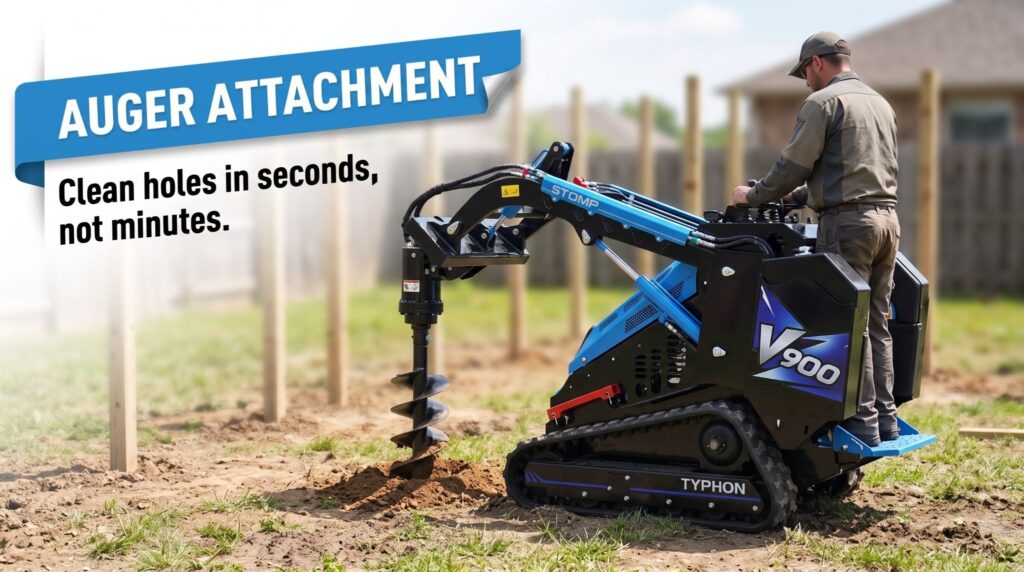
Key takeaway: An auger gives the V900 clean, repeatable holes for posts and footings. Match the bit size to your soil and the machine’s hydraulic flow, and let the bit dig at its own pace rather than forcing it.
Grabbing and Hauling With a Grapple
Grapples add a clamping arm that a plain bucket simply can’t match, and it changes what the V900 can pick up. Closing a hydraulic jaw over a load, a grapple grabs and hauls brush, logs, rocks, scrap, and demolition debris that would spill or roll right out of an open bucket. Land clearing, storm cleanup, and site demolition all move faster when the machine can actually hold irregular material.
Powered by the auxiliary hydraulics, the grapple’s jaw opens and closes on demand, letting the operator secure a load before lifting it. Keeping the grabbed material within the 1,014 lb capacity matters as much here as with any tool, since a tangled pile of wet brush or a dense log can hide more weight than it looks. Testing a questionable load by lifting slightly before hauling confirms the machine can carry it safely.
Grapple styles suit different work. A root grapple with spaced tines shakes dirt free while gripping brush and roots, while a solid closed grapple holds smaller debris and loose material that would fall through gaps. Choosing the grapple that fits your debris keeps material in the jaw instead of scattered across the site.
Key takeaway: A grapple lets the V900 grab and haul the awkward, loose material a bucket can’t hold. Stay within the capacity on dense loads, and pick the grapple style that matches the debris you’re clearing.
Breaking Concrete and Rock With a Hydraulic Hammer
Hydraulic breakers push the compact V900 into demolition work, turning it into a pint-sized wrecking tool. Mounted on the coupler and fed by the auxiliary hydraulics, a breaker pounds through concrete slabs, asphalt, rock, and old footings that no bucket or blade could touch. Small demolition jobs, curb removal, and hardscape teardowns that once meant a jackhammer and sore arms now belong to the machine.
Flow and pressure drive the hammer, so confirm the breaker suits the V900’s hydraulic output before you run it. A breaker sized to the machine strikes with steady, effective blows, while an oversized unit starved for flow just chatters without breaking through. Matching the tool to the machine keeps every strike doing real work.
Technique protects both the breaker and the operator on this one. Positioning the point near an edge rather than the center of a slab lets the concrete break away in manageable pieces, and moving the hammer to fresh spots instead of pounding one location keeps the tool from overheating. Working methodically across a slab breaks it up faster than hammering a single stubborn point.
Key takeaway: A hydraulic breaker gives the V900 real demolition muscle for concrete, rock, and asphalt. Match the hammer to the machine’s hydraulic flow, and break from the edges in steady, moving strikes rather than pounding one spot.
Lifting Pallets and Loads With Forks
Pallet forks transform the V900 into a rough-terrain forklift, which opens up material handling no bucket can manage. Slotting onto the quick coupler, two forks lift and carry palletized loads like block, brick, bagged concrete, sod, and lumber around a site where a warehouse forklift would sink or stall. Delivering material right to the work area saves the crew from carrying it by hand across rough ground.
Capacity governs fork work more strictly than most tools, so respect the 1,014 lb rating closely. A load’s weight rides out front on the forks, which shifts the machine’s balance forward and stresses the front axle, so staying within the rating keeps the V900 planted and safe. Carrying the load low and tilted back slightly holds it secure and preserves stability as you travel.
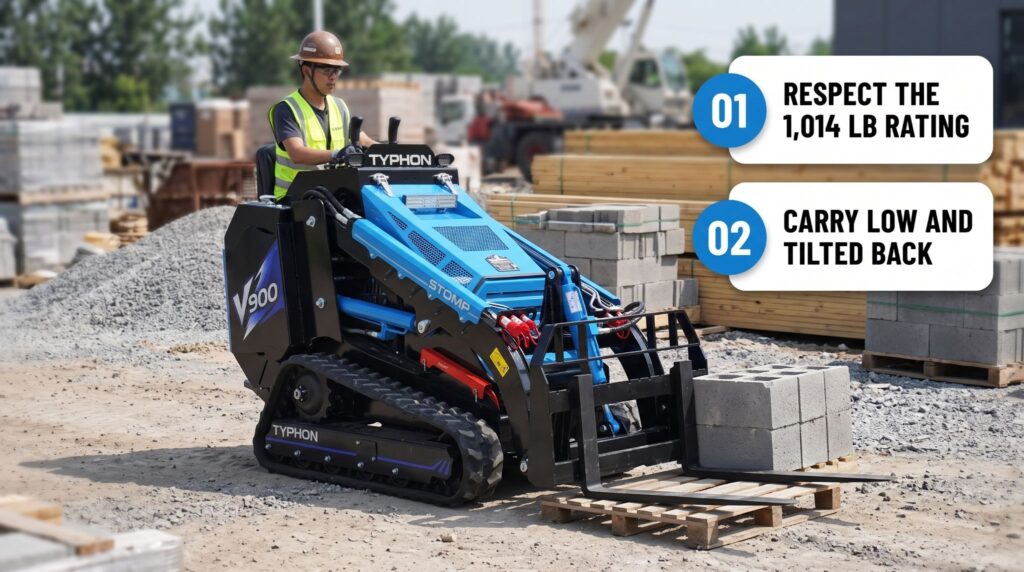
Load placement decides how safely forks handle. Centering the load across both forks, seating it fully against the backrest, and confirming the pallet is sound before lifting all prevent a load from shifting or sliding off mid-move. Approaching a stack squarely and lifting straight up keeps the forks and the load aligned the way they should be.
Key takeaway: Pallet forks turn the V900 into a jobsite lift truck for palletized material. Keep loads within the 1,014 lb capacity, carry them low and tilted back, and center every load fully on the forks before you move.
Conclusion
The V900 earns its keep through the tools you hang on its universal quick coupler, and five attachments cover most of the work a compact machine faces. A bucket moves loose material, an auger drills clean holes for posts and footings, a grapple grabs and hauls the awkward debris a bucket can’t hold, a hydraulic breaker tackles concrete and rock demolition, and pallet forks turn the machine into a rough-terrain lift truck. Across all five, two things stay constant: respect the 1,014 lb rated operating capacity on every load, and match any powered tool to the machine’s hydraulic flow so it performs the way it should. Read the job, pick the tool that fits it, and click it on in under a minute. Choose your attachments well, and this compact machine handles work that would otherwise take a fleet. When you’re ready to put a dependable V900 and the right attachments to work, reach out to a trusted equipment specialist who can pair a reliable machine with the results your projects depend on.
Frequently Asked Questions
What attachments can a V900 skid steer run?
The V900 uses a universal quick-attach coupler, so it runs the same family of tools that fit standard skid steers, including buckets, augers, grapples, hydraulic breakers, and pallet forks. Its three hydraulic valves also feed powered attachments that need flow, like augers and breakers. With a 1,014 lb rated operating capacity and a compact 35.9-inch width, it handles a wide range of tools while still fitting through tight gates and spaces.
How much can a V900 skid steer lift?
The V900 has a rated operating capacity of 1,014 lb, which is the maximum load it handles safely under normal conditions. Actual safe handling depends on the attachment, how the load sits, the terrain, and the operating conditions, so keep every load within that rating and carry it low for stability. Fork work especially calls for respecting the limit, since a load out front shifts the machine’s balance forward.
Do V900 attachments need hydraulic flow to work?
Some do. Simple tools like buckets and pallet forks rely only on the machine’s lifting power, so they don’t need auxiliary hydraulics. Powered attachments like augers, grapples, and hydraulic breakers run off the V900’s hydraulic valves and need adequate flow to perform. Match each powered tool to the machine’s hydraulic output before you run it, since a tool starved for flow won’t do the job the way it should.