Road Roller Weight Distribution Across the Compaction Drum
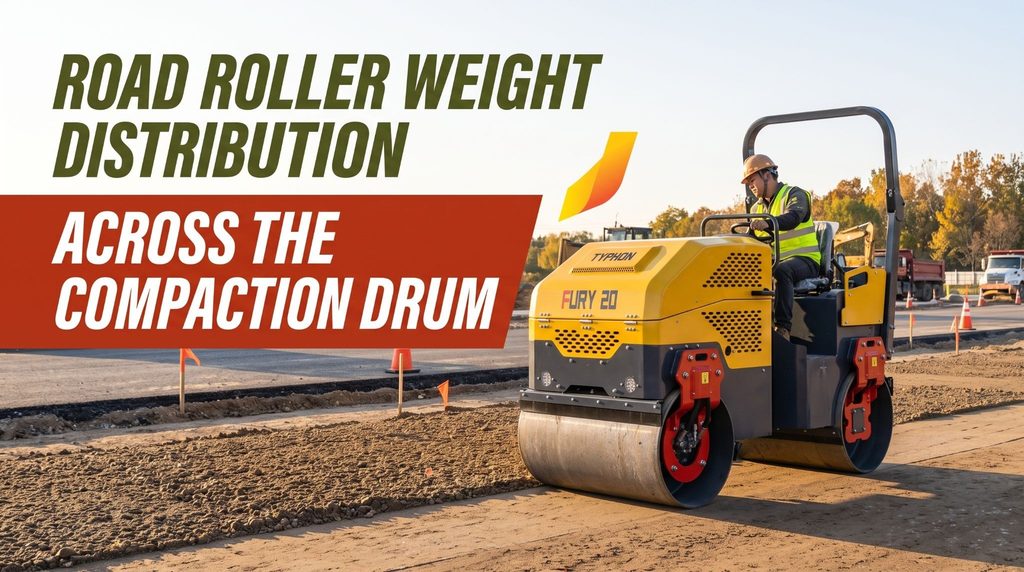
A road roller places substantial weight over the material that needs greater density, but machine mass alone does not determine compaction performance. A heavy roller that distributes its load poorly can leave uneven density, while a balanced design transfers force more effectively through the drum. The important factor is how the machine’s weight reaches the contact surface, how that load is distributed across the drum, and how efficiently the resulting force works into the material below.
Proper weight distribution gives the operator better control over how force reaches the mat during each pass. Drum load influences the pressure applied to the surface, while front-to-rear balance affects how consistently the machine contacts the material. Static weight provides the initial downward force, and vibration can add dynamic energy that helps drive compaction deeper into the lift. Together, these factors determine how effectively each pass contributes to the target density.
Different materials respond differently to the force delivered by a roller. Asphalt, granular base, and other surfaces can require different combinations of static loading, vibration, speed, and drum contact to achieve consistent density. Maintaining an even load across the machine and keeping steady drum contact helps prevent variations between passes. Matching the roller’s operating setup to the material and lift thickness then allows the available weight and vibration to produce more uniform results.
How Machine Weight Reaches the Drum
A road roller’s operating weight does not act on the material as a single lump; part of it is carried through the compaction drum and transferred directly into the surface below. The drum is the point of contact, so the share of the machine’s mass resting on it determines how much static force reaches the material on each pass. That share depends on the machine’s design and how its weight is distributed between the drum and the rest of the chassis.
This is what compaction professionals call static loading, and it is the continuous downward force the drum exerts simply by bearing weight. On a vibratory roller, this static load works alongside the dynamic energy from the vibratory system, with the two combining to drive density into the material. But the foundation is always the weight the drum carries. A machine engineered to place a substantial, controlled portion of its mass on the drum delivers that static force reliably, pass after pass, which is exactly what dependable compaction depends on.
Key takeaway: The weight carried through the compaction drum creates the static loading that drives force into the material, and how much reaches the drum depends on the machine’s design and weight distribution.
Drum Load and Ground Contact
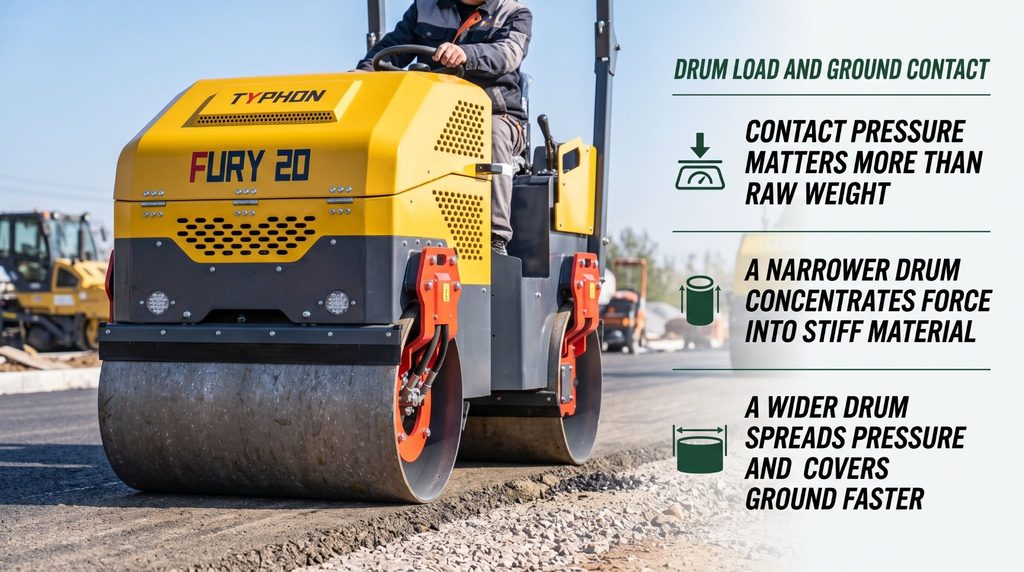
Weight matters only in relation to the area it acts on, which is why contact pressure, not raw load, tells the real story. The same drum weight spread across a small contact patch produces high pressure, while that weight distributed over a wider contact area produces lower pressure across more material. Understanding this relationship is what lets an operator predict how a given roller will behave on a given surface.
Drum dimensions and machine configuration therefore shape every pass. A narrower drum concentrates the load and can generate greater contact pressure, useful where you need to drive force into a stiff material. A wider drum spreads that same weight across more surfaces, applying gentler pressure over a larger footprint and covering ground faster. Neither is universally better; the right choice depends on the material and the density target. What stays constant is the principle: to know how a roller will perform, you have to weigh the drum load against the contact area, not just read the weight figure.
Key takeaway: Contact pressure comes from drum load divided across the contact area, so drum width and dimensions determine whether the machine applies concentrated or distributed force.
Front and Rear Weight Balance
Many rollers carry their weight on more than one contact point, whether through dual drums or a drum paired with a rear axle on tires. On these machines, the operating weight is divided between the front and rear, and how it splits affects how the roller performs across its length. Balanced loading helps the machine maintain steady, consistent contact with the material as it travels, so each contact point does its intended share of the work.
When distribution goes uneven, the loading characteristics change between the front and rear sections, and compaction can become inconsistent as a result. A machine carrying too much weight forward or aft applies different pressure at each point, which can leave density that varies within a single pass. This is why balance is a design consideration and an operating one. Keeping the machine loaded as intended, without unnecessary added weight shifting the balance, helps the roller deliver even force from front to back and produce uniform results across the working area.
Key takeaway: On multi-drum or drum-and-axle machines, balanced front-to-rear loading keeps contact consistent, while uneven distribution changes pressure between sections and can produce variable density.
Static Weight Versus Vibration
Static weight and vibration are two different forces that work together during compaction. Static weight creates a continuous downward force through the drum, while vibration adds dynamic energy through rapid drum movement. On a vibratory roller, both forces reach the material through the drum, but each contributes differently to the compaction process.
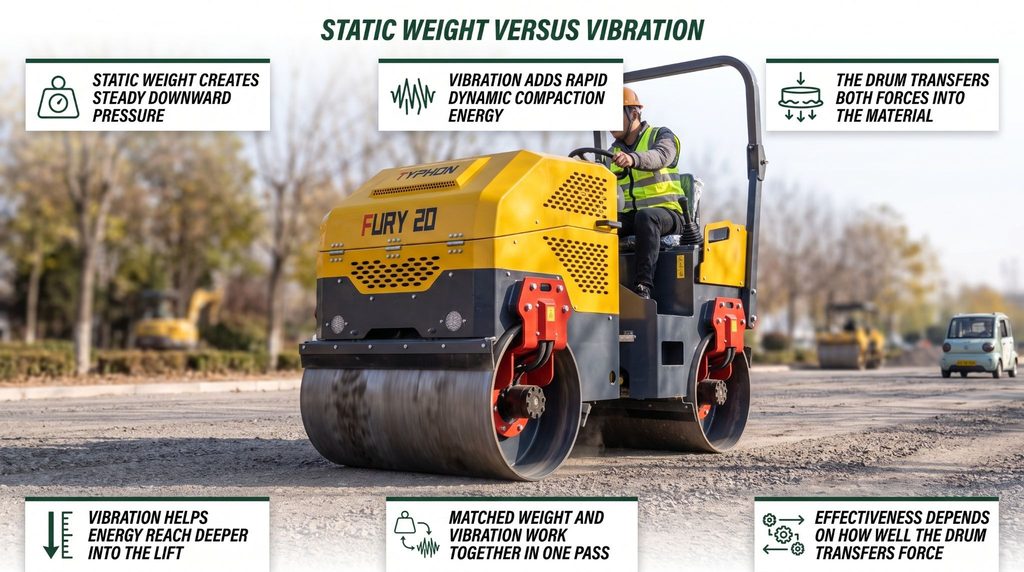
- Static weight: The machine’s operating weight creates steady downward pressure through the drum, helping press the material together under the roller’s mass.
- Vibratory force: The vibration system adds rapid dynamic movement that sends additional compaction energy into the material beyond the force created by static weight alone.
- Drum transfer: The drum is the main contact point between the roller and the surface, transferring both the machine’s static load and the vibration into the material.
- Compaction depth: Static weight establishes the baseline force, while vibration can help transmit additional energy deeper into the material during repeated passes.
- Combined effect: A properly matched drum weight and vibratory system allow the roller to apply both steady pressure and dynamic energy during the same pass.
- Machine-to-material connection: The effectiveness of compaction depends on how efficiently the roller transfers its weight and vibration through the drum into the material being compacted.
Key takeaway: Static weight supplies continuous downward force while vibration adds dynamic energy, and both reach the material through the drum, so the machine’s weight transfer shapes how well the vibratory system performs.
Material Type Changes the Result
No single combination of weight and vibration suits every material, because asphalt, granular base, and soil each respond to drum loading in their own way. Fresh asphalt calls for careful control of weight and vibration to reach density without displacing or marking the mat. A granular base often accepts firmer treatment. Soil can behave differently again, depending on its type and moisture. Reading the material is the first step toward setting the machine correctly.
Because of these differences, the right approach means matching machine weight, vibration, drum configuration, and operating speed to the material in front of you. The combination that compacts a base layer efficiently may be wrong for a finish course of asphalt, and treating every surface the same wastes passes or risks damaging the work. When you tune weight distribution and force to how the material actually responds, you reach the required density with fewer passes and a cleaner result. That efficiency, achieving the target without overworking the surface, is where matching equipment to material pays off directly.
Key takeaway: Asphalt, base, and soil respond differently to drum load and vibration, so matching the roller’s weight, force, drum setup, and speed to the material achieves density without excessive passes.
Maintaining Consistent Drum Contact
Even the best-matched roller only performs when it contacts the ground evenly, and several conditions influence that contact. Tire condition on machines with a rear axle, the condition and alignment of the drum itself, the articulation joint that lets the machine steer and follow the surface, and the machine’s overall balance all affect how uniformly the drum meets the material. A problem in any of these can create uneven contact and inconsistent density behind the machine.
Surface preparation and operating habits carry just as much weight. A well-prepared, even surface allows the drum to contact the material consistently, while a poorly graded one leaves gaps and high spots that disrupt loading. Proper maintenance keeps the drum aligned and functioning as intended, so it applies force the way the design intends. Consistent travel speed matters too, since steady movement supports uniform compaction across the working area, while constant speed changes vary how force is applied. Keeping the machine maintained and the technique steady is what turns good weight distribution into reliable results on the ground.
Key takeaway: Tire and drum condition, articulation, surface preparation, machine balance, and steady travel speed all shape how evenly the drum contacts the material, so maintenance and consistent technique protect uniform compaction.
Conclusion
Road roller weight distribution determines how effectively machine mass is transferred through the drum to the material during compaction. The portion of operating weight supported by the drum establishes static drum loading, while drum width and contact area influence how that load is distributed across the surface. Balanced front-to-rear loading helps maintain consistent contact and force distribution, whereas uneven loading can produce variations in compaction across the drum path. Static loading provides the baseline compactive force, while vibration adds dynamic excitation that increases the energy transmitted into suitable soil, aggregate, or asphalt. Actual compaction performance also depends on material properties, layer thickness, moisture or temperature, drum configuration, travel speed, and machine condition. Drum and tire condition, articulation, and weight distribution should therefore be maintained to preserve consistent contact throughout each pass. Roller selection should consider operating weight, drum load, drum width, static linear load, vibration frequency and amplitude, material type, and required density rather than relying on total machine weight alone. Matching these factors to the material and maintaining a consistent travel speed helps produce more uniform density while reducing unnecessary passes and uneven compaction.
Frequently Asked Questions
Why is weight distribution important on a road roller?
Weight distribution determines how much operating weight is transferred through the drum and into the material. A heavier roller does not always compact better because the way weight reaches the surface also matters. Proper distribution helps maintain consistent contact pressure and more uniform density across the compacted layer.
Does drum width affect weight distribution?
Yes. Drum width changes how the drum load is spread across the contact area. A narrower drum concentrates weight over a smaller area, creating higher contact pressure, while a wider drum spreads the load across more surfaces. The suitable width depends on the material and required compaction, so roller weight alone does not determine performance.
What is the difference between static weight and vibration?
Static weight provides continuous downward pressure through the drum, while vibration creates rapid dynamic forces that transfer energy deeper into the material. Vibratory rollers use both forces together, with static loading providing the base and vibration increasing compaction efficiency. Neither completely replaces the other.
Does material type affect the required roller weight?
Yes. Asphalt, soil, and granular materials respond differently to weight, vibration, contact pressure, and moisture. Fresh asphalt may require controlled weight and vibration, while granular base and soil can need different force levels and operating techniques. Matching roller weight, vibration, drum type, and speed to the material helps achieve the target density efficiently.