Rough Terrain Scissor Lift vs All-Terrain Forklift: Outdoor Job Showdown
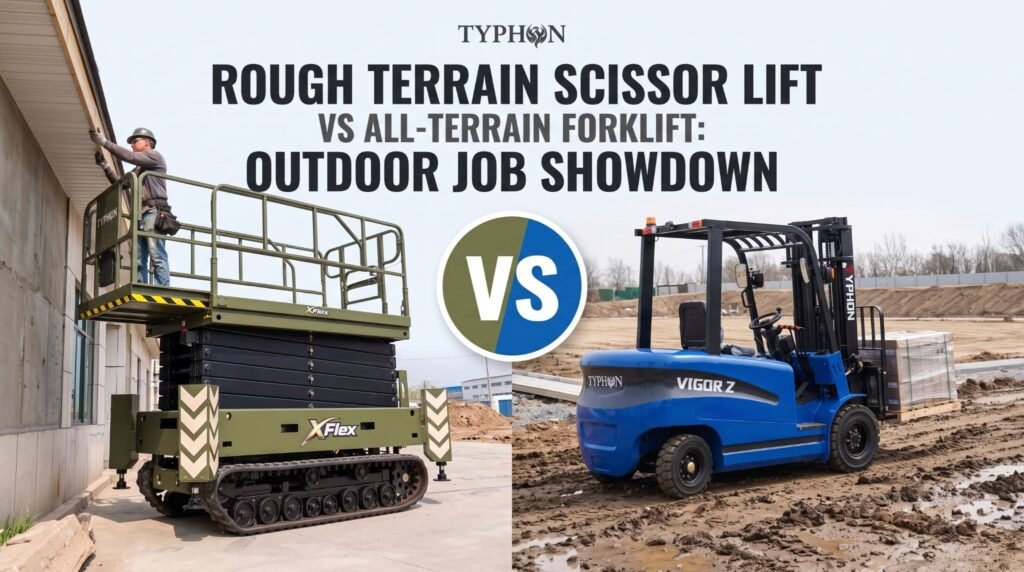
A crew rolls onto a half-graded commercial site to finish exterior work on a new building. One worker needs to reach up and install soffit and fascia along a wall, standing at height with tools and material spread around him. Another has a truck full of palletized siding that needs to move across a muddy lot and lift up to the second floor. The rough terrain scissor lift handles the wall work with ease but sits useless when the pallets show up. The all-terrain forklift moves and lifts the load fast but gives the soffit crew nowhere stable to stand and work. Neither machine failed. They were simply built for two different halves of the same job.
The choice between a rough terrain scissor lift vs all-terrain forklift comes down to whether the job needs a stable platform for workers or muscle to move and place heavy loads. A rough terrain scissor lift raises a crew and their tools straight up on a wide, stable platform, built tough enough to work on dirt and uneven ground. An all-terrain forklift carries heavy palletized loads across rough sites and lifts them to height. Both belong to outdoor jobs, but they solve different problems, and picking wrong costs you time, rental fees, and a stalled crew. Here is how they stack up and when each one earns its spot.
The biggest mistake is judging these machines by size or lifting height alone. A jobsite can have the same building, the same materials, and the same deadline, yet require completely different equipment depending on the task happening that day. If the priority is keeping workers safe and productive while performing overhead work, the platform design of a rough terrain scissor lift becomes the advantage. If the priority is unloading, transporting, and placing heavy materials, the carrying power and reach of an all-terrain forklift takes over. Understanding the difference before the project starts helps crews avoid downtime and choose the equipment that keeps the work moving.
The Core Difference in Plain Terms
Strip away the specs and the split is simple. A rough terrain scissor lift is a vertical work platform. It lifts people and their gear straight up so they can work at height on walls, ceilings, signs, and structures. Rugged tires, higher ground clearance, and a wider base let it operate outdoors on dirt, gravel, and uneven lots that would stop a standard indoor scissor lift cold. What it does not do is move loads across a site or lift heavy material on forks.
An all-terrain forklift is a material mover built for rough ground. Its forks slide under a pallet, lift it, and carry it across a graded lot or up to height. Big tires, four-wheel drive, and strong ground clearance let it roll through mud and over uneven terrain that a standard warehouse forklift could never cross. What it does not do well is give a crew a stable, roomy place to stand and work overhead.
Here’s the key idea: one raises workers, the other hauls and places loads. When you know which task drives your outdoor job, the right machine usually picks itself. If your crews swing between both kinds of work, understanding your typical matters more than any single spec.
Comparing What Matters Most
The best choice comes down to the work your site actually demands and the challenges your crew faces most often. A rough terrain scissor lift and an all-terrain forklift may both handle outdoor jobs, but they are built for different purposes. One focuses on safe access for workers, while the other focuses on moving and lifting heavy materials. Here is how the two compare across the factors that decide the job.
Outdoor Terrain Handling
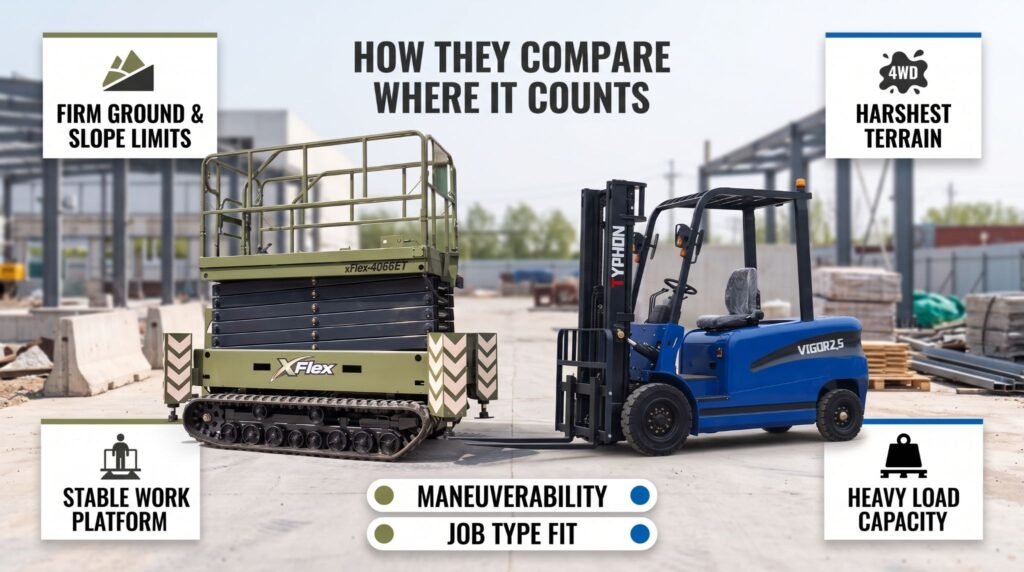
Both machines are built for rough ground, so the split is subtler here. A rough terrain scissor lift crosses dirt, gravel, and uneven lots and raises its platform on surfaces a standard lift can’t touch. Still, it wants ground that is reasonably firm and within its slope rating before you elevate, since raising a platform on soft or steeply pitched ground gets risky fast.
An all-terrain forklift usually handles the harshest ground of the two. Four-wheel drive, high clearance, and big tires let it plow through mud, ruts, and loose fill while carrying a load. When the site is genuinely rough and the work is about moving material across it, the forklift holds the edge. Following manufacturer guidance on slope limits and ground conditions keeps either machine safe as the terrain changes.
Load Capacity and What You’re Lifting
This is where the two split the clearest. An all-terrain forklift is built to lift heavy palletized and bundled loads, measured by how much weight it carries on the forks and how high it raises it. If your job involves staging deliveries, feeding a build with material, or lifting pallets to an upper floor, the forklift is the tool.
A rough terrain scissor lift carries people plus their tools and light material, straight up and nothing more. Its capacity is measured by platform weight, and while a wide deck holds a full crew and their gear, it was never designed to move heavy loads across a site. Match the machine to the weight and the task, and the choice is usually obvious the moment you look at the job.
Platform vs. Forks
The heart of the comparison is what sits at the top. A scissor lift gives you a large, flat, guarded platform where workers stand, spread out tools, and work with both hands at height. For exterior finishing, siding, painting, sign work, and maintenance, that stable deck beats anything a forklift can offer.
A forklift gives you forks, built to lift and place loads, not people. With the right approved attachment it can handle specialized lifting, but it does not replace a work platform for crews building or finishing at height. If the job is about workers up high, the scissor lift wins. If it’s about material up high, the forklift wins.
Maneuverability
A rough terrain scissor lift moves in tight, predictable patterns and holds a steady footprint once raised. It fits well against walls and structures where a crew needs to work close to the surface. The trade is range, since it travels slowly and stays put once elevated.
An all-terrain forklift covers ground fast, turns for a machine its size, and carries loads across a wide site without much trouble. On tight exterior work right against a building, though, its size and turning needs become a liability. Match the maneuverability to the space and the task your site demands.
Cost and Rental Flexibility
Cost tracks capability, and rental flexibility often decides it. Rough terrain scissor lifts generally rent for less by the day and suit stretches of exterior at-height work. All-terrain forklifts cost more but carry heavy loads across rough ground, so you pay for muscle you may not always need.
Here’s the objection worth naming: buying either machine for a single phase ties up cash you could keep working. For crews whose needs shift by the job, renting the right unit per phase usually beats owning one machine that only half fits. Weighing against your real workload keeps that spend lean, and following a steady maintenance routine protects either machine while safe operating practices protect the whole crew on site.
Matching the Machine to Your Work
Match the machine to the outdoor work you do most, not the widest range you can imagine.
Choose a rough terrain scissor lift if your work leans on exterior tasks at height, siding, soffit and fascia, painting, sign installation, and building maintenance on firm, reasonably level outdoor ground. The wide, stable platform, clean vertical lift, and lower rental cost make it the smarter pick when crews work up rather than across, and when the job is about giving workers a solid place to stand.
Choose an all-terrain forklift if your work involves moving heavy material across a rough site, unloading trucks, staging deliveries, or lifting pallets to an upper floor. Its four-wheel drive, high clearance, and lift capacity make it the machine when the ground is harsh and the job is about getting heavy loads where they need to go.
Still unsure? Many crews rent both across a job, running a scissor lift for the at-height exterior phases and a forklift for the material moves. Pairing the right machine with the right task keeps you from paying for capability you don’t need on a given day.
Conclusion
Both machines earn their place outdoors, so the choice comes down to what your site actually asks. A rough terrain scissor lift raises workers and light material straight up on a wide, stable platform, making it the pick for exterior finishing, siding, and maintenance where crews need a solid place to stand at height. An all-terrain forklift moves and lifts heavy loads across rough, muddy ground, which makes it the tool when the job is about getting material where it needs to go. Terrain handling, load needs, platform versus forks, and maneuverability decide the winner far more than price alone. For crews whose work spans both, renting the right machine per phase usually beats owning one that only half fits. Match the machine to the job in front of you, weigh the spec sheets and cost against your real work, and when you are ready to line up dependable equipment, reach out to a trusted equipment specialist who can pair reliable machines with the results your projects depend on.
Frequently Asked Questions
What is the main difference between a rough terrain scissor lift and an all-terrain forklift?
A rough terrain scissor lift raises workers and their tools straight up on a stable platform, while an all-terrain forklift lifts and carries heavy palletized loads across rough ground.
Can an all-terrain forklift lift people like a scissor lift?
Not the same way. A forklift is built to lift material, not people, so for crews working at height a scissor lift’s guarded platform is the safer, better fit.
Which machine handles rough, muddy ground better?
An all-terrain forklift usually handles the harshest ground thanks to four-wheel drive and high clearance, though a rough terrain scissor lift still works well on firm, reasonably level outdoor sites.