
How to Choose the Right Trencher for Your Job Site
In the world of construction, landscaping, and utility installation, digging trenches is a fundamental and often labor-intensive task. Whether you’re laying irrigation pipes for a new garden, installing electrical conduits for a commercial building, or burying fiber optic cables across a vast property, the efficiency and precision of your trenching operation can significantly impact the success and profitability of your project. Manual digging is slow, physically demanding, and prone to inconsistencies, making it impractical for most modern job sites. This is where trenchers come into play – specialized machines designed to cut narrow, deep channels in the ground quickly and effectively.
However, the term “trencher” encompasses a wide range of equipment, from compact walk-behind models suitable for small residential jobs to massive, ride-on machines capable of carving through rock for large-scale infrastructure projects. Choosing the right trencher isn’t just about picking the biggest or cheapest option; it’s about making an informed decision that aligns perfectly with the specific demands of your job site, your budget, and your operational capabilities. A mismatch can lead to wasted time, increased costs, project delays, and even safety hazards. This comprehensive guide is designed to demystify the process, providing you with the knowledge and actionable insights needed to confidently select the ideal trencher for your next project, ensuring efficiency, safety, and a successful outcome.
What is How to Choose the Right Trencher for Your Job Site?
At its core, the process of selecting the right trencher involves a deep dive into several critical factors. Firstly, you must accurately define the scope of your trenching needs: how long, how deep, and how wide does the trench need to be? What type of material will you be digging through – soft soil, clay, gravel, or even solid rock? These parameters immediately narrow down the field of potential machines. For instance, a small walk-behind trencher is perfectly adequate for a 50-foot irrigation line in soft soil, but it would be utterly useless for a 1,000-foot utility trench through compacted earth and small stones.
Secondly, you need to consider the site conditions. Is the job site easily accessible? Are there tight spaces, existing structures, or sensitive landscaping that require a compact machine with precise maneuverability? Or is it an open field where a larger, more powerful trencher can operate without constraints? The terrain itself also plays a role; slopes, uneven ground, and wet conditions might necessitate track-mounted trenchers for better stability and traction, as opposed to wheeled models.
Thirdly, the operational aspects are paramount. Who will be operating the machine? Do they have the necessary experience and certifications for larger, more complex equipment? What are your labor resources like? A walk-behind trencher might be operated by a single individual, while a ride-on trencher often requires more skilled operators and potentially additional ground crew for support. Furthermore, consider the logistics of transport. Can you easily move the chosen trencher to and from the job site, or will it require specialized hauling equipment?
Finally, the financial implications are always a significant consideration. This isn’t just about the purchase price or rental cost but also includes fuel consumption, maintenance requirements, potential repair costs, and the overall return on investment (ROI) in terms of project speed and labor savings. A more expensive, powerful machine might seem like an overspend initially, but if it significantly reduces project time and labor hours, it could be the more economical choice in the long run. Conversely, renting a specialized trencher for a one-off project might be more cost-effective than purchasing one you’ll rarely use.
By systematically addressing these questions, you transition from a broad understanding of “trenchers” to a focused selection process, ensuring that the machine you choose is not just capable, but optimally suited for your specific job site, maximizing efficiency, safety, and cost-effectiveness. This comprehensive approach is what “How to Choose the Right Trencher for Your Job Site” truly entails.
Key Benefits
Selecting the appropriate trencher for your job site offers a multitude of benefits that extend far beyond simply digging a hole. It’s a strategic decision that impacts project timelines, budget, safety, and the overall quality of work. Understanding these key advantages can underscore the importance of a thorough selection process.
One of the most immediate and significant benefits is enhanced efficiency and productivity. The right trencher can complete tasks in a fraction of the time it would take with manual labor or an ill-suited machine. Imagine a project requiring 500 feet of trench for an electrical line. With shovels, this could take days, involve multiple workers, and result in inconsistent trench depth. A suitable walk-behind or compact ride-on trencher could complete the same task in a few hours with one operator, freeing up labor for other critical tasks. For larger projects, a powerful chain trencher can cut miles of trench in a day, a feat impossible without the right machinery. This speed directly translates into faster project completion, allowing you to move on to the next job sooner and potentially take on more contracts.
Secondly, choosing the correct trencher leads to significant cost savings. While the initial investment or rental cost might seem substantial, these machines drastically reduce labor hours, which is often the largest expense on a construction project. Less time spent digging means fewer wages paid. Furthermore, an efficient trencher minimizes rework. A machine designed for the specific soil type and trench dimensions will create a clean, consistent trench, reducing the need for manual adjustments or re-digging. It also optimizes fuel consumption; a trencher operating within its ideal capacity will use fuel more efficiently than one that is undersized and struggling or oversized and underutilized. For example, using a compact trencher for a small job avoids the higher fuel costs and transportation logistics associated with a large, heavy-duty model.
Thirdly, improved safety is a paramount benefit. Manual trenching is inherently dangerous, exposing workers to strain injuries, collapses, and fatigue. Trenchers, when operated correctly, remove workers from the immediate danger zone of digging. Moreover, a machine that is appropriate for the terrain and task is less likely to encounter operational issues, breakdowns, or instability, all of which can lead to accidents. For instance, a track-mounted trencher on uneven or soft ground provides far greater stability than a wheeled model, reducing the risk of tipping or getting stuck. Proper selection ensures the machine can handle the workload without being pushed beyond its limits, which is a common cause of equipment failure and accidents.
Fourth, the right trencher ensures superior trench quality and consistency. Modern trenchers are designed to dig precise, uniform trenches in terms of depth, width, and straightness. This consistency is vital for proper pipe laying, cable installation, and drainage. An uneven trench can lead to issues like improper water flow, damaged utilities, or structural instability. For example, a micro-trencher creates a very narrow, shallow cut perfect for fiber optics, minimizing disruption to existing surfaces and ensuring a clean, precise channel for delicate cables. This precision reduces the need for backfilling and compaction, saving time and materials.
Finally, proper trencher selection contributes to reduced environmental impact and site disruption. By using a machine precisely suited for the job, you minimize the overall footprint of the operation. Narrower trenches mean less excavated soil to manage and dispose of, and less surface area disturbed. This is particularly important in urban environments or sensitive landscapes where preserving existing infrastructure and aesthetics is crucial. A compact trencher, for instance, can navigate tight spaces and minimize damage to surrounding vegetation or paved areas, which a larger machine could not.
In essence, the decision to invest time and effort into choosing the right trencher pays dividends across every aspect of a project, transforming a potentially arduous task into an efficient, safe, and cost-effective operation.

How to Get Started
1. Define Your Project’s Trenching Requirements
The first and most critical step is to clearly articulate what your project demands from a trencher. This involves several key dimensions:
- Trench Depth: How deep does your trench need to be? This is perhaps the most significant factor. Are you burying shallow irrigation lines (6-12 inches), standard utility lines (2-4 feet), or deep sewer pipes (5 feet or more)? Trencher capabilities vary widely, from mini-trenchers digging a few inches to large chain trenchers reaching depths of 10 feet or more.
- Trench Width: What is the required width of the trench? This depends on the size of the pipes or cables you’re laying and the amount of bedding material needed. Trencher chains and blades come in various widths, typically ranging from 2 to 18 inches. A micro-trencher might cut a 1-inch slot, while a rock saw can create a 12-inch wide trench.
- Total Length of Trench: How many linear feet or meters of trench do you need to dig? A small, walk-behind trencher might be suitable for a few hundred feet, but for thousands of feet, a ride-on or even a tractor-mounted trencher becomes essential for efficiency.
- Material to be Trenched: This is a game-changer. Are you dealing with:
- Soft Soil/Sand: Most trenchers can handle this.
- Clay/Compacted Earth: Requires more power and robust teeth.
- Gravel/Small Rocks: Demands heavy-duty chains and possibly carbide-tipped teeth.
- Asphalt/Concrete/Solid Rock: This necessitates specialized trenchers like rock saws or wheel trenchers with carbide-tipped bits, which can cut through extremely hard surfaces.
- Obstacles: Will you encounter roots, existing pipes, or other underground utilities? Some trenchers are better equipped to handle roots (e.g., chain trenchers with specific tooth configurations), while others might get bogged down. Understanding potential obstacles helps in choosing a trencher that won’t constantly jam or break down.
2. Assess Your Job Site Conditions
Beyond the trench itself, the environment in which the trencher will operate plays a vital role in selection:
- Accessibility and Space Constraints: Is the job site open and spacious, or are there tight corners, narrow gates, existing landscaping, or buildings to navigate? Walk-behind trenchers and compact ride-on models excel in confined spaces, while larger machines require ample room to maneuver.
- Terrain and Slope: Is the ground flat, or are there significant slopes? Wheeled trenchers perform best on relatively flat, stable ground. For uneven, soft, or sloped terrain, track-mounted trenchers offer superior traction, stability, and flotation, reducing the risk of getting stuck or tipping.
- Ground Conditions (Surface): Is the surface paved (asphalt, concrete) or unpaved (grass, dirt)? If you need to cut through pavement, a rock wheel trencher or a micro-trencher with a specialized cutting wheel is necessary. For unpaved surfaces, a chain trencher is typically the go-to.
- Existing Infrastructure: Are there overhead power lines, underground utilities (that you know of!), or other structures that could interfere with the trencher’s operation or require specific safety precautions? This might influence the height of the machine or necessitate careful planning of trenching paths.
3. Consider Your Operational Resources
The human and logistical elements are just as important as the machine’s specifications:
- Operator Skill and Experience: Do you have operators trained and experienced in using specific types of trenchers? Larger, more complex ride-on trenchers require skilled operators, while walk-behind models are generally easier for less experienced personnel to manage.
- Labor Availability: How many people do you have on your crew? A walk-behind trencher might be a one-person job, but a larger trencher often requires additional ground crew for spotting, managing spoil, and backfilling.
- Transportation and Logistics: How will you get the trencher to and from the job site? Can it be towed by a standard pickup truck, or does it require a heavy-duty trailer and specialized hauling equipment? Consider the cost and availability of transportation.
- Maintenance and Support: Do you have access to parts and service for the trencher you’re considering? Downtime due to maintenance issues can be costly, so local support is a significant factor.
By thoroughly addressing these initial questions, you’ll build a comprehensive profile of your trenching needs and site conditions. This profile will serve as your blueprint, guiding you through the various types of trenchers available and helping you eliminate unsuitable options, bringing you closer to the ideal machine for your project.
Best Practices
Once you’ve defined your project’s needs and assessed your job site, implementing best practices in trencher selection and operation becomes paramount. These practices ensure not only that you choose the right machine but also that you maximize its efficiency, maintain safety, and achieve the best possible outcome for your trenching project.
1. Understand the Different Types of Trenchers
A critical best practice is to familiarize yourself with the various categories of trenchers available, as each is designed for specific applications:
- Walk-Behind Trenchers:
- Description: Small, maneuverable machines operated by an individual walking behind them. They typically have a digging chain and a small engine.
- Best For: Smaller residential projects, irrigation systems, shallow utility lines, tight access areas, and soft to moderately hard soil.
- Example Use Case: Laying a new sprinkler system in a backyard, installing low-voltage landscape lighting, or digging a small drainage ditch.
- Pros: Easy to transport, relatively inexpensive to rent/buy, good for tight spaces.
- Cons: Slower, limited depth/width, physically demanding for the operator on longer runs.
- Compact Ride-On Trenchers (Mini Trenchers):
- Description: Larger than walk-behind models, operators ride on them. Often articulated or skid-steer style.
- Best For: Medium-sized projects, commercial landscaping, plumbing, electrical, and telecom installations where more power and speed are needed than a walk-behind, but space is still a concern.
- Example Use Case: Installing a main water line to a commercial building, burying electrical conduits across a medium-sized property, or preparing trenches for multiple garden beds.
- Pros: Faster, more powerful, less operator fatigue, better depth/width capabilities than walk-behind.
- Cons: More expensive, requires more transport space, still limited for very large projects.
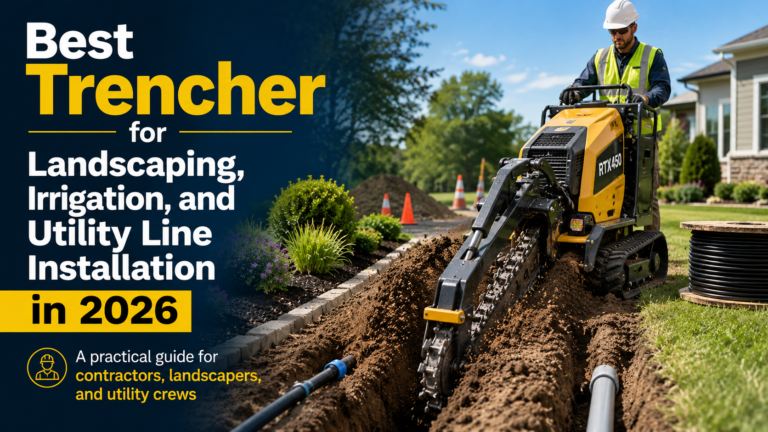
- Tractor-Mounted Trenchers (PTO Trenchers):
- Description: Attachments that connect to the Power Take-Off (PTO) of a tractor. The tractor provides the power and mobility.
- Best For: Agricultural applications, long runs in open fields, large-scale irrigation, and rural utility installations where a tractor is already available.
- Example Use Case: Digging long drainage ditches in farmland, installing extensive irrigation lines for crops, or burying communication cables along a rural road.
- Pros: Cost-effective if you already own a tractor, good for long, straight runs, uses existing equipment.
- Cons: Requires a compatible tractor, less maneuverable in tight spaces, limited by tractor’s power.
- Chain Trenchers (Large Ride-On/Crawler Trenchers):
- Description: Dedicated, heavy-duty machines, often track-mounted, with a long boom and a continuous chain of digging teeth.
- Best For: Large-scale utility projects (gas, water, sewer, fiber optics), extensive pipeline installations, and projects requiring significant depth and length in various soil conditions.
- Example Use Case: Laying miles of fiber optic cable across a city, installing a new municipal water main, or preparing trenches for a large-scale solar farm.
- Pros: High speed and productivity, deep and wide trenches, excellent for challenging soil and long distances.
- Cons: Very expensive to purchase/rent, requires specialized transport, skilled operators, and significant space.
- Wheel Trenchers (Rock Saws):
- Description: Feature a large, rotating steel wheel with carbide-tipped teeth or bits.
- Best For: Extremely hard materials like asphalt, concrete, frozen ground, and solid rock.
- Example Use Case: Cutting trenches through paved roads for urban utility upgrades, trenching in rocky mountainous regions, or breaking up frozen ground in winter construction.
- Pros: Unmatched ability to cut through hard surfaces, precise and clean cuts.
- Cons: Very specialized, high purchase/rental cost, slower than chain trenchers in soft soil, high wear on teeth.
- Micro Trenchers:
- Description: Small, highly specialized wheel trenchers that cut extremely narrow (1-3 inches) and shallow (6-12 inches) slots.
- Best For: Fiber optic cable installation in urban areas, minimizing disruption to existing infrastructure and surfaces.
- Example Use Case: Installing fiber to the home (FTTH) in residential neighborhoods, creating minimal disturbance for telecom upgrades in paved areas.
- Pros: Minimal surface disruption, very fast for narrow trenches, less spoil to manage.
- Cons: Limited depth/width, specialized application, can be expensive for their size.
2. Prioritize Safety
Regardless of the trencher type, safety must always be the top priority.
- Call 811 (or your local equivalent): Always, without exception, call your local utility notification center before you dig to have underground utilities marked. Hitting a gas line or electrical cable can be catastrophic.
- Operator Training: Ensure all operators are properly trained, certified (if required), and familiar with the specific trencher model being used.
- Personal Protective Equipment (PPE): Mandate the use of hard hats, safety glasses, hearing protection, steel-toed boots, and high-visibility clothing.
- Site Assessment: Conduct a thorough site assessment for hazards like unstable ground, overhead power lines, or existing structures.
- Spoil Management: Plan for where the excavated soil (spoil) will be placed to avoid creating hazards or blocking access.
- Trench Safety: Understand trenching and excavation safety standards, including shoring or sloping requirements for deeper trenches to prevent collapses.

3. Consider Rental vs. Purchase
This is a crucial financial decision.
- Rent if: You have infrequent trenching needs, require a specialized trencher for a one-off project, want to avoid maintenance costs, or need to test different models.
- Purchase if: You have consistent, high-volume trenching work, specific long-term project requirements, or the cost of frequent rentals outweighs the purchase price and maintenance.
4. Evaluate Power and Engine Type
The trencher’s engine dictates its performance.
- Horsepower (HP): More HP generally means more digging power, especially important for hard soil or deep trenches.
- Fuel Type: Most trenchers run on gasoline or diesel. Diesel engines typically offer more torque and fuel efficiency for heavy-duty work, while gasoline engines are common in smaller models.
- Hydraulic Systems: Many trenchers use hydraulic systems for boom and chain operation. A robust hydraulic system is key for smooth, powerful digging.
5. Research Attachments and Accessories
Enhance your trencher’s versatility.
- Different Chain Types:
- Cup Teeth: Best for soft, sandy soils.
- Shark Teeth: Good for general purpose, moderately hard soils.
- Rock/Carbide Teeth: Essential for compacted earth, gravel, and light rock.
- Combination Chains: Offer a mix of different teeth for varied conditions.
- Backfill Blades: Many ride-on trenchers come with a front-mounted blade for pushing excavated spoil back into the trench, saving time and labor.
- Crumber Bars: These ensure the trench bottom is clean and level after digging.
- Reel Carriers: For laying cable or pipe directly into the trench as it’s dug.
6. Read Reviews and Seek Expert Advice
Don’t rely solely on manufacturer specifications.
- Online Reviews: Look for reviews from other contractors or operators who have used the specific models you’re considering.
- Industry Forums: Engage with professionals in online communities to get real-world insights.
- Dealer/Rental Company Expertise: Reputable dealers and rental companies often have experienced staff who can provide valuable recommendations based on your project details. They can guide you through the “How to Choose the Right Trencher for Your Job Site” process with practical advice.
By diligently following these best practices, you move beyond simply identifying a trencher to strategically selecting and utilizing a machine that will deliver optimal performance, safety, and cost-effectiveness for your specific job site.
Frequently Asked Questions
Choosing the right trencher can bring up a lot of questions, especially for those new to the equipment or facing a unique project. Here are some of the most common inquiries, designed to further clarify the selection process.
Q1: What is the primary factor to consider when choosing a trencher?
The primary factor is the type of material you need to trench through. While depth, width, and length are crucial, the ground composition (soft soil, clay, rock, asphalt) dictates the fundamental type of trencher (chain, wheel, micro) and the type of teeth/bits required. An underpowered trencher or one with the wrong cutting mechanism for the soil type will be inefficient at best and ineffective or prone to breakdown at worst. Always assess your ground conditions first.
Q2: How does trench depth and width affect my trencher choice?
Trench depth and width directly influence the size and power of the trencher you’ll need.
- Depth: Small walk-behind trenchers typically handle depths up to 2-3 feet. For depths of 4-6 feet, you’ll likely need a compact ride-on or a medium-sized chain trencher. Depths beyond 6 feet often require large, heavy-duty chain trenchers or specialized wheel trenchers.
- Width: Trencher chains and wheels come in various widths. For narrow trenches (1-4 inches), micro trenchers or specialized chain trenchers are ideal. Standard utility trenches usually require 6-12 inches. Wider trenches (12+ inches) necessitate larger, more powerful machines with wider chain options or specific attachments. Trying to dig a wider trench than a machine is designed for can damage the equipment or produce an inconsistent trench.
Q3: What are the benefits of using a track-mounted trencher over a wheeled trencher?
Track-mounted trenchers offer several distinct benefits over wheeled models, especially in challenging conditions:
- Superior Traction: Tracks provide a larger contact area with the ground, offering significantly better traction on soft, muddy, or loose soil, as well as on slopes.
- Increased Stability: The wider footprint of tracks enhances stability, reducing the risk of tipping on uneven terrain.
- Better Flotation: Tracks distribute the machine’s weight over a larger area, preventing it from sinking into soft ground, which can be a major issue for wheeled trenchers.
- Reduced Ground Pressure: This can be beneficial in sensitive areas where minimizing ground disturbance is important. However, wheeled trenchers are generally faster for transport on hard surfaces and can be more maneuverable on flat, firm ground.
Q4: How does the length of the trenching job impact my decision?
The total length of the trench is a major determinant of the trencher’s required speed and operator comfort.
- Short Runs (under 100 feet): A manual shovel or a small walk-behind trencher might suffice.
- Medium Runs (100-500 feet): Walk-behind trenchers are still viable, but a compact ride-on trencher will significantly increase efficiency and reduce operator fatigue.
- Long Runs (500+ feet to miles): Ride-on trenchers (compact or large chain trenchers) or tractor-mounted trenchers become essential. These machines are designed for continuous operation, offering higher speeds and greater comfort for the operator over extended periods, making them the most cost-effective choice for large-scale projects.
Q5: Can I use one trencher for multiple types of jobs or soil conditions?
While some trenchers offer a degree of versatility, it’s generally true that specialized trenchers excel in their niche. A general-purpose chain trencher can handle soft to moderately hard soil but will struggle or fail in solid rock. A rock wheel trencher is fantastic for concrete but inefficient and costly for soft soil. However, some manufacturers offer interchangeable attachments or different chain types (e.g., cup teeth for soft soil, carbide teeth for rock) that can be swapped on the same base machine, increasing its versatility. For example, a compact ride-on trencher might be able to switch between a standard chain and a micro-trenching wheel. Always check the machine’s specifications and available accessories to understand its true multi-tasking capabilities. For diverse job sites, a versatile compact ride-on with multiple chain options might be a good compromise, but for extreme conditions, dedicated equipment is usually best.
Q6: What are the hidden costs associated with trenchers that I should consider?
Beyond the initial purchase or rental price, several hidden costs can impact your budget:
- Fuel Consumption: Larger, more powerful trenchers consume significantly more fuel.
- Maintenance and Repairs: Wear and tear on chains, teeth, and hydraulic components can be substantial, especially in abrasive soil. Factor in replacement parts and labor.
- Transportation: Moving larger trenchers to and from job sites requires appropriate trailers and towing vehicles, which incur costs.
- Operator Training: Ensuring your crew is properly trained on specific models can be an upfront cost but prevents costly mistakes and accidents.
- Insurance: Equipment insurance is essential to protect against damage or theft.
- Spoil Disposal: Managing and disposing of excavated soil can be a significant logistical and financial undertaking, particularly for large projects or in urban areas.
- Downtime: Equipment breakdowns lead to project delays, which can be very expensive in terms of lost labor and extended project timelines.
Q7: How important is ground clearance and maneuverability for a trencher?
Ground clearance and maneuverability are extremely important, particularly on job sites with obstacles, uneven terrain, or tight spaces.
- Ground Clearance: A trencher with good ground clearance can navigate over small obstacles, rocks, or uneven terrain without getting stuck or damaging its undercarriage. This is especially crucial for track-mounted models operating in rough environments.
- Maneuverability:
- Tight Spaces: For residential yards, urban areas, or sites with existing structures, a compact walk-behind or articulated ride-on trencher with a tight turning radius is essential.
- Obstacles: Machines that can easily turn and adjust their digging path help avoid roots, rocks, and existing utilities, reducing the risk of damage or delays.
- Straightness: While maneuverability is good, the ability to maintain a straight trench line is also vital. Features like automatic steering or laser guidance can aid in this, especially on long runs.
Conclusion
Choosing the right trencher for your job site is far more than a simple equipment purchase or rental; it’s a strategic decision that underpins the efficiency, safety, and profitability of your entire project. By systematically evaluating your project’s specific requirements – from the depth and width of the trench to the type of soil and the length of the run – and carefully considering your job site’s conditions and operational resources, you can narrow down the vast array of available trenchers to find the perfect match.
Remember that understanding the distinct capabilities of walk-behind, ride-on, tractor-mounted, chain, wheel, and micro trenchers is crucial. Prioritizing safety through proper utility marking, operator training, and site assessment is non-negotiable. Weighing the benefits of renting versus purchasing, evaluating power and attachments, and seeking expert advice will further refine your decision. The right trencher isn’t just a machine; it’s a productivity multiplier, a safety enhancer, and a key factor in delivering high-quality results on time and within budget. Make an informed choice, and set your project up for success from the ground up.
Learn more today and ensure your next trenching project is a resounding success!