
8 Types of Trenchers Working on Construction Sites: Which One Is Right for Your Job?
Trenching is one of the most important jobs on construction sites, landscaping projects, farms, roadwork areas, and utility installation projects. A clean trench can be used for drainage systems, irrigation lines, water pipes, electrical cables, fiber optic lines, gas lines, footings, and many other underground services. Without the right trenching equipment, a simple digging job can become slow, messy, expensive, and unsafe.
A trencher is designed to cut a narrow and controlled trench through soil, clay, gravel, asphalt, or even rocky ground depending on the machine type. Compared with digging by hand or using a general bucket, a trencher can create a cleaner trench with better depth control and faster production. This makes it one of the most useful machines for contractors, landscapers, utility crews, farmers, and property owners.
However, not all trenchers are the same. Some trenchers are small and easy to use in gardens or residential yards. Some are powerful ride-on machines built for long utility lines. Some are made for hard ground and road surfaces. Others are attachments for skid steers, excavators, or tractors. Choosing the wrong trencher can slow down the job, damage the site, or create a trench that is too wide, too shallow, or not suitable for the project.
This guide explains the 8 main types of trenchers working on construction sites and helps you understand which one is right for your job.
1. Walk-Behind Trencher
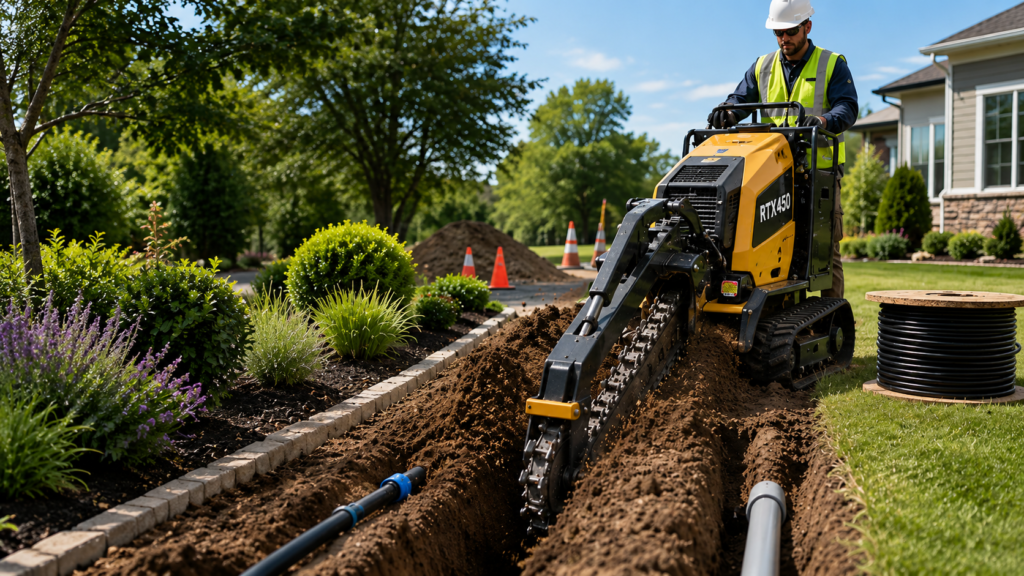
A walk-behind trencher is one of the most common trenching machines for landscaping, irrigation, garden work, and small utility jobs. As the name suggests, the operator walks behind the machine while controlling its movement and digging chain. It is compact, simple to transport, and easier to operate in tight spaces compared with larger trenching machines.
Walk-behind trenchers are often used for residential projects such as sprinkler systems, garden irrigation, landscape lighting cable, drainage lines, and small pipe installation. Because they are smaller, they can access narrow areas where larger machines cannot fit. This makes them useful for backyards, parks, sidewalks, lawns, and small property maintenance jobs.
Most walk-behind trenchers use a chain digging system. The chain rotates around a boom and cuts into the soil. As the chain moves, it removes dirt from the trench and throws it to the side. The operator guides the machine forward slowly while maintaining the trench depth and direction.
The biggest advantage of a walk-behind trencher is maneuverability. It can work in small spaces, between buildings, near fences, and around landscape features. It is also easier to transport using a small trailer or pickup-compatible equipment trailer. For contractors who handle irrigation, drainage, or landscaping, a walk-behind trencher can save a lot of time compared with hand digging.
However, walk-behind trenchers are not designed for every job. They are not the best choice for very long trenches, extremely rocky soil, deep utility lines, or large commercial projects. They also require the operator to walk and guide the machine, which can be tiring during long jobs.
A walk-behind trencher is best for small to medium trenching jobs where access is limited and the trench does not need to be extremely deep or wide.
Best uses:
Residential irrigation lines, landscape lighting cables, garden drainage, sprinkler systems, small utility trenches, and narrow access projects.
Best jobsite type:
Landscaping sites, home improvement projects, small farms, parks, gardens, and residential yards.
2. Ride-On Trencher
A ride-on trencher is a larger and more powerful machine designed for longer, deeper, and more demanding trenching jobs. Instead of walking behind the machine, the operator sits or stands on the trencher and drives it across the jobsite. This makes it more comfortable and efficient for long trenching runs.
Ride-on trenchers are commonly used for commercial construction, utility installation, water lines, gas lines, electrical lines, fiber optic cable, drainage systems, and roadwork support. They are built for higher production and can dig longer trenches faster than walk-behind machines.
Many ride-on trenchers use a chain trencher system, but some can also be equipped with different attachments depending on the job. Some models may support backhoe attachments, plows, reel carriers, or rockwheel attachments. This makes them more versatile for utility contractors who need to complete different underground installation tasks.
The main advantage of a ride-on trencher is productivity. It can cover more distance, dig deeper trenches, and handle tougher soil conditions. It is also easier on the operator during long workdays because the operator does not need to physically walk behind the machine.
Ride-on trenchers are also better for straight trench lines over long distances. For example, installing underground cable across a construction site or laying a water line across a large property is much easier with a ride-on trencher than a walk-behind trencher.
The downside is size and cost. Ride-on trenchers are more expensive to buy, rent, transport, and maintain. They require more space to operate and may not be suitable for narrow residential areas or delicate landscaping. They are also heavier, so ground conditions must be considered before use.
A ride-on trencher is the right choice when speed, depth, distance, and production matter more than compact size.
Best uses:
Utility lines, water lines, gas lines, electrical cable, fiber cable, drainage systems, commercial trenching, and long-distance trench work.
Best jobsite type:
Commercial construction sites, utility projects, large properties, road shoulders, municipal work, and infrastructure projects.
3. Chain Trencher
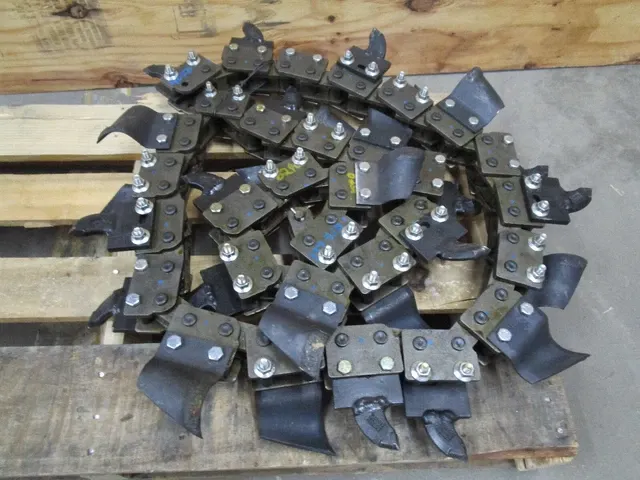
A chain trencher is one of the most recognized types of trenchers. It works using a digging chain with teeth or cutting bits attached to it. The chain rotates around a long metal boom and cuts into the ground, similar to how a chainsaw cuts wood. As the chain digs, it removes soil and creates a clean trench.
Chain trenchers can be found on walk-behind machines, ride-on machines, skid steer attachments, and other trenching equipment. This makes the chain trencher design very common and versatile.
Chain trenchers are best for soil, clay, sand, loam, and mixed ground conditions. They can create trenches for pipes, cables, irrigation lines, drainage systems, and utility installation. Depending on the machine size and chain setup, a chain trencher can dig shallow or deep trenches.
The chain type matters. Some chains are designed for soft soil, while others are made for harder ground, clay, frost, or rocky conditions. The teeth or cutting bits must match the jobsite material. Using the wrong chain can reduce digging performance and increase wear.
One of the main benefits of a chain trencher is trench control. It can dig a consistent trench width and depth, making installation cleaner and more predictable. This is important when laying pipe or cable because the trench must be deep enough and properly shaped.
Chain trenchers are also efficient for narrow trenches. Instead of removing a large amount of soil like a bucket would, the chain cuts only the needed trench width. This reduces backfill work and keeps the jobsite cleaner.
The limitation is that chain trenchers can struggle in very hard rock or thick asphalt unless they are equipped with the correct chain and enough power. For extremely hard surfaces, a wheel trencher or rockwheel may be more suitable.
A chain trencher is a strong all-around choice for most soil trenching jobs.
Best uses:
Pipe installation, cable lines, irrigation, drainage, utility trenches, and general construction trenching.
Best jobsite type:
Construction sites, landscaping projects, farms, residential properties, and utility installation areas.
4. Wheel Trencher or Rockwheel Trencher
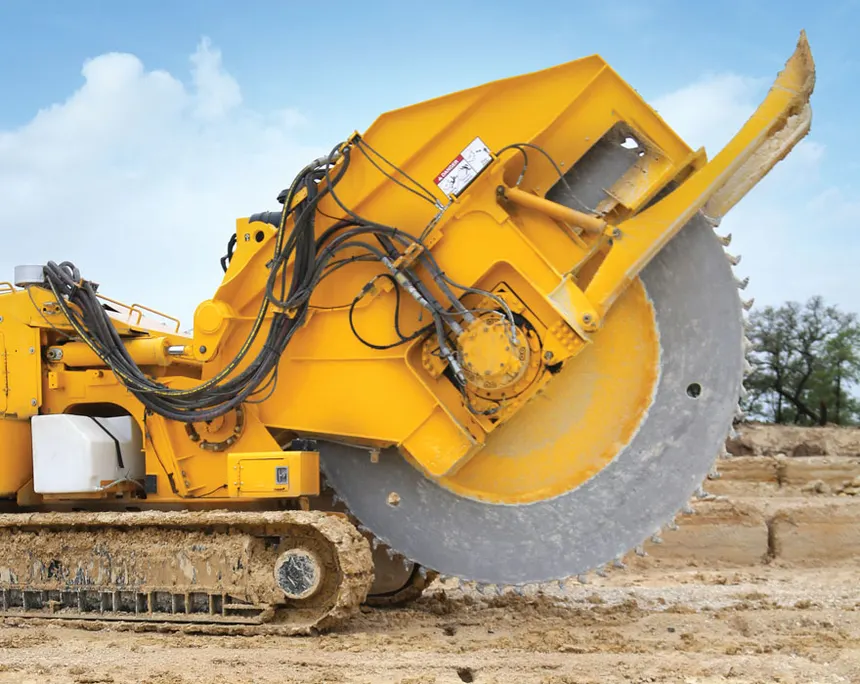
A wheel trencher, also called a rockwheel trencher in heavy-duty applications, uses a large rotating metal wheel with cutting teeth. Instead of using a chain, the cutting wheel spins and cuts into the ground or surface material. This type of trencher is especially useful for hard ground, rocky soil, asphalt, concrete, and roadwork applications.
Wheel trenchers are often used in urban utility work, road construction, fiber optic cable installation, pipeline work, and projects where the trench needs to be cut through hard surfaces. They can create clean, straight cuts and are often faster in hard materials than chain trenchers.
A rockwheel is especially useful when the ground contains rock layers or when the trench must pass through paved surfaces. For example, if a crew needs to install a cable line along a road shoulder or cut a narrow trench through asphalt, a rockwheel trencher can be a better choice than a standard chain trencher.
The biggest advantage of a wheel trencher is cutting power in hard material. The rotating wheel can grind and cut through surfaces that would quickly wear down or slow a normal chain trencher. It can also create a cleaner trench in road surfaces, which is useful for repair and backfill work.
Wheel trenchers are also useful for controlled trench width. They can make narrow cuts for utilities without disturbing too much surrounding material. This can reduce restoration work after the utility line is installed.
However, wheel trenchers are not always the best choice for soft soil or tight landscaping areas. They are usually more specialized and may require larger equipment or attachment carriers. They can also be more expensive to operate because cutting teeth wear over time, especially in rock and concrete.
A wheel trencher is the right choice when the jobsite has hard ground, rocky material, asphalt, or concrete cutting needs.
Best uses:
Roadwork, asphalt trenching, concrete cutting, rocky ground, utility installation, fiber optic lines, and hard-surface trenching.
Best jobsite type:
Road construction sites, urban utility projects, parking lots, sidewalks, rocky terrain, and infrastructure jobs.
5. Micro Trencher
A micro trencher is designed to cut very narrow and shallow trenches. It is commonly used for fiber optic cable, internet lines, communication cables, and urban utility installation. Micro trenching is popular in cities because it reduces surface damage and allows crews to install underground lines with less disruption.
Micro trenchers are usually wheel-based cutting machines. They cut a thin slot into asphalt, concrete, or compact surfaces. After the cable or conduit is placed inside, the trench can be sealed quickly. This makes the process faster and cleaner than traditional trenching in many urban areas.
The biggest advantage of a micro trencher is minimal surface disturbance. Instead of opening a wide trench, it creates a narrow channel. This means less material is removed, less backfill is needed, and restoration is faster. For city streets, sidewalks, and commercial properties, this can save time and reduce traffic disruption.
Micro trenchers are often used for broadband and fiber optic network expansion. Because fiber cables are smaller than water or sewer pipes, they do not always require large trenches. A narrow micro trench can be enough for the installation, depending on local requirements and project design.
However, micro trenching is not suitable for every underground utility. It is not the best choice for large pipes, deep drainage systems, sewer lines, or jobs that require wide trench access. It is also more specialized and may need a clean surface, accurate depth control, and proper sealing after installation.
Micro trenching also requires careful planning. Crews must avoid existing underground utilities and follow local rules for trench depth, placement, and restoration. Even though the trench is small, utility marking and safety procedures are still required.
A micro trencher is the right choice for narrow cable installation in urban areas where speed and low surface damage are important.
Best uses:
Fiber optic cable, internet lines, communication cable, small conduit, and shallow urban utility work.
Best jobsite type:
City streets, sidewalks, parking lots, commercial areas, neighborhoods, and urban infrastructure projects.
6. Skid Steer Trencher Attachment
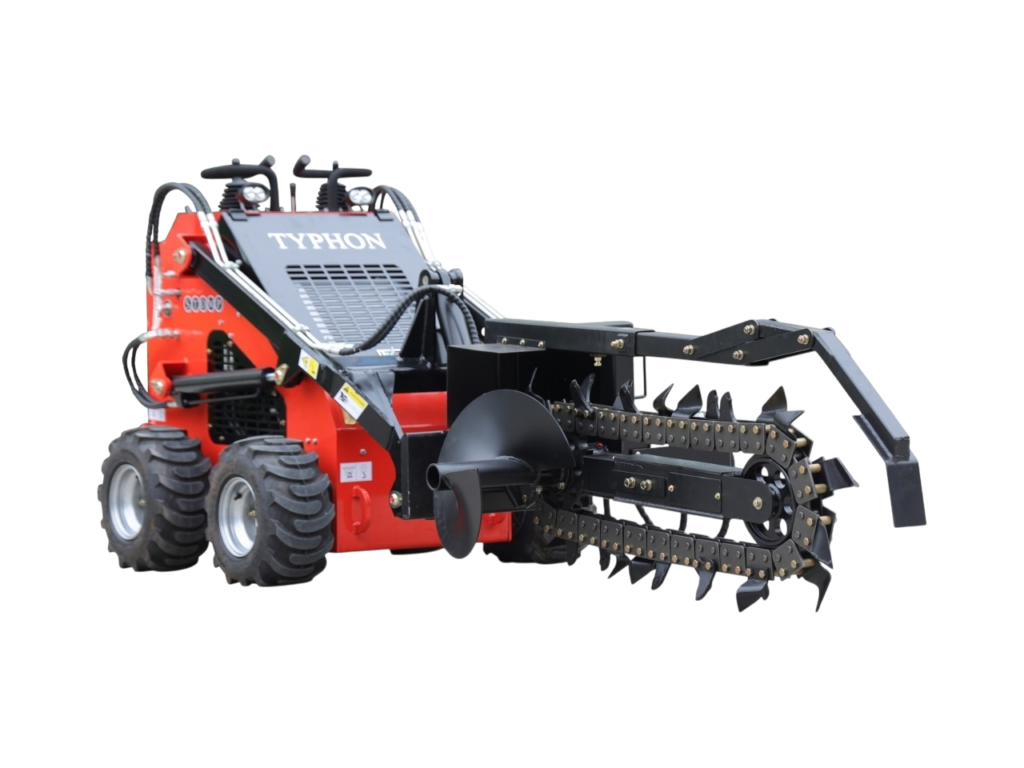
Skid steer trencher attachments are popular in construction, landscaping, farming, irrigation, drainage, and utility work. They are useful because skid steers are already common on many jobsites. A skid steer may be used for grading, loading, lifting, clearing, and moving material. With a trencher attachment, the same machine can also dig narrow trenches.
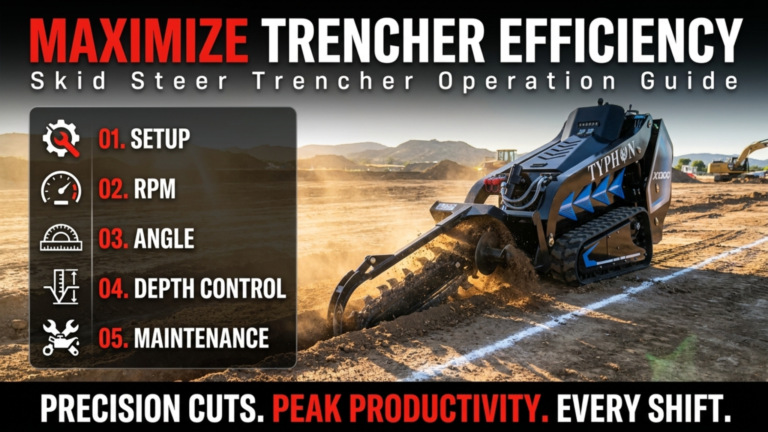
This type of attachment usually uses a chain trencher system. The chain cuts into the ground while the skid steer moves slowly backward or forward depending on the attachment design. The operator controls the trench depth, machine speed, and attachment position from inside the skid steer cab or operator platform.
The biggest advantage is machine versatility. A contractor can use one machine for multiple jobs by switching attachments. For example, a skid steer can start the day with a bucket to move gravel, switch to a trencher for drainage lines, then use pallet forks to move materials. This saves space, money, and transport time compared with bringing multiple dedicated machines.
Skid steer trenchers are also useful in rough jobsites where a walk-behind trencher may be too small. The skid steer provides traction, hydraulic power, and stability. This makes it suitable for utility lines, drainage systems, farm irrigation, and construction site preparation.
However, compatibility is important. The trencher attachment must match the skid steer’s hydraulic flow, mounting plate, horsepower, and operating capacity. If the attachment requires more hydraulic flow than the skid steer can provide, it may dig slowly or struggle in hard ground.
The operator must also be careful with visibility and trench alignment. Because the attachment is mounted on the front, accurate control is important to keep the trench straight and consistent.
A skid steer trencher attachment is ideal for contractors who want more value from a machine they already use every day.
Best uses:
Drainage lines, irrigation systems, electrical conduit, utility trenches, farm work, landscaping, and construction site trenching.
Best jobsite type:
Construction sites, landscaping projects, farms, residential developments, and contractor jobsites.
7. Excavator Trencher Attachment
An excavator trencher attachment is designed to mount onto an excavator and cut trenches using the excavator’s hydraulic system. This setup is useful when the job requires reach, control, uneven terrain access, or trenching in areas where a skid steer or walk-behind trencher may not work well.
Excavators are already excellent digging machines, but a bucket does not always make the cleanest narrow trench. A bucket can dig deeper and wider, but it removes more soil than needed. A trencher attachment allows the excavator to cut a more controlled trench while still using the excavator’s reach and positioning ability.
This is useful on slopes, ditches, roadside areas, uneven ground, and tight areas where the excavator can sit in one place and reach the trench line. For example, if a utility trench needs to be cut along a slope or near an obstacle, an excavator trencher attachment can provide better positioning than a ride-on trencher.
Excavator trenchers are often used for drainage lines, irrigation systems, utility lines, and site preparation. They can also be useful in areas with limited access because compact excavators can work in smaller spaces while still offering boom reach.
The biggest advantage is reach and flexibility. The operator can position the boom, arm, and attachment at different angles. This makes it useful for trenching near walls, fences, embankments, or uneven surfaces.
Another advantage is that the excavator can perform other jobs on the same site. After trenching, the excavator can switch back to a bucket for backfilling, grading, or digging. This makes it a practical attachment option for contractors who already use excavators.
The limitation is that excavator trencher attachments may not be as fast as dedicated trenchers for long straight trench runs. They are usually better for controlled or difficult-access trenching rather than high-speed production over long distances.
Hydraulic compatibility is also important. The attachment must match the excavator’s hydraulic flow and pressure. The size of the attachment should also match the excavator class. A small mini excavator needs a smaller trencher attachment, while a larger excavator can handle heavier-duty tools.
An excavator trencher attachment is the right choice when reach, terrain access, and precision matter more than long-distance production speed.
Best uses:
Drainage trenches, slope trenching, irrigation, utility lines, tight-access trenching, and uneven terrain work.
Best jobsite type:
Sloped sites, drainage projects, road edges, farms, landscaping areas, and construction sites with obstacles.
8. Tractor Trencher Attachment
A tractor trencher attachment is commonly used in agriculture, rural property maintenance, irrigation work, drainage installation, and land development. It connects to a tractor and uses the tractor’s power system, hydraulic system, or PTO setup depending on the attachment design.
Tractor trenchers are useful for farms and large properties because tractors are already common in these environments. Instead of hiring separate trenching equipment, property owners can use the tractor they already have and add a trencher attachment for specific underground installation work.
These attachments are often used for irrigation lines, water lines, drainage systems, electrical lines to barns or outbuildings, and general farm utility work. They can also help with trenching along fields, fence lines, driveways, and rural access roads.
The biggest advantage of a tractor trencher is practicality for agricultural work. Farms often need long utility runs across open land. A tractor trencher can be a cost-effective solution for property owners who need trenching but do not want to invest in a dedicated ride-on trencher.
Tractor trenchers are also useful in open areas where maneuverability is not a major problem. A tractor has enough size and stability for many rural trenching tasks, especially when the ground is relatively open and accessible.
However, tractor trenchers may not be ideal for tight residential spaces, finished landscaping, or urban jobsite conditions. Tractors need turning room, and the attachment setup may not be as compact as a walk-behind trencher or skid steer attachment.
Soil condition also matters. For soft farm soil, a tractor trencher can be very effective. For hard rock, asphalt, or concrete, a specialized wheel trencher or rockwheel may be better.
A tractor trencher attachment is the right choice for farms, rural properties, irrigation systems, and long utility runs across open land.
Best uses:
Farm drainage, irrigation lines, water lines, electrical lines, rural utility work, and property maintenance.
Best jobsite type:
Farms, ranches, rural properties, fields, orchards, and open land projects.
How to Choose the Right Trencher for Your Job
Choosing the right trencher depends on the job, the site, the material, and the trench requirements. The best machine is not always the biggest one. It is the one that matches the work.
The second factor is ground condition. Soft soil is easier to cut than clay, gravel, frozen ground, asphalt, concrete, or rock. For normal soil, a chain trencher is usually effective. For hard surfaces or rocky ground, a wheel trencher or rockwheel may be needed.
The third factor is job length. A short trench in a backyard does not need the same equipment as a mile-long utility trench. For short jobs, compact equipment may be easier and more affordable. For long runs, a ride-on trencher is usually faster and more efficient.
The fourth factor is access. Can the machine fit into the work area? If the job is in a narrow backyard, garden, or residential property, a walk-behind trencher may be better. If the job is in a large open field, a tractor trencher or ride-on trencher may work well. If the job has obstacles, slopes, or uneven terrain, an excavator trencher attachment may be useful.
The fifth factor is machine availability. If you already own a skid steer, excavator, or tractor, an attachment may be more cost-effective than renting or buying a dedicated trencher. Attachments can increase the value of machines already on the jobsite.
The sixth factor is finish quality. Some jobs require a clean and narrow trench with minimal surface damage. For fiber optic lines and urban cable work, a micro trencher may be the best option. For landscaping and irrigation, a walk-behind or compact chain trencher can create a clean trench without destroying the entire yard.
The final factor is productivity. If time is important, choose a trencher that can complete the job quickly without overworking the machine. A small trencher may fit the site, but it may take too long for a large project. A large trencher may be powerful, but it may be too expensive or too difficult to transport for a small job.
Trencher Safety Tips Before Digging
Trenching can be dangerous if the job is not planned correctly. Before digging, always locate underground utilities. This includes gas lines, water pipes, electrical cables, communication lines, sewer lines, and irrigation systems. Striking an underground utility can cause serious injury, service disruption, equipment damage, and expensive repairs.
The jobsite should be inspected before trenching begins. Look for slopes, soft ground, nearby structures, overhead obstacles, people, vehicles, and existing utility markers. Make sure the trencher has enough room to operate safely.
Operators should use the correct personal protective equipment, including safety boots, gloves, hearing protection, eye protection, and high-visibility clothing when needed. Trenchers can throw dirt, rocks, and debris, so bystanders should stay away from the work area.
Never operate a trencher without understanding the controls. Each machine type works differently. A walk-behind trencher does not operate the same way as a ride-on trencher, skid steer trencher, or excavator attachment.
For deep trenches, trench collapse can be a serious hazard. Follow proper safety rules for trench depth, trench wall stability, and worker entry. A trench may look safe from the top but can collapse quickly depending on soil type and moisture.
Keep hands, feet, and clothing away from the digging chain, wheel, boom, and moving parts. Trencher components are powerful and can cause serious injury.
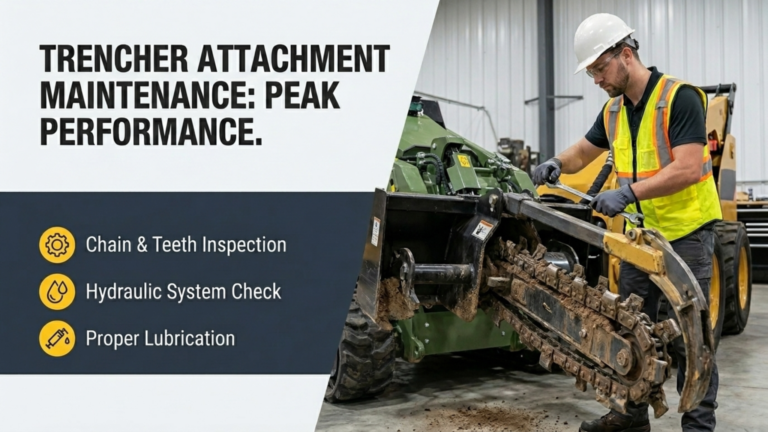
Maintenance is also part of safety. Check the chain, teeth, hydraulic hoses, fluid levels, guards, bolts, and controls before operation. Worn teeth can reduce performance and increase stress on the machine.
A safe trenching job starts before the machine touches the ground.
Final Recommendation: Which Trencher Is Right for Your Job?
The right trencher depends on what you are building, where you are working, and what kind of ground you need to cut.
Choose a walk-behind trencher if you are working on small landscaping, irrigation, garden, or residential jobs.
Choose a ride-on trencher if you need speed, deeper trenching, and long-distance utility installation.
Choose a chain trencher if you need a strong all-around trenching solution for soil, clay, drainage, pipes, and cables.
Choose a wheel trencher or rockwheel trencher if you are cutting through asphalt, concrete, road surfaces, or rocky ground.
Choose a micro trencher if you are installing fiber optic cable, internet lines, or small communication utilities in urban areas.
Choose a skid steer trencher attachment if you already use a skid steer and want one machine to handle trenching, grading, lifting, and material handling.
Choose an excavator trencher attachment if your job requires reach, control, slope access, or trenching near obstacles.
Choose a tractor trencher attachment if you are working on farms, rural properties, irrigation systems, or open land utility projects.
A trencher can save time, reduce labor, and create cleaner results when matched correctly to the job. The most important thing is to understand your trench depth, trench width, ground condition, site access, and project size before choosing the machine.
For landscaping, irrigation, drainage, utility work, and construction site preparation, trenchers are powerful tools that make underground installation faster and more professional. When you choose the right trencher, the job becomes cleaner, safer, and more efficient from the first cut to the final backfill.