What Happens When a Skid Steer Has Low Hydraulic Flow?
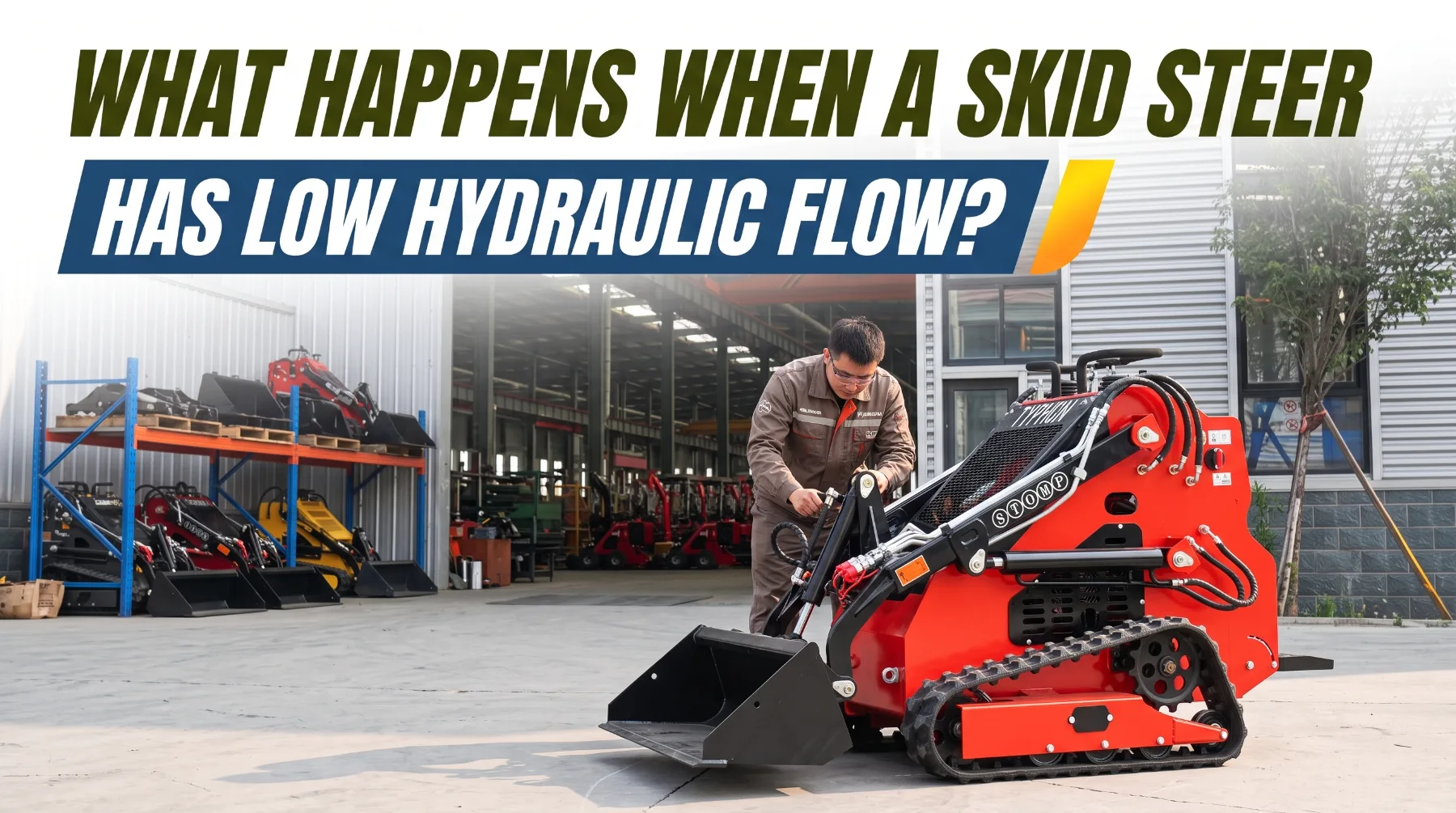 A skid steer that begins lifting more slowly, loses attachment performance, or struggles with loads it previously handled may be experiencing insufficient hydraulic flow. Hydraulic flow determines how quickly oil reaches cylinders and hydraulic motors, so a reduction in available flow can affect lift-arm movement, attachment speed, auxiliary functions, and overall cycle time. The problem can originate from several points in the hydraulic circuit, including a worn or damaged pump, restricted filters or lines, low fluid level, excessive internal leakage, or an engine that is not maintaining the required speed under load. Because these systems are closely connected, a flow reduction can become noticeable across multiple machine functions rather than remaining isolated to one attachment.
Low hydraulic flow also affects attachments according to their specific flow requirements. Hydraulic motors on mulchers, augers, trenchers, and similar tools depend on sufficient continuous flow to maintain operating speed, while cylinders require adequate flow to maintain predictable movement rates. A restriction or loss of pump capacity can reduce attachment speed and productivity, while forcing the hydraulic system to operate inefficiently can increase heat generation and accelerate component wear. Diagnosing the problem requires checking hydraulic fluid level and condition, filter restriction, hose and fitting condition, pump performance, engine speed, system pressure, and measured flow against the manufacturer’s specifications. Identifying a flow problem early helps prevent secondary damage and restores the hydraulic system to its intended operating range.
What Hydraulic Flow Is and Why It Matters
Hydraulic flow is the volume of fluid the pump moves through the system each minute, measured in gallons per minute (GPM). A skid steer does almost none of its real work mechanically. The engine drives a hydraulic pump, and that pump sends pressurized fluid to the lift and tilt cylinders, the drive motors, and every attachment you mount on the coupler. Flow is what makes those functions move, and the rate of that flow sets how fast they move.
Here’s the key distinction worth holding onto: flow governs speed, while pressure governs force. The GPM reaching a hydraulic motor decides how fast it spins, so more flow means faster cutting, quicker lift cycles, and brisker attachment speed. Pressure, measured in PSI, decides how much force the system can exert against resistance. The two work together, but when flow drops below what a function needs, everything slows, and the machine can’t do its job at full effectiveness. That’s why low flow is such a common thread behind poor skid steer performance.
The Real World Symptoms of Low Hydraulic Flow
Low hydraulic flow rarely announces itself with a warning light. Instead, it reveals itself in how the machine behaves, and once you know the signs, they’re hard to miss.
The most visible symptom is slow lift and tilt functions. The loader arms that once raised quickly now crawl upward, and the bucket curls sluggishly. Because the cylinders depend on flow to extend at speed, a shortfall stretches every lift and dump, so cycle times climb and your output drops without the machine ever throwing a fault.
The next sign is sluggish attachment performance. A hydraulic attachment that used to run at full speed turns slowly or lacks its usual bite. A mulcher drum spins lazily, an auger bores at a crawl, a trencher chain barely moves. If a tool that performed well last month now feels weak, low flow is a leading suspect.
The third symptom is bogging or stalling under load. When the machine meets resistance, driving a bucket into packed ground or pushing an attachment through tough material, it loses speed or stalls where it once powered through. Low flow leaves the system unable to sustain both the speed and the force the work demands, so the machine gives way exactly when you need it most. Add hesitation between functions, jerky movement, or a machine that only performs well at high throttle, and the picture gets clearer still.
The Common Causes of Low Hydraulic Flow
Low flow traces back to a handful of clear, controllable causes. Working through them in order usually points you straight to the problem.
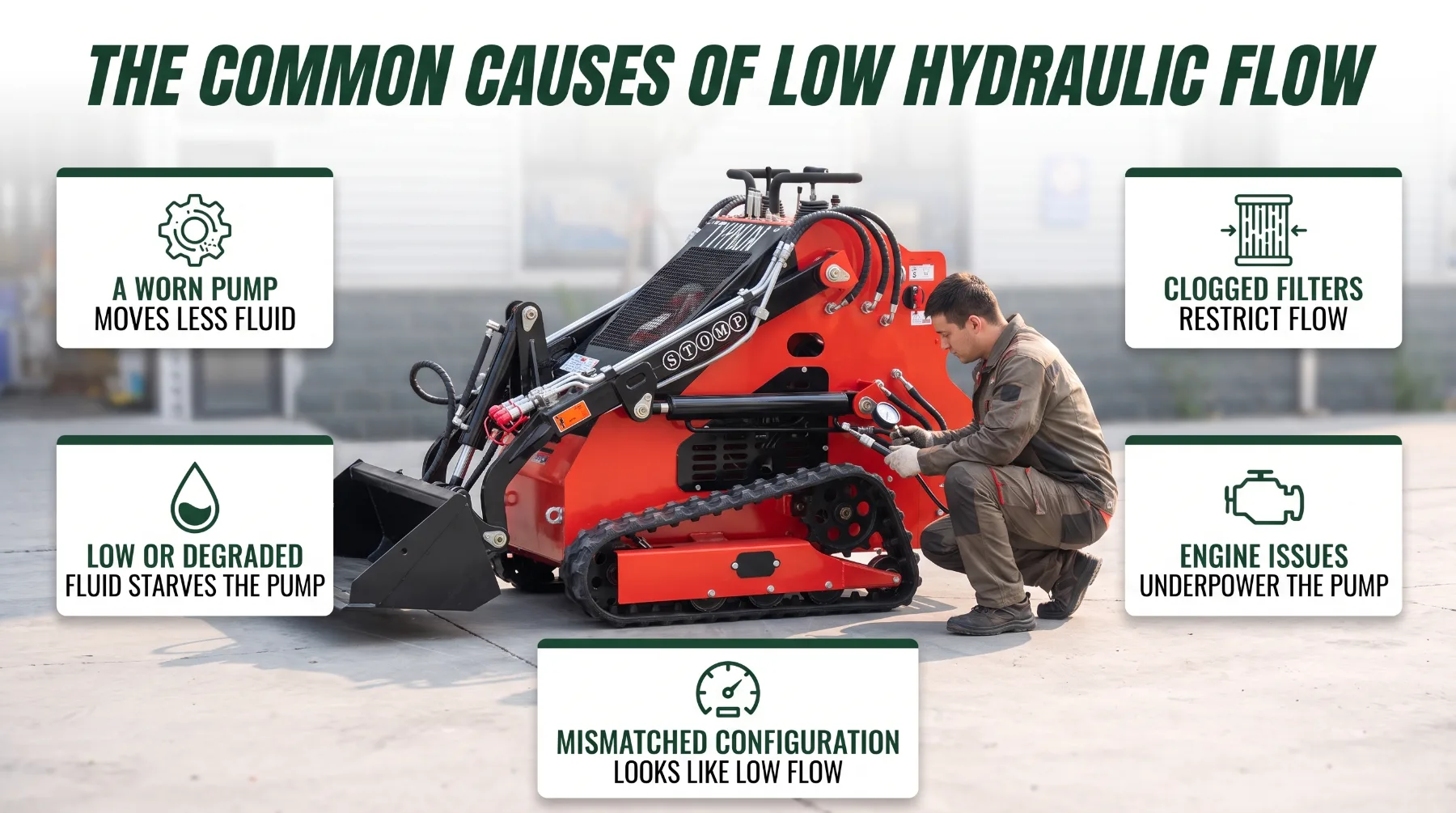
- A worn hydraulic pump. The pump is the heart of the system, and it wears over time. As internal clearances open up, fluid slips past instead of being pushed forward, so the pump moves less volume than it should. A pump losing efficiency is one of the most common reasons flow falls off gradually, and heavy hours or past overheating accelerate the decline.
- Clogged filters. Hydraulic filters catch contaminants to protect the system, but a filter left in service too long becomes restrictive. Fluid can’t pass freely, flow drops, and the whole system suffers. This is among the most frequent and most preventable causes of low flow.
- Low or degraded fluid. The system needs the correct fluid level to move its rated volume. A low reservoir, often from a leak, starves the pump. Old or contaminated fluid that has broken down or thinned from overheating also transmits power poorly, robbing the machine of effective flow.
- Engine issues. The engine powers the pump, so an engine that can’t hold its output, from fuel delivery problems, a clogged air filter, or general power loss, leaves the pump underpowered. The result feels exactly like low flow, because the pump can’t move its full volume without the engine behind it.
- Incorrect configuration. Sometimes the flow isn’t faulty, just mismatched. Running a high flow attachment on a standard flow machine, or leaving the auxiliary hydraulics in the wrong mode or setting, delivers less flow than the tool needs. Always confirm the machine’s flow output matches the attachment’s requirement before assuming a mechanical fault.
How Low Flow Affects Specific Attachments
Low flow hits hardest on the attachments that depend on a steady, high volume of fluid to run. These continuous flow tools have no cylinder stroke to fall back on, their motors need to keep turning, and the GPM feeding them sets the pace.
Mulchers are the most flow hungry tools a skid steer runs, and they suffer first. A mulcher drum needs sustained high flow to spin at full speed and hold that speed against thick brush. Starve it of flow, and the drum turns slowly, loses momentum the moment it meets material, and bogs down or stalls in brush it should chew through cleanly. Cutting quality drops, the work drags, and the tool never performs as designed.
Augers rely on flow to spin the bit at digging speed. With adequate flow, the auger bores steadily through soil. With low flow, it turns sluggishly, struggles to advance in harder or deeper ground, and can stall when it meets resistance it would normally handle. What should be a clean, quick hole becomes a slow fight.
Trenchers depend on continuous flow to keep the digging chain moving at cutting speed. Low flow slows the chain, so the trencher cuts more slowly, stretches every job, and can stall in compacted or rocky ground. A trencher that crawls where it once cut steadily is often a flow problem, not a worn chain. Across all three tools, the pattern is the same: less flow means less speed, and less speed means a tool that can’t do its job.
The Long Term Damage of Running With Insufficient Flow
Running a skid steer with low hydraulic flow isn’t only a productivity problem, it’s a reliability problem that compounds the longer it goes unaddressed. When the system can’t deliver the flow the work demands, the machine works harder to accomplish less, and that strain takes a toll on the components you most want to protect.
Heat is the biggest culprit. A system starved of proper flow, or one pushing degraded fluid, tends to run hotter, and heat pushes hydraulic fluid past its efficient temperature range where it transmits power poorly and breaks down faster. Degraded fluid then accelerates wear on the pump, valves, seals, and motors, which drops flow even further, a downward spiral that feeds on itself. A worn pump forced to keep working wears faster still, and an attachment run below its needed flow can suffer its own damage from overheating and strain. Left unchecked, a small, cheap issue like a clogged filter can cascade into pump failure and a major repair bill. Addressing low flow early isn’t just about performance today; it’s about protecting the machine’s service life and avoiding the far higher cost of neglect.
Practical Diagnostic and Maintenance Tips
The good news is that most causes of low hydraulic flow are preventable, and the rest are straightforward to track down. A little discipline keeps flow where it belongs and catches problems before they grow.
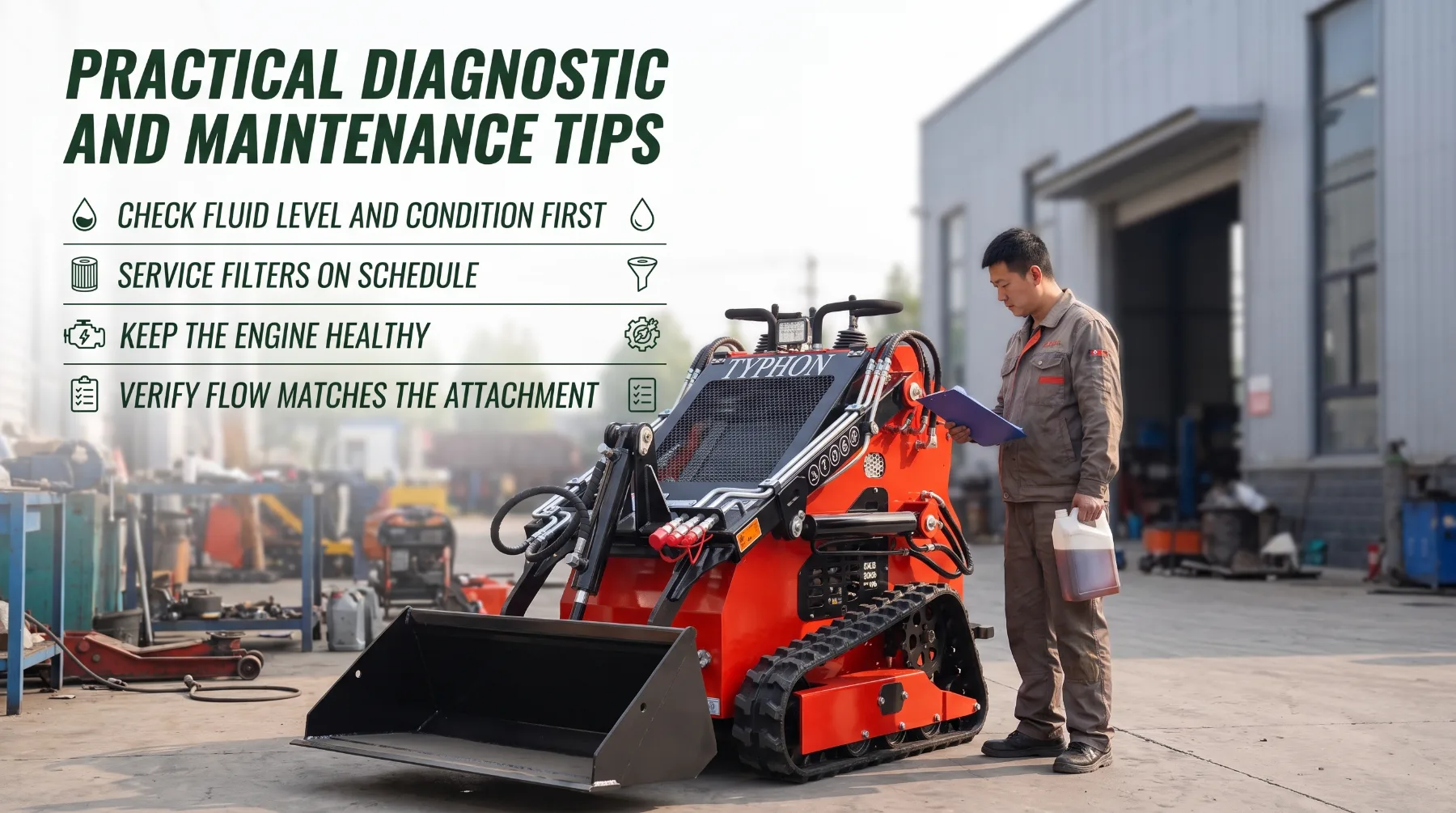
- Check the fluid first. Confirm the reservoir sits at the correct level and inspect the fluid’s condition. Milky, dark, or burnt smelling fluid signals contamination or overheating and needs attention. Look for leaks at hoses, fittings, and cylinders that could be draining the system.
- Service filters on schedule. Replace hydraulic filters at the intervals the manufacturer specifies, and sooner in dirty, demanding work. A clean filter is one of the cheapest, highest return maintenance steps you can take.
- Keep the engine healthy. Because the engine powers the pump, routine engine care, clean air and fuel filters, sound fuel delivery, full power output, directly protects hydraulic flow. Rule out an engine issue before condemning the hydraulics.
- Verify the configuration. Confirm the machine’s rated flow matches the attachment you’re running, and check that the auxiliary hydraulics are set to the correct mode. Many “low flow” complaints are simply a high flow tool on a standard flow circuit.
- Watch for gradual decline. Note how the machine and its attachments perform over time. A steady loss of speed or force, once fluid, filters, and configuration check out, points toward a wearing pump. Tracking that trend lets you plan a repair before a breakdown forces one.
- Know when to call a professional. If the basics are sound and flow is still low, a technician can measure actual flow and pressure with a flow meter to pinpoint a failing pump or valve. Testing the real numbers takes the guesswork out of the diagnosis.
Conclusion
Low hydraulic flow can significantly reduce skid steer performance because flow rate primarily determines the operating speed of hydraulic cylinders and motors, while system pressure determines the force available to overcome resistance. A reduction in pump flow can cause slower boom lift, bucket tilt, auxiliary attachment operation, and travel functions, with the effect becoming especially noticeable when using flow-demanding attachments such as mulchers, augers, trenchers, and other continuous-duty hydraulic tools. Common causes include low or degraded hydraulic fluid, restricted or contaminated filters, excessive internal leakage, worn pump components, engine speed or power limitations, incorrect auxiliary circuit settings, and attachment requirements that exceed the machine’s available hydraulic capacity. Engine condition is also important because the hydraulic pump depends on sufficient mechanical input power and operating speed to maintain its specified flow and pressure under load. When the pump cannot maintain the required flow, attachments may operate below their designed speed, while excessive restriction, leakage, or relief-valve operation can convert more input power into heat and increase hydraulic-system temperature. Continued operation under these conditions can accelerate pump, valve, motor, seal, and fluid degradation and may eventually lead to more extensive component damage. Diagnosis should therefore begin with hydraulic fluid level and condition, filter condition, engine speed and power, auxiliary circuit configuration, and attachment specifications before evaluating pump wear or internal leakage. Measuring actual hydraulic flow and pressure with appropriate test equipment provides a more reliable assessment than judging performance by attachment speed alone. Maintaining correct fluid viscosity, clean filtration, proper engine performance, and hydraulic components within specification helps preserve flow capacity, control operating temperature, and maintain consistent skid steer productivity across the intended duty cycle.
Frequently Asked Questions
How can I tell if my skid steer’s problem is low hydraulic flow or something else?
Look for slower lift and tilt functions, sluggish attachments, or the machine bogging down under load. Check the hydraulic fluid level and condition, inspect the filters, and confirm the engine is producing full power because it drives the pump. Also make sure the attachment’s flow requirement matches the machine’s hydraulic output. If these checks are normal but performance remains weak, a technician can measure actual flow to determine whether the pump is losing efficiency.
Why does my mulcher or trencher run slower than it used to?
Mulchers, augers, and trenchers rely on steady hydraulic flow to maintain motor speed, making them quick to reveal flow problems. If an attachment that once worked well now slows down, loses speed under load, or stalls in material, low flow is a likely cause. Common sources include a clogged filter, low or degraded fluid, or an aging pump. Check these areas first and confirm the attachment’s flow requirement matches the machine’s output.
Is it safe to keep working while hydraulic flow seems low?
It’s generally not worth continuing. Low flow makes the machine work harder while reducing performance, and the underlying problem can worsen. Restricted flow or degraded fluid can increase heat and accelerate wear on the pump, seals, valves, and motors. A clogged filter can eventually lead to pump failure, while an attachment operating below its required flow may also be damaged. Stop, diagnose the cause, and fix the issue early to avoid more expensive repairs.