Why Mini Excavator Swing Ability Matters in Tight Spaces
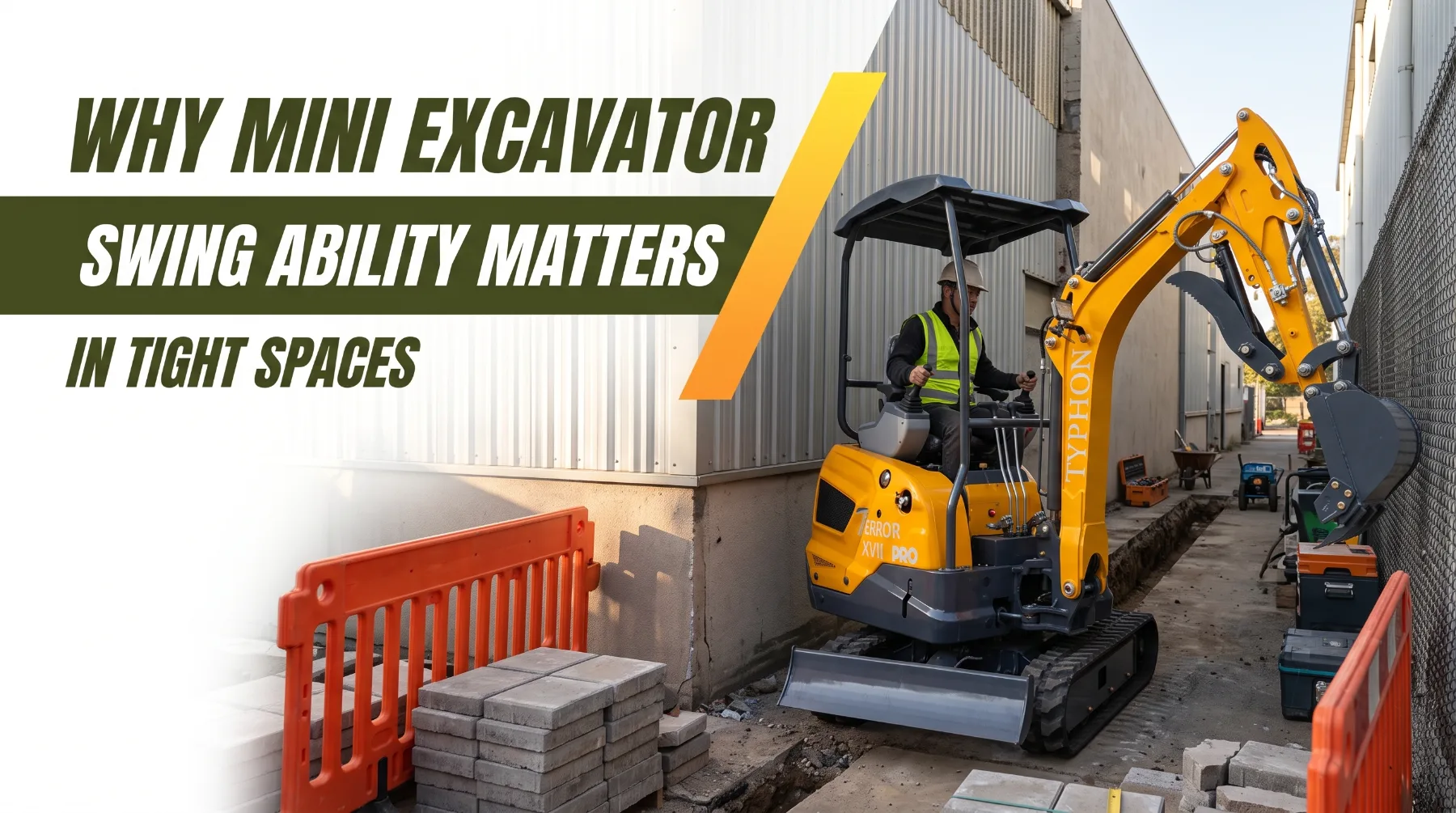 Picture an operator squeezed between a garden wall and the side of a house, digging a trench that barely leaves room to breathe. Every time the bucket fills, the machine has to send that spoil somewhere, and the truck waiting to catch it sits off at an awkward angle. On a wide-open site this is a non-event. In a backyard the size of a parking space, it decides whether the job flows smoothly or turns into a slow, frustrating grind. What carries the operator through moments like these is a quality that rarely makes the top of a spec sheet: swing ability. It is the machine’s power to rotate its upper body and shift its digging arm without moving the tracks, and in confined work it quietly separates the excavators that thrive from the ones that fight you at every turn.
Swing ability is easy to underestimate because it sounds simple. The house spins, the boom pivots, the bucket ends up where you need it. Yet the details behind that motion shape how productive a mini excavator really is when space runs short. This post looks at what swing ability actually involves, why it matters so much on cramped residential and urban jobs, how tail swing radius governs safe repositioning, how independent boom swing unlocks digging right against walls, what habits help operators get the most from it, and how to read swing specifications when you are choosing a machine.
What Swing Ability Really Means
Swing ability on a mini excavator comes in two distinct forms, and understanding the difference is the first step to appreciating why it matters. The first is house rotation, the continuous spinning of the entire upper structure, cab, boom, and engine together, on top of the undercarriage. Most machines rotate a full 360 degrees without any mechanical stop, which lets the operator dig in one direction and dump in another simply by turning the seat, no track movement required. The speed of that rotation, measured in revolutions per minute, sets how quickly the machine can cycle from digging to dumping and back.
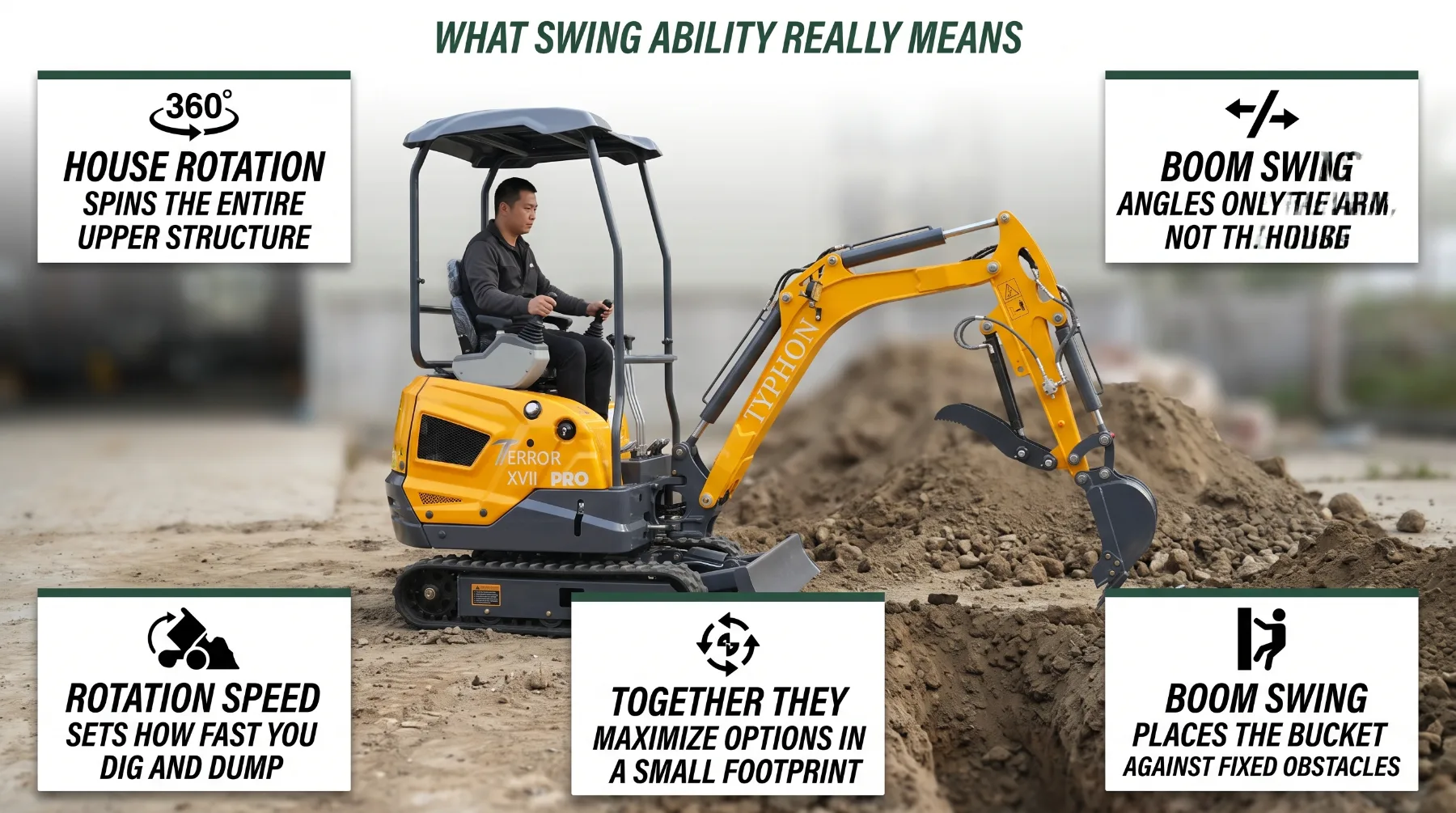 The second form is boom swing, sometimes called offset swing, and it works quite differently. Here the boom itself pivots left or right at its base, angling the digging arm off the machine’s centerline while the house stays put. Instead of spinning the whole upper body, the boom swing shifts only the arm sideways, so the bucket can reach around obstacles or dig parallel to a structure. The two motions serve separate purposes. House rotation handles the broad job of moving spoils and repositioning the work zone, while boom swing handles the fine job of placing the bucket exactly where a fixed wall or foundation demands. A machine that does both well gives the operator far more options in a small footprint.
Key takeaway: Mini excavator swing ability combines continuous 360-degree house rotation for cycling between digging and dumping with independent boom swing for angling the arm off-center, and the two motions solve different problems on a tight site.
Why Swing Matters on Confined Residential and Urban Sites
The value of swing climbs sharply the moment space grows scarce. On a spacious jobsite, an operator can afford to drive the machine around, line up a fresh angle, and reposition freely between passes. In a fenced backyard, a narrow utility corridor, or a lot boxed in by buildings, that freedom disappears. The tracks may have almost nowhere to go, and every unnecessary movement risks clipping a fence, a wall, or a parked vehicle. Swing ability lets the operator do the work while keeping the undercarriage still, which is often the only practical way to get anything done in these settings.
Consider how a typical confined job unfolds. The excavator digs a trench, and the spoil has to land in a pile or a truck that sits wherever it fits, rarely in the ideal spot. With smooth, continuous rotation, the operator swings the loaded bucket to the pile, dumps, and swings back to the cut in one flowing motion, repeating the cycle hundreds of times a shift. Each swing that lands cleanly saves seconds, and those seconds compound across a full day into real productivity. Just as importantly, keeping the tracks stationary protects the surroundings. In residential and urban work, where finished landscaping, sidewalks, and structures crowd the machine, the ability to work without constant repositioning is not a luxury. It is what makes the job possible without damage or delay.
Key takeaway: On confined residential and urban sites, swing ability lets the operator dig, dump, and reposition the work zone while keeping the tracks still, protecting the surroundings and turning cramped conditions into workable ones.
How Tail Swing Radius Affects Repositioning
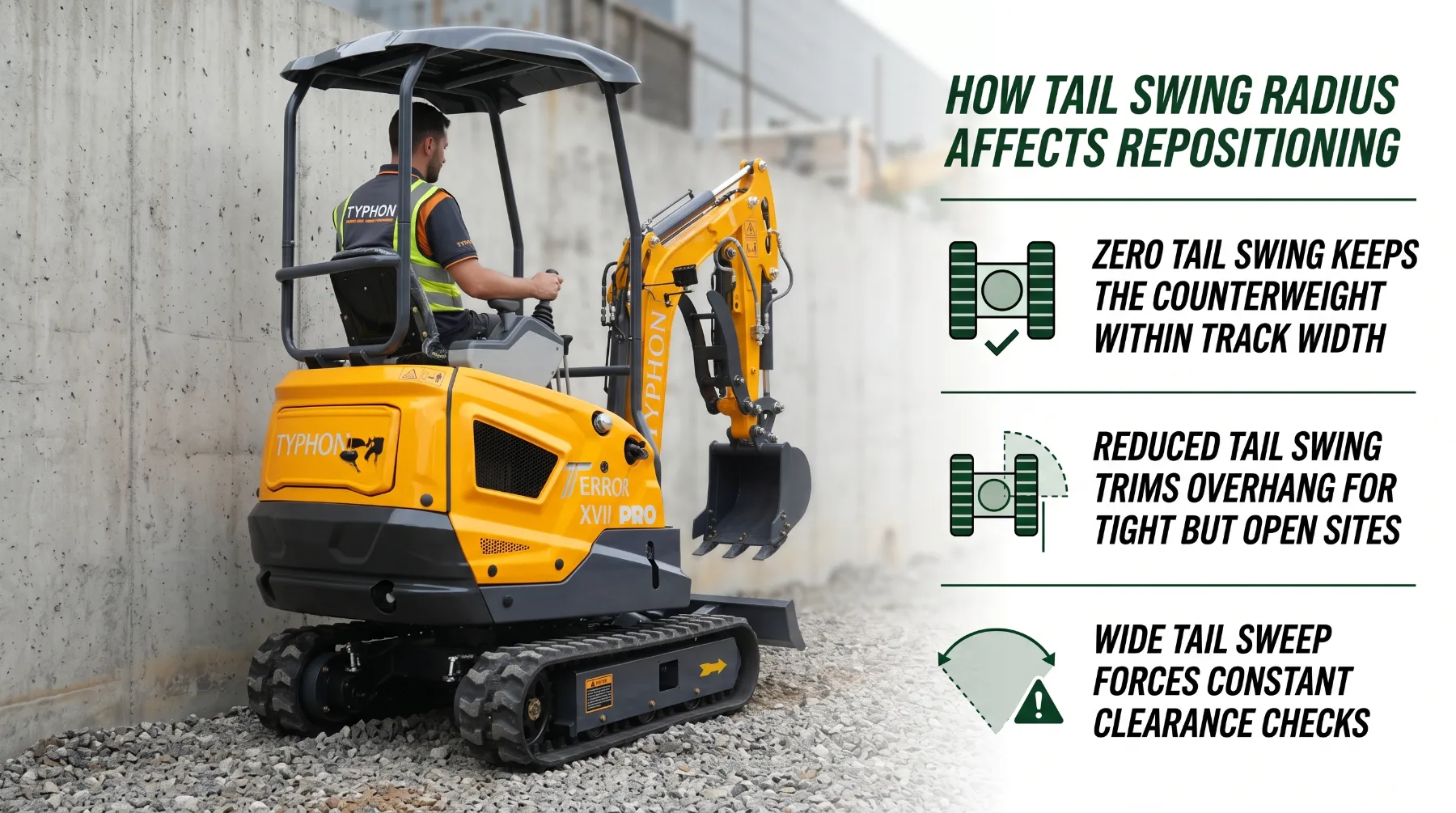 One number shapes how a mini excavator behaves in tight quarters more than almost any other: tail swing radius. This is how far the rear of the house, the counterweight end, extends beyond the width of the tracks as the machine rotates. On a conventional excavator, that tail sweeps out well past the undercarriage, so when the operator spins the house, the back end swings into whatever sits behind it. In open space this goes unnoticed. Against a wall or a fence, it becomes a constant hazard, forcing the operator to stop, check clearance, and rotate with caution on every cycle.
This is exactly why zero tail swing and reduced tail swing machines exist. On a zero tail swing design, the counterweight stays within, or very nearly within, the track width as the house turns, so the rear never overhangs into the danger zone. The operator can rotate freely with a wall directly behind the machine, confident the tail will not strike it. That single feature transforms how the machine works in confined spaces, removing the mental load of watching the back end and letting the operator focus fully on the digging. Reduced tail swing models split the difference, trimming the overhang without eliminating it entirely, which suits sites that are tight but not extreme. When you weigh a mini excavator for cramped work, tail swing radius deserves as much attention as dig depth, because it directly governs how safely and quickly you can rotate where it counts.
Key takeaway: Tail swing radius determines how far the rear of the machine overhangs the tracks during rotation, and zero or reduced tail swing designs let the operator spin freely against walls and fences without striking them.
How Independent Boom Swing Enables Offset Trenching
Some of the most demanding confined work involves digging right alongside something you cannot move: a foundation wall, a building edge, a curb, a fence line. Here house rotation alone falls short, because spinning the whole upper body would swing the boom away from the surface you need to follow. This is where independent boom swing earns its keep. By pivoting the boom sideways at its base, the operator can angle the digging arm to run parallel to a wall while the machine itself sits square and stable, with tracks facing straight ahead.
The practical payoff is offset trenching, and it changes what a small machine can accomplish. Say a trench has to run tight against a house for a drainage line. With boom swing, the operator angles the arm toward the wall and digs a clean, straight trench hard against it, without the bucket or the machine crowding the structure. Without boom swing, that same trench would demand awkward angling of the entire excavator, repeated repositioning, and often a compromise on how close to the wall the cut could actually go. Boom swing also lets the operator dig around obstacles, working past a pole or a corner that a fixed boom could never negotiate. In the tight, obstacle-heavy conditions typical of urban and residential jobs, this independent sideways reach is frequently the feature that decides whether a job can be done at all from a single machine position.
Key takeaway: Independent boom swing angles the digging arm off the machine’s centerline, letting the operator trench tight against walls and foundations and dig around fixed obstacles while the undercarriage stays square and planted.
Conclusion
Swing ability is the quiet engine behind a mini excavator’s usefulness in tight spaces. Continuous 360-degree house rotation moves spoil and repositions the work without touching the tracks, independent boom swing angles the arm to dig hard against walls and around obstacles, and a compact tail swing radius lets the operator rotate freely where fixed structures crowd the machine. Together these motions let a small excavator accomplish in a fenced backyard or a boxed-in urban lot what would otherwise be slow, awkward, or simply impossible. The machines that shine in confined work are rarely the ones with the deepest dig or the biggest engine. They are the ones that swing cleanly and precisely where there is no room to spare.
Frequently Asked Questions
What is the difference between house rotation and boom swing on a mini excavator?
House rotation turns the entire upper structure, including the cab, boom, and engine, usually through 360 degrees, while boom swing pivots only the boom sideways from its base. House rotation changes the machine’s working direction without moving the tracks, while boom swing lets the bucket work around obstacles or alongside walls. Using both gives the operator greater flexibility in confined spaces.
Why does tail swing radius matter so much for tight-space work?
Tail swing radius determines how far the rear of the excavator extends as the upper structure rotates. Conventional machines may swing beyond the tracks, creating clearance concerns near walls and fences. Zero-tail-swing models keep the rear within or nearly within the track width, allowing rotation closer to structures. A smaller tail swing radius can improve access and maneuverability in confined jobsites.
Can a mini excavator dig a trench right up against a wall?
Yes. Independent boom swing allows the operator to keep the tracks straight while pivoting the arm sideways to work parallel to a wall. This helps create clean trenches beside foundations, buildings, and other structures without repeatedly repositioning the machine. Combined with a compact tail swing radius, boom swing makes wall-side digging and spoil removal more practical.